


The blockchain has potential far beyond cryptocurrency speculation alone.
Introduction
I admit that initially, I was taken by surprise by the request to write this article. Typically, I’ve operated behind the scenes, working quietly and remaining unknown to end users. Faced with this new challenge, I told myself, “Continue in the way you’re used to, explain everything as if you were telling it to your child who is still in the ‘Why’ and ‘How come’ phase.” So, let’s start with the basics. What is a blockchain, and why do we need it?
Blockchain is a technology that allows for the secure, transparent, and decentralized recording and sharing of information. It is based on distributed data structures composed of blocks, each containing a series of transactions or information. Each block is cryptographically linked to the previous one, forming a chain (hence the term “blockchain”).
The fundamental characteristics are:
Decentralization: The blockchain is maintained by a network of distributed nodes. This means there is no central authority that controls or holds power over the network. Each node has a copy of the entire chain of blocks and participates in the transaction validation process.
Transparency and Immutability: All transactions recorded on a blockchain are visible to all participants in the network. Once a transaction is recorded, it is extremely difficult and costly to modify or delete it. This ensures data integrity.
Consensus: To validate a transaction and add it to the chain, nodes in the network must reach a consensus. There are different consensus mechanisms, but the most common ones are Proof of Work (POW) and Proof of Stake (POS).
Blockchains were first introduced with Bitcoin in 2009, but since then, numerous other blockchains with different features and uses have been developed. For example, Ethereum introduced smart contracts that allow code to be executed automatically under specific conditions.
Why We Need Blockchain
Blockchain technology has the potential to change many aspects of how we handle digital information and transactions, introducing new forms of security and transparency. In an era where everything is digitized, innovation and blockchain are closely linked because blockchain technology represents a significant step forward in technological infrastructure and applications.
Let’s take a moment to think about some of the key areas of innovation where blockchain is having a significant impact:
Delegated Trust: Traditionally, for online transactions, we rely on intermediaries or central authorities like banks or payment platforms. Blockchain allows for direct transactions between involved parties, eliminating the need for intermediaries. This end-to-end communication can reduce costs and increase transaction efficiency.
Smart Contracts: Smart contracts are programs that can be triggered and executed under specific conditions. They are recorded on the blockchain and can automate a wide range of business operations, from handling payments with specific requirements to executing complex agreements. This is a highly innovative area that is changing contract and business process management.
Asset Tokenization: Blockchain enables the representation and exchange of any type of asset (stocks, real estate, art, collectibles, fine wines, etc.) in the form of digital tokens. This opens up new opportunities for fractional ownership and democratizing investments, allowing a broader range of people to participate in previously inaccessible markets.
Digital Identity: Blockchains can be used to manage and protect digital identities. This means people can have more direct control over their personal information and decide which parts of it to share with third parties. For example, the Brazilian government will use a private blockchain to issue new ID cards for over 200 million citizens.
Decentralized Finance (DeFi): DeFi is a sector that leverages blockchain and smart contracts to provide traditional financial services (such as asset exchanges, loans, savings, etc.) in a decentralized manner, bypassing traditional financial institutions.
Renewable Energy: Blockchain can facilitate peer-to-peer renewable energy trading, allowing energy producers to sell directly to consumers.
Agriculture and Food: Blockchain can be used to track the origin and quality of food, ensuring food safety and traceability.
Healthcare: By enabling secure and shared management of medical data, blockchain can revolutionize the management of personal health data, improving diagnosis accuracy and aiding medical research.
Supply Chain Management: Using blockchain to track a product’s journey throughout the supply chain provides a transparent and immutable record of transactions and associated information, improving traceability and preventing fraud. This is particularly important in the food, pharmaceutical, and logistics industries.
Non-Fungible Tokens (NFTs) and Metaverse: NFTs are unique digital representations of objects, artworks, and audiovisual content recorded on the blockchain. This innovation has revolutionized the art industry and created new opportunities for digital content creators. The Metaverse, on the other hand, is a concept that refers to a virtual universe inhabited through digital avatars. In the Metaverse, users can interact with each other and the surrounding environment through virtual or augmented realities.
In short, NFTs play a critical role in enabling ownership and transferability of virtual objects within the Metaverse and are a key component in the evolution of the digital economy.
Voting and Decentralized Governance (DAO): Blockchains can be used to create transparent and incorruptible voting and governance systems.
In practice, blockchain has sparked a wide range of innovations in sectors ranging from finance to art, logistics, security, and more.
Challenges
However, despite its immense potential, blockchain still presents challenges and limitations that need to be addressed as it continues to evolve. Here are some of the main limitations of current blockchains:
Scalability: Well-known blockchains like Bitcoin and Ethereum have scalability limits that can lead to long transaction times and high costs when the network is congested. This is a barrier to widespread adoption and use in applications with high transaction volumes. Various solutions with different approaches are being implemented (e.g., Lightning Network for Bitcoin or the use of Layer 2 systems for Ethereum).
Privacy and Security: While blockchains offer strong security regarding data immutability, they do not always provide the same level of protection for the data itself. Some information can be visible to all network users unless advanced encryption measures are adopted.
Regulation and Compliance: The decentralized nature of blockchains can make it challenging to enforce laws that are often inadequate or unenforceable. This can create tensions with local and global regulations, especially in the financial context.
Interoperability: Different blockchains operate on separate networks with different standards and protocols. This makes communication and collaboration between different blockchains and applications difficult.
Bug and Hacking Protection: Although blockchain technology is designed to be secure, there are still vulnerabilities in the protocols or applications built on them. Incidents such as hacking or security breaches can lead to significant financial losses.
Consensus Risks: Different blockchains use different consensus mechanisms, each with its own advantages and disadvantages. For example, POW blockchains can be vulnerable to majority attacks (51% attack) and require significant computing power, while POS blockchains may raise concerns about centralization and “wealth accumulation.”
Technological Limitations: Despite the dominance of NFTs and the Metaverse in 2021/2022, enthusiasm appears to be gradually waning due to technological limitations that still do not allow for satisfactory immersive experiences.
Conclusions
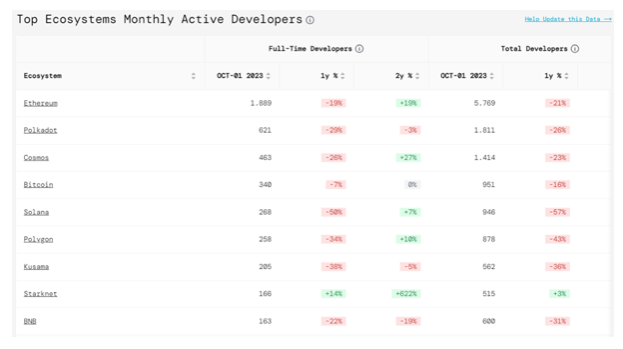
It is important to note that the growing prominence of blockchain is attracting the attention of developers and researchers who have been captivated by this new technology in recent years and are working to address many of these limitations. The number of active developers on a monthly basis has steadily increased over the past 8 years, growing from 1,000 to around 20,000 this past October, with a thriving community of developers in the Ethereum ( here all updated data in detail ).
While blockchain is a promising technology, it is still in a phase of growth and development. It is undeniable that it currently presents significant limitations and inefficiencies, especially in certain application areas. However, it’s important to consider that blockchains are relatively young, and as such, it’s natural for them to undergo improvements and optimizations over time.
With an increasing number of professionals from various sectors entering the field, new opportunities for innovation and widespread blockchain adoption are emerging. These experts will bring new methodologies and approaches aimed at overcoming current obstacles and making blockchains more efficient and versatile. This will promote the spread and large-scale implementation of this technology, helping to overcome current challenges and unlock its full potential.
The World Economic Forum has repeatedly pointed to blockchain as one of the innovations that will have the greatest global societal impact.
As early as 2015, it anticipated that blockchain would be one of the six major megatrends, alongside Artificial Intelligence and the Internet of Things (here all the details, page no 5 and shift 16 and 18).
In 2022, it announced that Central Bank Digital Currencies (CBDCs) have the potential, within 5 years, to revolutionize current financial systems, leading to greater financial inclusion and improving the lives of billions of people worldwide by providing access to affordable and convenient financial services (full article here).
Blockchain has a potential that goes far beyond cryptocurrency speculation, but in the immediate future, it will still be closely tied to the financial aspect, especially with the likely approval of Bitcoin Spot ETFs, which are poised to capture the attention of investors.
The truth is that this technology will transform multiple sectors in ways that may seem unthinkable today. Imagine a decentralized network composed of multiple intercommunicating networks that will revolutionize contract management, the buying and selling of goods and services, food supply, goods traceability, sharing of healthcare data, and even digital art.
As blockchain evolves and becomes more deeply integrated into the fabric of our society, it will become so ubiquitous that most people will use it in their everyday lives, often without even realizing it. This will lead to a significant increase in efficiency, transparency, and security in many aspects of our lives. In this process, blockchain will become an invisible but powerful foundation of our interaction with the digital and physical world. We are only at the beginning of this revolution, and the potential of blockchain is largely unexplored.


 Market and Data
 _old_Become an author
 Wallet


