


Intro.
Businesses have always evolved by embracing technological advancements.
Transitioning from fire to light, from horse to car, from pen and paper to computers and software, from phone to smartphone isn’t simple. It’s progress, but it needs time!
An example? The power of cars is still commonly named in HP (horsepower), and only now with the advent of electric cars, we start talking about Kw. For more than a century, deep in our minds, we compare the power of our car to how many horses it would take to have the same force as a steam engine! So, let’s relax, in about a hundred years we can adapt to anything! Fire fared better. None of us think anymore about warming up with firewood, even though a lit fireplace creates romance and nostalgia.
But is technology or its use more important? What is the value of a technology?
The answer to the second question is straightforward: the value of a technology is given by its use, which in turn is generated by people meeting their needs or solving their problems. For the first question, let’s give an example: when I want to trace the name of a person or a product on a search engine, do I focus on the algorithm that allows the operation, or on the results that the algorithm returns to me? I’ve answered one question with another question! That’s why businesses should not focus on technology, but on how to build relationships with their customers and identify, only afterwards, the technologies that meet the goal.
This premise was necessary to alleviate some fear: the fundamental questions are always the same and do not depend on technology. If I ask myself how to warm up, the answer goes from fire to boiler, to coal, goes through diesel, and reaches electric panels or wind systems; the technology changes based on the historical period but the initial need is always the same: not to be cold.
What are the questions then? And what are the times for the use of new technologies?
How can I reward my customers?
Blockchain and NFTs are the technologies that allow me to answer this question.
With these two technologies, I can engage in a dialogue with the customer, providing discounts or experiences based on their personal needs, and not based on statistics or corporate decisions. I finally communicate to the customer that I am interested in them, in their life, and not just in them coming back to me to buy what they don’t need. Blockchain creates efficiency and an automatic reward mechanism based on the customer’s actual interests. The NFT is the carrier of the message, and its value will be as high as the message is personalized, and, therefore, unique.
Time: already in use, already tested. Present, go!
How can I guarantee my products?
Blockchain and NFTs. Is it still enough for me to have xyz certification? No!
When there was a bakery under the house, my mother always knew it, so she bought from it, because she trusted that they would buy the best raw materials, would work the flour with care and cleanliness, and at eight they would sell us the focaccia, courteously, at a fair price. Simple.
Then big distribution arrived and companies began to produce for people and customers they no longer knew, so how could they maintain trust? Look customer, you don’t know me but I produce judiciously and these third parties certify that what I say is what I do. They guarantee for me. More complicated.
Then social media arrived, the world became one and unique. I can buy anywhere and so how do I know the name of the certifier of a country that is not mine? Who guarantees me? Blockchain, here is the solution, this immutable register! I deposit there, in front of everyone, where everyone can check, my truth and my seriousness. Here is the notarial deed with the customer. Here comes our NFT again, carrier of an immutable and democratic message. Simple! Like with the baker. Efficient, fast and certain.
Times: already in use, already tested. Present, go!
How can I attract more customers?
A question that is always of interest. Web3 and Metaverse, these are the new tools that work together with NFT and Blockchain. Web3 will be nothing more than our decentralized, personalized, and even more interactive internet. It will be a global and open network, that will enhance everyone’s work. It will change the way we communicate and generate great freedom, and for this, it will require preparation and strategy. Metaverse, this world that exists or doesn’t exist, a simple 3D gaming. Without writing a doctoral thesis here, Web3 and Metaverse have the logic we need: they can be used to go towards the goal. That’s why they answer the question of how I can attract more customers. Because they speak new languages, those of the new generations, who are already consumers and customers of our companies, but currently still have the filter of their parents. These youngsters, aged 20 and below, don’t consider anything that’s not digital. I repeat: they don’t consider anything that’s not digital. It’s their world! We have to respond to them, we have to please them, we have to be useful to them. Strangely, but not so much, if a company does not consider the Metaverse and Web3, it is not carefully considering its customers of the next thirty years!
Times: already present and usable, still under evaluation in various types of use.
In conclusion, scientists have amply demonstrated that in the race for evolution, the one who adapts first and best wins, not the strongest.
My invitation is to action, to curiosity, to the desire to experiment and progress.
I conclude by bothering the poet E.W.Wilcox:
“A ship is sent east, another west The same wind drives both; The set of the sails, not the wind is what sets the two courses.”
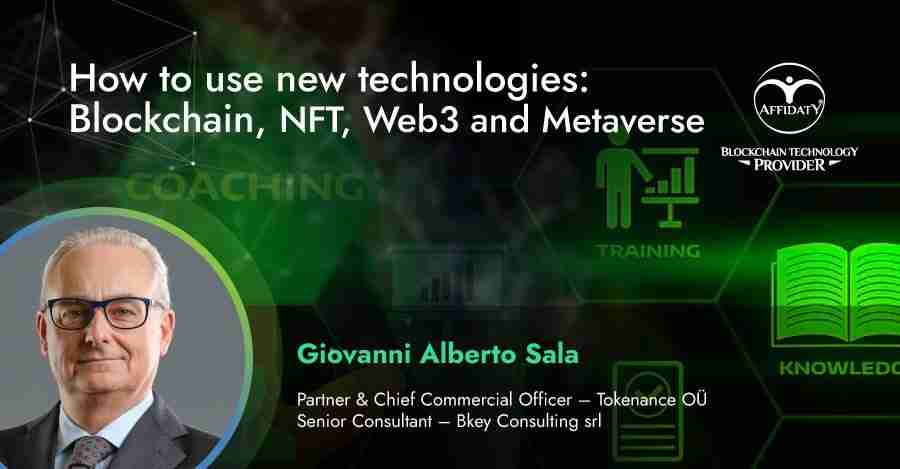
Giovanni Alberto Sala
Partner & Chief Commercial Officer – Tokenance OÜ – https://tokenance.io
Senior Consultant – Bkey Consulting srl – https://www.bkeyconsulting.it


 Market and Data
 _old_Become an author
 Wallet


