


Introduction.
Blockchain, or rather Bitcoin, emerged by chance (but not too much!) in the context of the 2008 financial crisis that brought with it a natural mass distrust towards the centralized Financial and Monetary system that, until then, had not known concrete alternatives.
As a result, it is easy to understand how Bitcoin and the underlying decentralized technology that allows its operation, gave people the feeling (but also the real perception) that there was a way to create, exchange and store value outside the typical centralization of traditional financial institutions. This has contributed and still contributes today to almost exclusively linking Blockchain to DeFi (Decentralized Finance) applications.
But let’s ask ourselves: where have we arrived in terms of social impact 14 years after Satoshi Nakatomo’s paper?
Bitcoin and energy consumption.
First of all, to talk about blockchain with social impact, we need to debunk the myth that, operationally, the sequential validation of Bitcoin transactions has such an energy consumption that its application itself would not be sustainable. This concept is related to the consensus algorithm used by Bitcoin to validate transactions within the Network, the Proof of Work.
The latter consists of using the computing power of nodes (computers) connected to the network to solve complex mathematical problems in order to validate Peer-To-Peer transactions in a completely decentralized manner. It is clear that the more computers are connected and the greater their computing power, the higher the energy expenditure needed to validate a number N of transactions. In general, this problem can be bypassed by applying new consensus algorithms not based solely on computational capacity. The most common, for example, is Proof of Stake. In a nutshell, PoS differs from PoW in that it does not require the use of a large amount of computational power, but the transaction blocks to be validated are immediately assigned to the nodes that hold the greatest interest (stake) within the network. Interest in this sense is represented by the amount of the same network’s cryptocurrency that the node holds. In the example of Ethereum (whose network will fully switch to PoS from September 19 with the so-called merge), the more ETH I hold, the greater the chance that I will be chosen as a “validator” node. This makes PoS hugely more scalable and less energy-intensive than PoW.
However, it must also be said that PoS has several limitations in terms of security and risks of decision-making centralization, making what should be a trustless technology trusted again. Moreover, the general problem of Bitcoin‘s energy consumption lies in the fact that, in the absence of renewable and sustainable energy sources (wind, solar, geothermal, etc.), the massive use of electricity contributes to global pollution. Therefore, Bitcoin mining powered by renewable sources would be absolutely sustainable over time.
However, it should be emphasized that the issue of Bitcoin‘s energy consumption is less straightforward than it may seem: the University of Cambridge has created the CBECI (Cambridge Bitcoin Estimate Index), which is a tool capable of calculating in real-time an estimate of the lower and upper limit of the electricity absorbed annually by mining operations. From their study, it emerged that the energy consumption of the Bitcoin network would be equal to 0.25% of the world’s consumption. It is clear that in absolute terms, the energy expenditure related to Bitcoin is a “non-issue” as it represents a really negligible slice of the cake.
However, it is interesting to see how the perception of the above data can change in relative terms when considering that, according to the same study, the constant average consumption of Bitcoin would be equivalent to 7 GW (gigawatts), corresponding to an annual consumption of approximately 64.15 terawatt hours of energy.
This consumption figure is higher than that of countries such as Switzerland and the Czech Republic (58.46 and 62.34 terawatt hours respectively). The above leads us to conclude that, in absolute terms, the energy consumption of Bitcoin represents a very small part of global consumption and is not the main contributor to global pollution.
However, in relative terms and with the perspective of a wider use of Bitcoin transactions, it is necessary to begin using renewable energies also in this field if we want Bitcoin energy consumption to remain a non-issue.
Blockchain for social purposes – SDGs.
In 2015, the United Nations member states established a plan of 17 Objectives to be pursued and achieved by 2030, in order to promote the sustainable development of the planet, the so-called Sustainable Development Goals (SDGs).
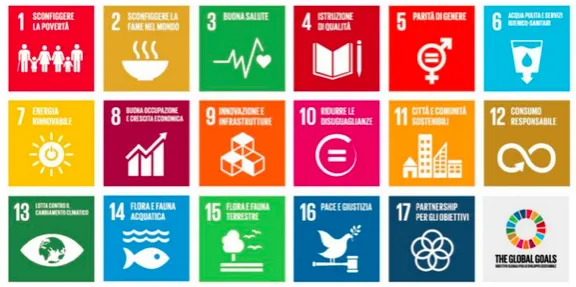
1 – Infographic of the 17 SDGs As in any planning process, once the objectives are defined, it is necessary to find the means necessary to achieve them. Seven years after the birth of the SDGs, the market is increasingly showing how Blockchain has become and is establishing itself as a powerful tool in pursuing these objectives.
An overview of how blockchain is helping sustainable development can be obtained through the data contained within the open-source database of positiveblockchain.io, a non-profit association that explores the potential of Blockchain technologies for social and environmental impact through its database, maintained, updated, and certified by a community of volunteers from all over the world. The association’s mission is to build a network of blockchain-based projects, experts, enthusiasts, and other organizations that can support the entire ecosystem in achieving the SDGs and a more sustainable future.
Through the data in the database, we can give an overview of how various startups, corporations, non-profit organizations, etc. are using blockchain in terms of Sustainable Development Goals at the European level.
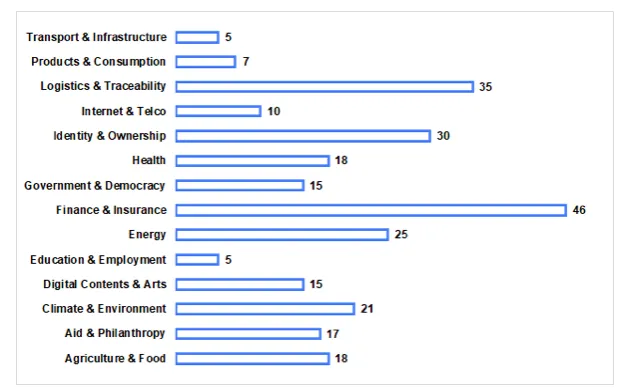
The graph below shows the breakdown of the 267 currently active blockchain projects in the EU, divided by the sector in which they operate:
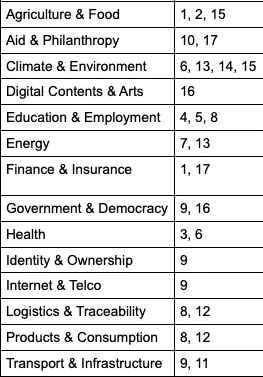
Based on the uses of blockchain technology and the purposes pursued by the individual projects entered in the Database, each category has been associated with SDGs:
As was easy to predict, the highest concentration of Blockchain applications, also in terms of social impact, is in the “Finance & Insurance” sector. However, what is the social need to be satisfied through the application of blockchain in the financial field? As reported by Acuant, in 2020, around 2 billion people still did not/do not have access to basic financial services, such as access to a bank account and, consequently, to the standard payment circuits adopted worldwide.
This is mainly due to two reasons:
- High costs of access to banking services for certain populations in the poorest areas of the world and subject to an increasingly high inflationary spiral (e.g., South America).
- Limited interest of traditional financial institutions in onboarding people with few guarantees and economically “passive” in terms of their own capital.
This perpetually exposes certain populations in the world to the so-called “shadow economy,” which generates neither sustainable value for the individual nor for the community. In this context, blockchain provides a completely accessible, cost-effective, global, and traceable means to allow these people to emerge from the shadow of the economic system.
One of the most interesting projects aimed at solving the problem of the unbanked population and contributing to the achievement of SDG No. 1 is GoodDollar, a decentralized finance protocol that leverages blockchain and smart contracts to distribute the so-called Universal Basic Income (UBI), regardless of social status, income, and any other contingent situation.
GoodDollar is basically an ecosystem based on two actors: Claimers, i.e., anyone who requests a certain amount of G$, and Supporters, individuals and/or organizations that support the cause pursued by G$, depositing capital in the form of Crypto into a blockchain protocol. Inside, thanks to a smart contract called “GoodReserve,” the deposited capital will produce interests that will be translated into G$ at a 1:2 ratio. The G$ generated by the interests make up 50% of the Universal Basic Income that will then be distributed among the various Claimers, while the remaining 50% is distributed as an incentive to supporters.
In addition to understanding the sector in which Blockchain-based projects are operating, it is interesting to understand which network is most widely used. The graph below shows the 5 most used Blockchains in the 267 projects mentioned above.
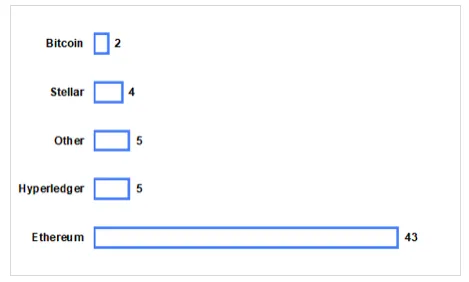
The huge gap in terms of the application of Ethereum compared to other Blockchains is immediately apparent. First of all, it should be noted that Ethereum is the most “popular” and well-known network in the world after Bitcoin. Obviously, the popularity of a Blockchain depends on how it is measured (number of applications, market capitalization of the reference Crypto, and so on). However, it is worth noting that for the first time since the advent of this technology, the only Blockchain to surpass Bitcoin in terms of the number of transactions was Ethereum in 2021. But then, how is it possible that there is such a big gap between Ethereum and Bitcoin in terms of concrete applications (in the social sphere)?
As explained at the beginning of the article, Bitcoin uses the Proof of Work consensus algorithm, which makes the blockchain less scalable in terms of speed/number of transactions per minute. Creating a new block on Bitcoin can take an average of 10 minutes compared to Ethereum’s 15 seconds. Moreover, Ethereum was the first blockchain to make the advent of Dapps (Decentralized Applications) possible, real programs that, through Smart Contracts, are able to execute commands, functions, and transactions in a completely autonomous, decentralized, and secure manner (in fact, maintaining all the peculiarities of the Blockchain). It is therefore not surprising that Ethereum’s greater flexibility translates into widespread adoption, even for projects with a social impact.
However, it is necessary to specify that this ranking is not an indication of the “best” (or at least the most effective) Blockchain to use in terms of social impact, but only takes into account the mere number of applications of one network compared to another. To make assumptions about which of the listed Blockchains is most effective in pursuing one or more SDGs, it would be necessary to analyze, for each project in the sample under analysis, profitability indices, targeted market share, and specific sustainability indices compared to the reference SDGs, and so on.
It’s probably time to also look at home and see if there are important examples of Blockchain application with social impact in Italy. One of the most interesting and successful case studies (as well as a reality!) is certainly Genuine Way.
GW is an Italo-Swiss startup that aims to create a connection between conscious consumers and ethical brands, ensuring transparency in the traceability of the distribution chain and countering the increasingly widespread practice of greenwashing. To this end, Genuine Way has developed the GEN Platform, a platform designed to allow brands to notarize their environmental and social impact on Blockchain. Through the platform, it’s possible to store company documents related to the supply chain and product life cycle directly on Blockchain, creating transparency for the consumer and holding the brand accountable to what is truly certified without proposing mere greenwashing marketing campaigns. Through this process and the platform’s functionalities, the notarized documents remain immutable and always accessible to the consumer who wants to be sure of the sustainability of the product they are purchasing.
Conclusions.
As you can see, both in the financial and non-financial sectors, there are several Blockchain applications in the social field, and it is not excluded that many more may appear in the coming years. However, it is important to remember that Blockchain is just a tool with potentials and limits (like any other technology). This means that, no matter how many new paths its advent may have opened up, attention must still be paid in analyzing a project (especially one with a social impact) to the purposes for which Blockchain is being used and which problems are intended to be overcome through its use. In the past, especially at the beginning of the great bubble created by enthusiasm for a new technology, the term Blockchain was used in various contexts, and in most cases, it was only pure instant marketing (as communication experts might say, certainly not me!) or in much more unfortunate cases, actual frauds. Well-known examples are those of fraudulent ICOs (Initial Coin Offerings), in some cases also known as “exit scams”.
For this very reason, I would like to conclude the article with what I believe are the three fundamental questions to ask oneself in order to understand if Blockchain can truly help us achieve the (social or non-social) objective we have set for ourselves:
- Is there an inclusivity problem? – It is necessary to evaluate whether there is a larger or smaller pool of users in the sector that we are considering intervening in, who for various reasons are cut off from the main economic/social interactions, and whether traditional means of exchange (e.g., currency) are sufficient to guarantee such inclusivity or not.
- If there is an inclusivity problem, can it be mitigated by lowering the costs for intermediation? – It is also necessary to ask oneself what the biggest barrier to inclusivity is. For example, if there is a chain of one or more intermediaries between the producer and the end user of a good, who apply their mark-up (the price that each intermediary “charges” on the final product) at each stage, this could make the final cost of the product/service inaccessible to a certain group of individuals.
- Is there a problem of transparency and “trust” in carrying out certain activities? – If it is necessary to guarantee a certain level of trust between the participants in a network or in any economic activity, one is immediately led to think that there must be a third party who is impartial and whose sole or almost sole purpose is to ensure that each individual can trust their counterpart (we could also say that reasonable certainty is ensured that my transaction will go smoothly and that my counterpart will not expose me to possible fraud). In case this third party already exists, then the adoption of Blockchain can be justified by the reasons discussed in point 2. In case there is no third party guarantor, then Blockchain protocols can be used to ensure the security of a transaction and the trustworthiness of the counterpart involved.


 Market and Data
 _old_Become an author
 Wallet


