


Intro.
We have rapidly transitioned from an industrial economy centered on material value, that is, the production of physical objects, to a cognitive capitalism, where the ability to produce objects is generic and widespread, and therefore no longer constitutes a strategic differentiator, shifting the focus onto immaterial components such as brand, design, and marketing.
NFT represents a unique tool available to actors operating within this new system as it provides companies with a digital-financial “medium” to convert their immaterial assets into revenue streams, without the intermediation of a physical product.
It is no coincidence that the majority of “early adopter” companies operate in the Luxury sector, such as Gucci, Prada, Ferrari, and Lamborghini, as most of their value is given more by the collective perception of consumers towards them than by the set of physical assets they own.
NFTs are therefore not an absolute novelty but an explicitation and economization of something pre-existing.
This technology provides a tradable “container” of social capital, defined by sociologist Pierre Bourdieu as “the sum of resources, material or otherwise, that each individual or social group obtains through participation in a network of interpersonal relationships based on principles of reciprocity and mutual recognition.”
Consider the case of the Bored Apes Yacht Club collection, which made headlines for the frequent purchases by celebrities from the entertainment and sports world for several hundred thousand dollars. Clearly, the value that the market attributes to this type of product is not in the JPEG graphics of the primates but in the social network constituted by the “holders” of these NFTs.
Buyers perceive themselves as members of an exclusive club and as such support each other even in the creation of personal brands, such as “Ape Influencers” on Twitter, who, thanks to the shared exposure right with the creators, can use their Bored Ape for commercial purposes.
NFTs and Museums.
In addition to companies, there is another type of organization that could benefit from the transmission channel of value that NFTs represent: Museums.
Unlike the former, which only need a conversion action to exploit the immaterial capital at their disposal, the transmutation of a work of art from physical to virtual form necessarily requires a series of symbolic actions that can be defined as “rituals of value creation.” These rituals are often constituted by an act of iconoclasm, that is, the metaphorical or concrete destruction of the work of art from which the NFT originates.
Here are some of the examples that we believe are fundamental in understanding the full operation of transmuting a work of art from physical to virtual form:
The Banksy Case.
In March 2021, a member of the Injective Protocol collective burned a Banksy serigraph purchased for $95,000 during a live stream on YouTube, converting it into an NFT.
The token containing the digitalized image of the work of art was later sold in Ethereum for a counter-value of $382,000.
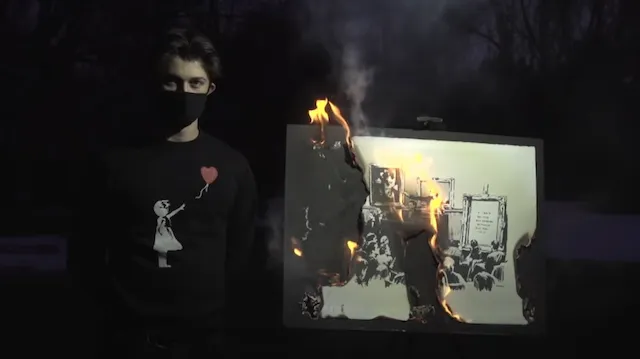
Morons Bansky burnt
The Basquiat Case.
In April, another sale was attempted on Opensea, the “Free Comb with Pagoda,” a mixed media on paper from 1986 by Jean-Michel Basquiat.
The physical work of art remained unsold during the traditional auction, while the smart contract provided the option for the highest bidder to destroy the physical drawing and keep only the NFT. Following the opposition of the Jean-Michel Basquiat Foundation, which considered the destruction of the work as a violation of the artist’s moral rights, the work was withdrawn from the sale.

“Free Comb with Pagoda” Jean-Micheal Basquiat -1986
The Particle Case.
The case of Particle, founded at the end of 2021, is also interesting. This company acquires physical works of art and performs a “legal destruction,” delivering them to a non-profit public trust whose sole purpose is to safeguard the works. A digital copy is made of the physical work and is then divided into 10,000 NFT pieces, each corresponding to a fraction of the original painting.
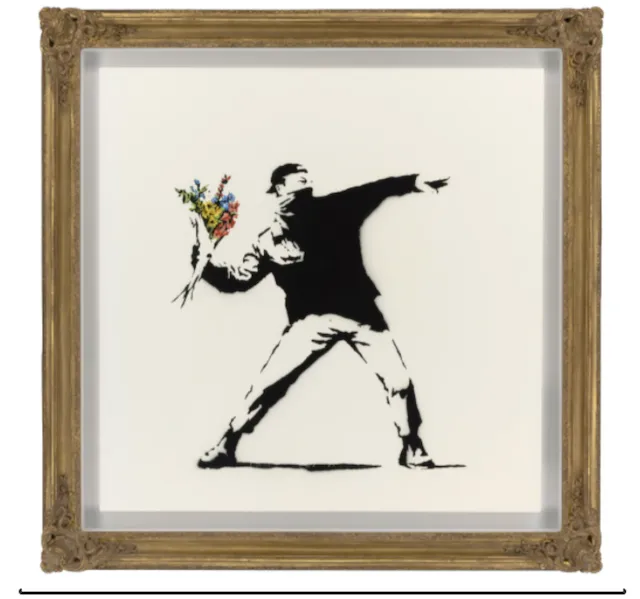
“Love is in the air” Bansky – 2003
The Hermitage Case.
The first attempt to combine NFTs and Museums was made by the State Hermitage Museum with the auction on Binance of 5 works: Leonardo da Vinci’s Madonna Litta, Giorgione’s Judith with the head of Oloferne, Vincent Van Gogh’s Lilac Bush, Wassily Kandinsky’s Composition VI, and Claude Monet’s A corner of the garden in Montgeron.
Two digital NFT copies in 1024 x 1024 px format were produced from the original physical work, one kept by the museum while the other was put up for sale with a starting price of 10,000 BUSD$. Each work was signed by the General Director of the State Hermitage Museum, Mikhail Piotrovsky, to provide a physical certificate of authenticity for use in the virtual world.
At the end of the auction, the NFT works generated a total revenue of $440,000, with the highest bid going to Leonardo da Vinci’s Madonna Litta, which sold for $150,500.
The new owner of the NFT work is left with complete freedom to display it for commercial or non-commercial purposes.
The Hermitage formula is peculiar in that, through the creation of only two authenticated digital copies, it simultaneously solves both the risk of “digital deaccession” inherent in creating a single copy and the risk of inflation and devaluation of the resulting NFT work, as one copy remains in the custody of the museum and only one is put on the market.
The MIDA Case.
MIDA, our company, takes inspiration from the “ritual” of the Hermitage, one of the foremost Museum Institutions, to create a bridge between the world of traditional art and the expanding Web 3.0.
These two realities are connected through the NFT Masterpiece, which does not aim to be a substitute for the physical work but rather its alter-ego within the new Metaverses being constructed by the great tech giants of our time such as Meta, Apple, and Microsoft.
The connection we create on the one hand performs a “distillation” of value, allowing what makes a work of art unique and authentic to remain in its digital alias, while on the other hand, it allows for the extraction of economic capital from the NFT market, supporting the Institutions that preserve the Collective Cultural Heritage.
The NFT Masterpiece created by MIDA, in addition to its collector value and its use in exhibitions in the Metaverses, acts as a key to access a “Golden Circle” of great art lovers, new talents, and renowned critics, linking them in a social network for the mutual benefit of the participants.
The adoption of these technologies by Museums is an increasingly imminent reality, driven by the process of digitization that has been accompanying the sector since before the arrival of the pandemic.
The opportunity for these organizations is not limited to the creation of alternative revenue streams but also extends to the creation of new audiences and offers the possibility of creating a direct relationship between the Museum and potential major supporters.
The goal for companies operating in this sector remains to ensure that these Institutions have a safe, forward-thinking, and regulatory-compliant entry into the blockchain world.
References:
- https://www.forbes.com/sites/avidan/2021/09/13/nfts-reshape-brand-marketing-in-the-creator-economy/?sh=77823fe7da2d
- André Gorz, L’immateriale. Conoscenza, valore e capitale, 2003
- Carlo Vercellone, Capitalismo cognitivo, manifestolibri, Roma, 2006, Esplorazioni, pag. 296.
- Andrea Fumagalli e Carlo Vercellone, (Dir.), Le Capitalism Cognitif. Apports et Perspetives, European Journal of Economic and Social Systems, vol. 20, n.1/2007
- Pierre Bourdieu, Le strutture sociali dell’economia, Asterios, 2004
- Pierre Bourdieu, Forme di Capitale – 1986
- https://www.rollingstone.com/culture/culture-news/bayc-bored-ape-yacht-club-nft-interview-1250461/
- https://www.bloomberg.com/news/articles/2022-01-06/nft-market-surpassed-40-billion-in-2021-new-estimate-shows
- https://www.ilmattino.it/primopiano/esteri/banksy_incendio_quadro_diretta_streaming_rivendono_online-5832377.html
- https://cointelegraph.com/news/russian-state-hermitage-raises-440k-via-binance-nft-auction
- https://medium.com/@MIDANFT/why-mida-is-the-next-big-thing-875b3b49c326


 Market and Data
 _old_Become an author
 Wallet


