


Hell exists only for those who fear it.
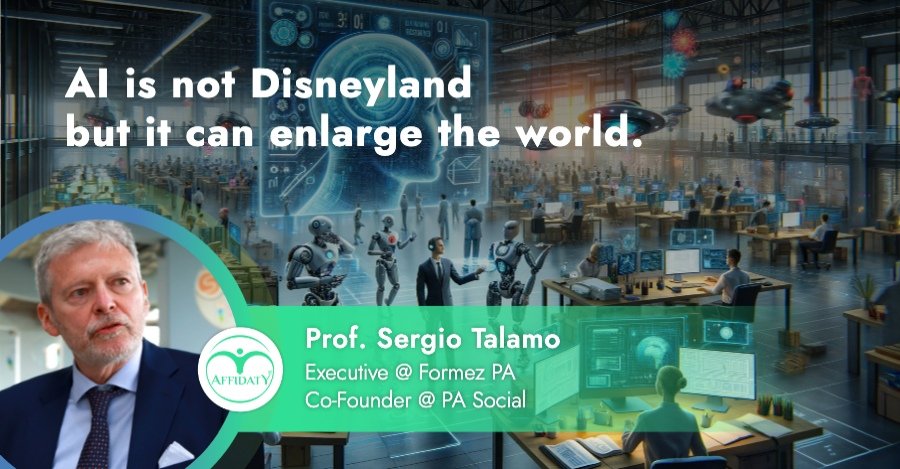
Artificial Intelligence is not Disneyland but it can expand the world. Towards AI-manager.
The advancement of Artificial Intelligence and digital innovation is transforming the work landscape and the daily lives of citizens in previously unimaginable ways. These technologies promise to improve efficiency, accessibility, and customization of services, offering significant opportunities for both workers and citizens. Despite these potentials, the adoption of AI and digital innovation also raises ethical issues and challenges, such as data privacy, cybersecurity, and the impact on the job market…
Stop. Let’s pause for a moment. How can we define the opening of this article? Impeccable, I would say. Comprehensive, clear, leaning towards analysis and critical thinking. But something is missing: the soul. It’s not by chance that it’s written by ChatGPT 4, a very friendly and caring robot that for $24 a month gives you increasingly prompt, complete, and efficient operational efficiency. It lacks the soul, but that too can be built in a laboratory. Or simulated. The “prompt” to submit to ChatGPT 4 can go as far as requesting an analysis of the pdf containing a novel, for example, the latest Strega Prize winner, or even the work of an unknown author, and in a few seconds, the application reads the hundreds of pages of text and provides a description or review, depending on what you asked for, with the desired number of characters, style, and language.
Generative intelligence, as we know, is based on processing vast amounts of text to learn how to respond coherently and relevantly to user requests. But it’s evident that we’re already far beyond mere processing of defined content: if indeed with these it’s possible to provide information on known materials – the award-winning novel – the moment AI can express judgments and even suggest and transfer emotions about an unpublished work, it means we’ve entered a new world.
It’s a dimension where humans not only “speak with machines” but interact with assistants that are also their competitors in terms of creativity and originality.
The deep learning techniques used aim not only to generate responses by imitating how people write and speak, but also how they think and imagine.
The real goal is a highly advanced conversational model, now common to all major platforms, because the machine seems to have learned what is not always clear to humans, namely, that one learns only by making mistakes and through successive approximations. The secret lies all here. In this ability – to be “humble” to overcome every limit over time – both the potentials and the presumed dangers of AI are hidden. It may escape human control only in the sense that it will know how to do what its creator has always been advised by religion and ethics but essentially inhibited from doing, namely, continuously learning from its mistakes in a potentially infinite projection. This evolution is so rapid that it drives all the major digital players into a frenzied race to outdo themselves. In recent months, it’s even difficult to fix the names: alongside OpenAI’s ChatGPT 4 – and the 5 is on its way – Google’s Gemini (formerly Bard) has quickly emerged in the United States, already incorporated into all G-products on IOS while on Android it’s accessible through a dedicated app, and Microsoft’s Copilot, already very efficient even here, because for example, it can create images based on simple textual instructions without accessing other apps. Although experts see Google in the pole position: as soon as Gemini is directly accessible on Chrome’s address bar or from Gmail’s mail, it will outshine competitors on the ever-winning ground of usability.
Father Paolo Benanti, the Franciscan friar advisor to the Pope and president of the Committee for Artificial Intelligence, says that AI simply shows that the industrial revolution has never really ended. And he adds:
“When, 60,000 years ago, man wielded the club, it could be a tool or a weapon. The same goes for every other tool.” Thus, the right key lies in using this powerful means of interpreting human events according to ethical criteria. “Algorethics” is indeed the term that now characterizes this current of studies and serves as a reference for various higher education courses in pontifical universities.
Let’s take public administration. In this sector, the pivot of public policies should be the culture of service and results. In other words, only user satisfaction should be the hallmark of their effectiveness, with explicit reference to Article 97 of the Constitution, which places “good functioning and impartiality” at the center.
But in the Italian public administration, citizen satisfaction remains an occasional fact, linked to innovative inspiration and the public sense of individual administrations that start the virtuous circle CSR – Service Charters/Service Standards/Citizen Feedback Survey – for the purpose of improving the performance of public services. This is due to the centralistic-verticist approach of the Administration, a derivation of Napoleonic culture that sees the central state as superior to the citizen. New technologies, for at least two decades, have shown the potential to reverse this trend. Not only because they allow much more effective service management, but also because they open the way, through social media, to the assessability and real-time two-way dialogue with the citizen, and because they make active participation possible through chats and public consultation platforms. Open government – the meeting point of transparency, participation, and accountability aimed at service quality – is therefore today a real possibility, whose experiments are now solid and consolidated. And we are now facing impressive numbers not only in the use of social media – with 43 million active users in Italy – but also in the field of digital service utilization.
Well, within a framework already much more evolved than one might think, a wide kaleidoscope of new AI applications fits: in the health, education, legal, and judicial fields. In the health field, for example, algorithms are used to diagnose diseases with precision and speed superior to humans, thus improving outcomes for patients and optimizing the workloads of industry professionals. In education, personalized systems can adapt to individual learning needs, making education more accessible and effective for students of all ages. Formez PA, in the FAST project for small municipalities, is experimenting with advanced uses of AI to facilitate and speed up administrative acts, with great interest from employees of local authorities.
The landscape is varied and in motion, as Francesco Giorgino narrates in an episode of his program “XXI Century”. The same goes for the Metaverse, the virtual place where different administrations are starting experiences of real public utility (discussed by PAsocial president Francesco Di Costanzo in “Pubblica”, the docuseries on digital in the PA). Great opportunities, therefore, arise beyond the dangers of machine encroachment on human activities. Moreover, even in the legislative field, work is in progress: the reform of law 150/2000 on public communication, the much sought-after “law 151”, will give a digital face to the skills required by the Italian PA.
The same goes for the world of work. As happened with digital professions, if it’s true that some manual and repetitive jobs will increasingly tend to be replaceable, huge spaces open up for skills previously unthinkable, related to the management, development, and supervision of digital technologies.
The social media manager of the 2010s and 2020s of the new century is already today supported by the AI-manager, a sort of “director” of generative AI technology to be managed with a humanistic mindset. This new figure is called not only to master the technique of AI platforms but also to direct them towards actions useful to the recipient, whether it be a customer of a private company or a citizen-user. Digital innovation, in fact, can make access to more available and personalized services immensely easier and more decisive. Of course, the AI-manager will also have to watch over disturbing uses of new technological tools, which in the field of predictive technology depict dystopian scenarios that Hollywood anticipated in the movie “Minority Report”. Journalist and mass media expert Michele Mezza writes:
“I read in the sports pages of Repubblica that for at least 2 years, a facial recognition system managed by an Italian company has been in operation at the Olympic Stadium in Rome. The system scans the faces of those entering and links them to the named ticket to have control over identities but above all, through a software that deciphers the subject’s characteristics, also a certain predisposition to transgression. A very slippery ground on which I understood that European norms were very explicit in prohibiting its use except for specific reasons and always and only directly by the police authorities. Furthermore, it’s not known where that data goes and who controls and uses it. It would be good if the Privacy Guarantor informed us if he already has the answers, and if not, he should ask the questions himself”.
Mezza’s concern is legitimate. Predictive algorithms, used to predict future behaviors or outcomes, can be based on historical data that perpetuate existing prejudices, leading to unfair decisions and discrimination, especially in sensitive sectors such as criminal justice, employment, and credit. The reading key provided by Formez President Giovanni Anastasi is important:
“The difference between traditional computing and artificial intelligence is that the latter creates doubts. That’s why I think the challenge is not technological but related to the ability to choose. The manager of the future must above all be capable of decision making”.
Experiment. Apply. Control. In these three verbs, certainly not new, lies the way to govern a very new phenomenon, destined to change the contours of our social and working life. “Hell exists only for those who fear it,” sang Fabrizio De André.
In 1876, the chief engineer of the British Post, Sir William Preece, proclaimed: “Americans need the telephone. We don’t. We have plenty of messengers”. It wasn’t a memorable statement, if not for its vaguely comic effects. It can be said that an alarmist and frightened ICT, perhaps understood as an acronym for “Technological Catastrophism”, is simply not needed. From AI, we must quickly move towards IE, ethical intelligence.
A bulwark against the spread of fake news, conformity, and excessive use of predictive technology. The distinction between what is true and what is false, or conforming to the interest of power, or simply presumed, remains an absolute peculiarity of the human person. It’s not enough that Google and Microsoft teach Gemini and Copilot to refuse to give us explanations that justify racism, violence, or sexism. Collective commitment is needed to make the splendid creative performances of the machine always and only the starting point for the critical intervention of the person.
Sergio Talamo



 Market and Data
 _old_Become an author
 Wallet


