


Introduction
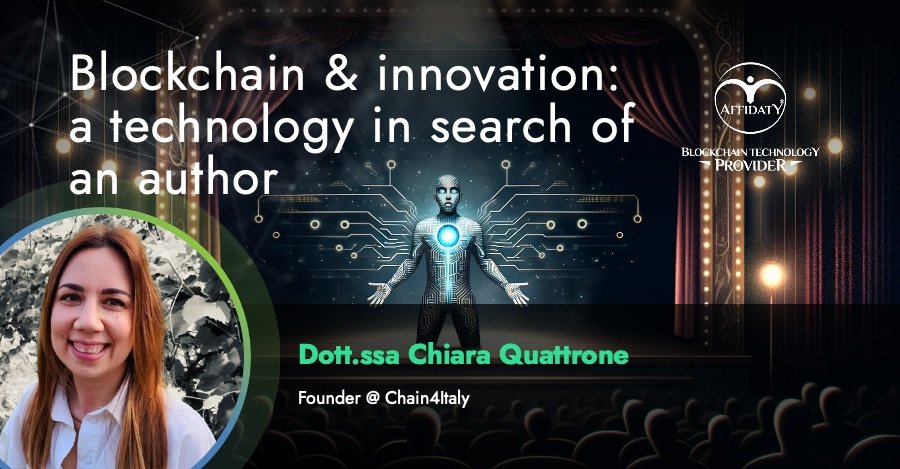
The recent history of blockchain and its innovative impact may evoke themes explored in Luigi Pirandello’s work, “Six Characters in Search of an Author,” such as incommunicability and the difficulty of self-representation.
The representation itself is so peculiar that on May 9, 1921, at the Teatro Valle in Rome, during the premiere, the audience was quite disoriented. The scene begins with the curtain rising on a stage being set up, with a group of people rehearsing their lines. The innovation of the play shook the audience so much that they filled the actors and the author with insults, shouting “Madhouse, madhouse!” and “Buf-foon! Buf-foon!” It is even said that physical confrontations occurred.
A few months later, on September 27, 1921, the play was staged at the Teatro Manzoni in Milan with the same theatrical company. This time it was a success; this initially misunderstood work was finally appreciated and became one of the most performed plays in the world, forever marking the history of theater.
Like one of Pirandello’s characters, blockchain is an innovation that is breaking into the global financial and economic scene, attracting much attention and raising numerous questions.
The impression is that businesses and institutions are cautiously and sometimes uncertainly embracing the countless advantages offered by this technology.
The question arises spontaneously: why does this technology raise a widespread sense of perplexity? Is it because it is a disruptive innovation, met with prejudice?
To find answers, it might be helpful to quickly analyze the recent history of blockchain up to the present day.
The “History” of Blockchain
The origins of blockchain, although relatively recent, have always remained shrouded in mystery.
In 2008, Satoshi Nakamoto, a pseudonym whose identity has never been revealed, published the paper “Bitcoin: a peer-to-peer Electronic Cash System.” This officially marked the birth of what would later be called the “king” of cryptocurrencies.
A few years later, in 2013, the nineteen-year-old Russian-Canadian Vitalik Buterin founded Ethereum.
Now, it’s not just about digital currencies; the new open-source system uses blockchain to program DApps (decentralized applications) and smart contracts.
“Smart contracts” are computer programs that execute only when certain conditions are met. The network remains decentralized, eliminating intermediaries and making the system more streamlined and faster.
As this mechanism allows for simpler and more transparent relationships, the immediate association of the “blockchain” with the supply chain and other processes where entities exchange assets is evident.
Despite its great potential, years pass with only a few blockchain applications in the commercial world.
In 2018 and 2019, two significant projects emerged:
- IBM Food Trust created its blockchain, used by companies such as Walmart and Nestlé;
- Carrefour France certified its free-range chicken line on the blockchain.
In 2020, the inevitable happened: Covid. Everything came to a halt, including supply chains.
The setback is understandable; priorities shifted, and after the storm passed, the aftermath of the largest global economic crisis we witnessed remained.
In the midst of the post-pandemic recovery, in 2022, Russia attacked Ukraine, dealing another heavy blow to the international crisis.
Tragic health events and political instability naturally have repercussions on the markets, inflation affects the entire economic-production system, and the effects will likely continue in the coming years.
Current Context
Observing recent events from a broader perspective and with resilience, what has happened has brought new awareness and different settings.
The world has experienced a significant acceleration; the global population has quickly adapted to becoming more technological and “smart.”
At the same time, there is a greater sensitivity towards safeguarding the planet; the effects of climate change are increasingly evident. Attention to sustainability and ecology is on the rise.
All of this is reflected in consumer purchasing behavior, which leans towards seeking greater value and quality in products and services.
Technology offers itself as a valuable tool to support increasingly complex consumer decisions. In the food sector, for example, knowing the origin and transparency of food is crucial for some consumers.
As evidence of this trend, in recent years, there has been talk of a digital passport, Agriculture 4.0, and agrifood tech to protect and consolidate the European agri-food market.
In particular, Italy, which holds the record for PDO (Protected Designation of Origin), PGI (Protected Geographical Indication), and TSG (Traditional Specialty Guaranteed) products according to Istat for the year 2017, has much to protect. Counterfeit “Made in Italy” agri-food products are estimated to generate 30 billion more than genuine ones, reaching 80 billion. Including the perceived “Made in Italy,” the figure is even higher.
To protect Italian production and curb counterfeiting and Italian-sounding products, innovative technologies could be a valuable ally.
Blockchain Takes the Stage
Returning to the association with Pirandello’s work “Six Characters in Search of an Author,” in recent times, blockchain has appeared, forcefully taking the stage from the audience and demanding to be a protagonist, offering to solve trust and security issues in a few simple moves.
As at the Teatro Valle in 1921, initially, the audience is disoriented and sometimes critical.
Reactions are skeptical, both due to the disruptive nature of the innovation and the crypto-financial scandals periodically heard about.
Audience members think of themselves as simple entrepreneurs, traders, employees, workers—not engineers or computer nerds!
The question arises: why change a system that has been proven for decades or even centuries? The fear of change could be enough as an answer to this resistance.
Regulation and Inclusivity for Blockchain
At this point, it remains to be asked what to do to give space and the proper value to this magnificent innovation.
It is curious to note that, on one hand, there are supporters of blockchain—professionals and enthusiasts ready and eager to fully exploit its potential. On the other hand, there is often an unprepared entrepreneurial fabric on the subject, needing training and information.
It will likely take time, but it’s better to update sooner rather than later, especially in Italy. Abroad, several countries have been experimenting with blockchain for years, such as the USA or Australia.
Another significant deficiency stems from the lack of a clear and defined regulatory framework. Recently, small steps forward are finally being glimpsed:
- The European Commission is introducing the digital euro.
- Last May, the European Council approved the MiCA (Markets in Crypto-Assets) regulation, European regulation for the crypto world, aimed at ensuring greater legal security and promoting the growth of distributed ledger technologies.
- Stablecoins are becoming more widespread; payment giant PayPal has recently issued its PayPal USD (PYUSD) token, which will run on the Ethereum blockchain.
Like characters in search of an author, blockchain seeks its expression, asking to exist and be a protagonist. It exists and lives on stage despite having little resonance with the public; the economic-production world receives it with perplexity.
In my opinion, for blockchain to assert itself more decisively, greater inclusivity is needed for this innovative technology, specifically:
- a clear regulatory framework by governments;
- greater simplicity in fiscal matters;
- cross-disciplinary training of personnel, especially at the managerial level;
- more information and less misinformation, especially regarding the bad publicity it receives due to cryptocurrency speculation.
Afterward, it will be easier to:
- acquire and use by businesses;
- apply in various fields;
- ensure greater protection for consumers and all users.
In a broader perspective of safeguarding the future, these decentralized systems could be a valuable support for innovating and protecting the world in a safer, more transparent, and sustainable way.


 Market and Data
 _old_Become an author
 Wallet


