


We often associate blockchain with the crypto world and NFTs, an increasingly robust ecosystem that can add value to our assets. Web 3.0 is slowly starting to encompass topics related to identity and privacy, leaving the gateway to the past behind. Among the emerging themes that the dear European Community is beginning to monitor and push for is ESG: Environmental, Sustainability, and Governance.
As highlighted by the analysis from the Politecnico di Milano Observatories in 2023, there have been 1046 global blockchain projects active from 2016 to 2022, and an increasing number of diverse sectors are turning to distributed ledger solutions.
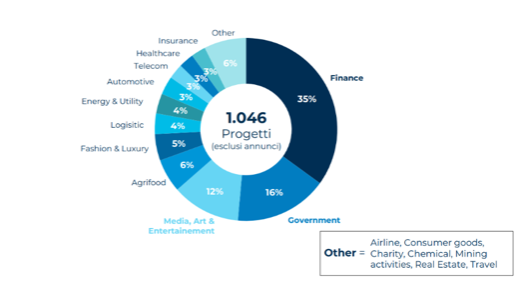
Application areas of Blockchain and Distributed Ledger projects worldwide
(Blockchain & Distributed Ledger Observatory)
Source: Osservatori Digital Innovation – Politecnico di Milano (www.osservatori.net)
As we are called upon to provide more evidence of our sustainability in the production and use of our products, the blockchain emerges as a relevant technology within the Life Cycle Assessment (LCA) ecosystem.
The detailed and accurate traceability of raw materials and their environmental impact, not limited to CO2 but also covering deforestation and water consumption, is becoming more crucial for investors and consumers. In which sectors? No one is excluded, from food to textiles, from electronics to furniture, to construction. What is the impact of the consumption and disposal of these products?
If we were called upon today to provide evidence, regardless of our role in the private sector or within a service-providing company, of how our environmental impact affects what we produce, consume, and dispose of, it would pose a significant challenge. Beyond the aspect of supply chain traceability, potentially well-covered by various companies in the field, we would find ourselves wondering how to link guarantees on environmental impact calculations, whether these products are truly compatible with standards and certifications, especially if all stakeholders in the supply chain, from raw material to disposal, can share and access this information without losing control to ensure an increasingly accurate LCA.
The supply chain traceability sector is the third most involved process in blockchain utilization, and thanks to European regulations, this figure is expected to grow exponentially.
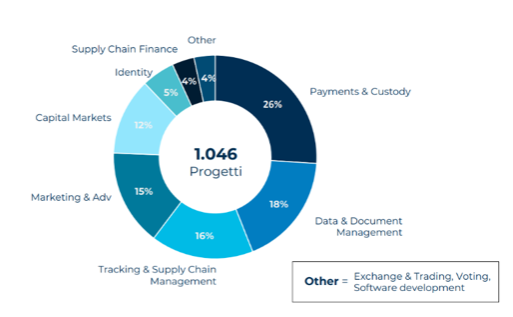
The main processes involved in Blockchain and Distributed Ledger projects
(Blockchain & Distributed Ledger Observatory)
Source: Osservatori Digital Innovation – Politecnico di Milano (www.osservatori.net)
Blockchain can not only play a significant role in this cause but also be a pivotal solution to ensure transparency and traceability of information, providing distributed accessibility to the entire supply chain while maintaining ownership of their data. Today, this is happening for certain producers in the food sector; you may have encountered QR codes on wine labels, like those on “Cantine Torrevento,” 1 or on “La Fiammante” 2 tomato boxes. These QR codes not only serve marketing purposes but also provide traceability information collected directly by the producer on the blockchain, verified by an on-chain certifying entity, and accessible to the consumer, making them more responsible.
Every stakeholder is not only responsible for their own information and actions but also raises awareness among others, influencing the entire consumer chain. There are blockchains structured for this purpose, where a scalable and more or less accurate and detailed process is developed within the supply chain based on the ESG theme in question. Every stakeholder can access only the necessary information for the supply chain while retaining control of their data. A third party may be called upon to verify the accuracy of this information, especially if there is a need to ensure compliance with European standards and regulations on environmental and human rights issues (this is already happening through AI tools and Smart Contracts).
The consumer, therefore, receives information that provides evidence of traceability and LCA, and for some products, the producer can even provide documentation for consumption and disposal.
Technically, the producer can use any tool and solution to improve their traceability, from IoT systems to PaaS, and can make available direct access to the blockchain-written process for aggregated information useful for LCA, empowering their suppliers, who, through their identity, can access the blockchain directly by entering relevant data that demonstrates their environmental impact. The producer can also add marketing and technical information to create what is known as a Product Passport, usable not only by the consumer but also by those involved in disposal, recycling, and authorities that verify ESG impact.
This ecosystem requires a scalable, reliable, and immutable architecture, with the core process defined in blockchain in terms of stakeholder access and information type. It can interface not only with the multiple platforms embedded by different manufacturers and suppliers but also operate through smart contracts to generate outcomes that give rise to a system of usable credits and, not too far in the future, exchangeable and measurable in a marketplace.
A real example is ReSea3, a company operating in ocean cleanup in the Pacific. By tokenizing the amount of collected plastic, grouping it by type, photographing and tagging it for tracking, and writing the quantity and category directly into the blockchain through smart contracts, they create a token system that returns tokens to investors and those who buy the recycled plastic. This is tangible proof that the producer can reuse it for their B2B or B2C purposes, becoming a solid and undeniable link within their supply chain. This is just the example of a single link, but when combined, the chain accurately and efficiently covers the entire LCA, providing evidence of their attention and compliance with ESG issues.
The drivers pushing the supply chain to move quickly are European regulations, which are increasingly focused on changing individual needs, encouraging reduced use of materials and primary resources. Two concrete examples expected to take effect within a year:
- The Carbon Border Adjustment Mechanism (CBAM), mainly aimed at importers, imposes a tax on all materials imported into the EU based on their environmental impact. Manufacturers must provide evidence of their CO2 impact to remain competitive in the EU market.
- Within the Ecodesign for Sustainable Products Regulation (ESPR) 5, the Digital Product Passport project led by Cirpass 6 for the European Community for product LCA, allows consumers to access information dictated by the regulations through a QR code.
Perhaps it’s a bit premature, but the ecosystem that can be created is based on the single asset or item purchased, based on verified traceability, and the calculation of publicly visible ESG impacts in the blockchain. It returns credits or NFTs to our wallets as consumers, which can be useful not only for transparent access to the quality of the products we consume but also for trading them with our energy providers, services, and solutions to make our ecosystem increasingly sustainable and increase the value of our assets.
References:
- Cantine Torrevento: https://www.torrevento.it/sostenibilita/
- La Fiammante: https://www.dnv.it/news/il-pomodoro-la-fiammante-su-blockchain-icab-entra-in-my-story-dnv-gl–177089
- Plastic recovery project: https://www.reseaproject.com/impact
- CBAM regulations: https://taxation-customs.ec.europa.eu/carbon-border-adjustment-mechanism_en
- ESPR: https://environment.ec.europa.eu/publications/proposal-ecodesign-sustainable-products-regulation_en
- Cirpass, Organization for EU Digital Product Passport: https://cirpassproject.eu/wp-content/uploads/2023/02/ESPR-short-summary-Final.pdf


 Market and Data
 _old_Become an author
 Wallet


