


From BIM to the application of Blockchain in the construction supply chain.
As mentioned by other authors in this blog, Building Information Modeling (BIM) has radically transformed the workflow of the construction supply chain. Professionals involved in the design, construction, and management of projects collaborate more efficiently and quickly, providing real-time updates to clients on the progress of their projects.
This has made the construction supply chain more robust and controlled, helping to avoid errors that would inevitably lead to budget overruns and delays in the traditional method.
According to a recent report by the McKinsey Global 1 Institute, this transformation is expected to drive a global investment of $57 trillion in infrastructure by 2030 to keep pace with global GDP growth. This presents a massive incentive for construction supply chain stakeholders to identify solutions that enhance productivity and project delivery through new technologies and improved practices.
The report explores various technologies that the industry can adopt in the coming years. Blockchain is expected to generate $3.1 trillion in new business value worldwide by 2030, with half of that expected by 2025 through operational improvements, according to Gartner.
Before the pandemic, the construction industry was weakly digitalized in several areas:
- Resources
- Usage
- Labor
Possible factors that could change this situation include:
- Increased investments in construction technology.
- Reduced technology costs.
- The formation of a technological ecosystem for construction.
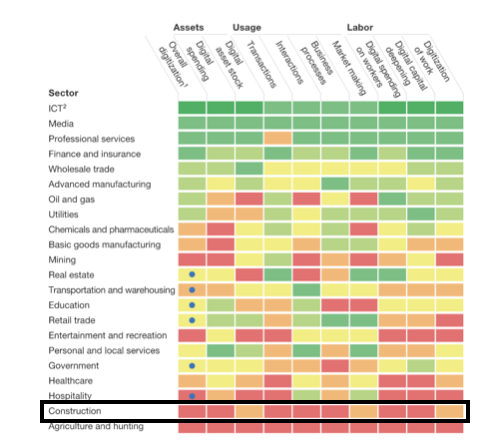
Figure 1 – source McKinsey Global Institute
However, this doesn’t preclude the introduction of Blockchain in the supply chain, as demonstrated by the activities of InnovationChain 2, a startup founded with the goal of integrating Blockchain into the BIM workflow.
This is confirmed by ARUP 3, which envisions the introduction of Blockchain into BIM with an average timeline and a series of implementation steps.
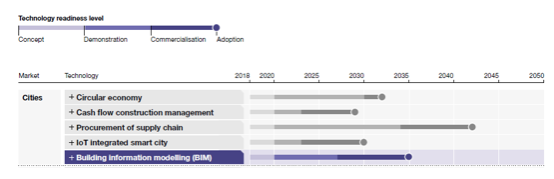
Figure 2 – source ARUP
Sectors related to BIM, Smart Cities, and IoT are expected to introduce Blockchain more rapidly, serving as “early adopters” and closely observed by major players in the construction industry.
GARTNER, another major player in the industry, states in its recent report “The Gartner Blockchain Spectrum“ 4 that the Blockchain approach will be progressive and inclusive.
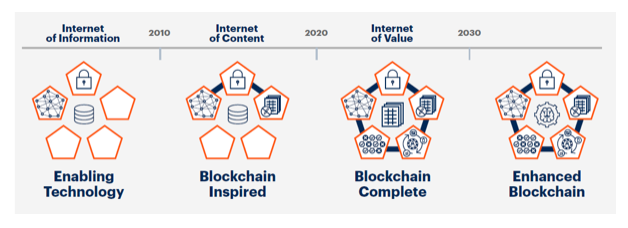
Figure 3 – source GARTNER
Among the major players in construction projects, it’s important to consider SKANSKA 5. In this case, there is a more cautious approach, particularly in the Real Estate sector, where digitalization is growing in other countries, thanks to legislative changes that have moved the real estate market 6 toward digitalization since 2019.
As per the reports mentioned, the global Blockchain market is projected to have a value of $1.431.54 billion by 2030 (Grand View Research 7) with an average annual growth rate (CAGR) of 85.9%. PWC 8, on the other hand, anticipates a higher technology value ($1.76 trillion), while Gartner 9 predicts a much higher value ($3.1 trillion).
However, it’s important to reevaluate these predictions in the context of the Italian market. Recent data suggests that Blockchain adoption is struggling to take off. Italian companies have been consistently investing in the technology (€30 million in 2019, €23 million in 2020, and €28 million in 2021) 10. The most favored sectors continue to be “Finance” (51%), followed by the public sector (15%), “Agrifood” (11%), and utilities (10%).
Since 2020, there has been an increase in the number of startups focused on producing specific Proof of Concepts (POCs).
In this context, InnovationChain 11 is one such innovative startup with the goal of integrating Blockchain into the BIM supply chain.
Let us now analyse how the main critical issues that emerged can be addressed and resolved.

Figure 4 – Inclusion of Blockchain in the BIM supply chain (source: InnovationChain)
Current Challenges in Introducing Blockchain to the Construction Supply Chain
The widespread adoption of Blockchain technology in the construction supply chain faces several challenges that need to be addressed for successful integration. Some of the main issues include:
- Industry Complexity: The construction sector is known for its complexity and intricate supply chain. Implementing Blockchain requires the cooperation of multiple stakeholders, including designers, construction companies, component and material suppliers, and, in the case of public works, government authorities. Coordinating these parties can be a challenging and complex task.
- Resistance to Change: The construction industry is traditionally resistant to change. Many companies prefer to stick with established and traditional processes, making the adoption of new technologies like Blockchain difficult.
- Regulation and Standards: Varied local regulations and standards can complicate the global adoption of Blockchain. Addressing regulatory challenges and ensuring compliance with local laws is essential.
- Investments and Resources: Implementing Blockchain requires initial investments, time, and technical expertise. Some companies may be reluctant to commit these resources without a clear understanding of the benefits. While Blockchain offers potential efficiency and transparency advantages, there are initial costs, such as developing custom platforms or integrating with existing systems, that may discourage some companies.
- Conceptual and Technological Novelty: Blockchain is a relatively new technology, and many construction industry stakeholders may not have a deep understanding of how it works and can be effectively applied.
Despite these challenges, there are pilot projects and initiatives introducing Blockchain into the construction supply chain 12. These projects aim to explore how Blockchain can improve transparency, material traceability, document management, and information sharing within the industry. With time, education, evolving regulations, and the demonstration of practical benefits, it’s likely that we’ll see increased Blockchain adoption in the construction industry.
Legal and Security Considerations
As mentioned, there are potential “gray areas” in the BIM workflow that can lead to disputes. In recent years, legal specializations have emerged specifically focused on BIM 13.
The BIM process defined by major international standards, as mentioned earlier, provides an excellent approach to design, construction, and project management. However, there are moments where greater data unification and rapid initiation of procedures can enhance it. The use of a Data Sharing Environment (ACDat) can be beneficial for implementing Blockchain at critical stages. Which stages are we referring to? For example, when the status of a BIM model changes from “shared” to “published,” the data can be notarized, making it unique. Similarly, notarizing important multidisciplinary model verifications, where the BIM Coordinator checks models based on various criteria (geometric, regulatory, classification, etc.), can be essential.
Digital Project Management
As seen from the key reference standards on the subject (UNI EN ISO 19650 14, UNI EN 11337 15, and UNI EN 17412 16), the design phases allow for continuous control of graphical and non-graphical information within the models, and the use of ACDat enables this management efficiently. Verification and control tools, such as model & code checking software (e.g., Solibri 17), can assist BIM Coordinators in accessing shared and cloud-published information, enabling them to report errors or geometric and regulatory inconsistencies to the responsible parties for correction. Privileged areas for Blockchain application in the BIM workflow can include:
- Data and Change Management: Following the guidance of major international BIM standards, Blockchain can be used to securely and immutably record all major model changes, allowing authorized parties to track the change history and maintain data consistency.
- Information Sharing and Access: Blockchain can create a shared and secure ledger of information, enabling all parties, including architects, engineers, contractors, and owners, to access necessary information efficiently and transparently.
- Data Trustworthiness: Blockchain offers cryptographic proof of immutable information, ensuring the integrity of BIM data. This is particularly important for legal or liability matters, as immutable information can serve as reliable evidence.
- Payments and Smart Contracts: Blockchain, through the use of Smart Contracts 18, can ensure that payments are made only when specific conditions are met.
- Protection of Sensitive Data: Blockchain can be used to safeguard sensitive BIM data, especially in hybrid or private solutions, allowing parties to share relevant information with those who need it.
- Document Storage and Sharing: Blockchain can securely store and share important documents such as contracts, certificates, and permits.
In summary, the use of Blockchain in the context of BIM can address key challenges, enhancing data management, transparency, security, and collaboration in the construction industry. However, it’s important to note that Blockchain is not a one-size-fits-all solution and requires careful planning and implementation to maximize its benefits.
Construction Site and Project Execution Phase
The project execution phase (commonly referred to as the construction site) can gain significant benefits from the proper use and application of Blockchain, improving efficiency, transparency, and security in construction processes. Here are some of the key advantages of implementing Blockchain on a construction site:
- Material Traceability: To ensure construction sustainability standards, Blockchain can be used to record the origin and path of construction materials used on the site. This allows for verifying material sources, ensuring quality, and compliance with regulations.
- Resource Utilization: Blockchain can help track resource usage during construction, reducing waste and optimizing resource management on the construction site. IoT sensors can monitor real-time inventory levels and automatically generate replenishment orders when materials reach certain minimum levels.
- Documentation and Information Sharing: Similar to the design phase, the execution phase requires notarization of critical documents such as permits, drawings, compliance certificates, and contracts. All project stakeholders can securely and transparently access relevant information.
- Smart Payments and Contracts: Payments between different construction site stakeholders can be automated and guaranteed through the proper use of Smart Contracts, reducing payment disputes and delays.
- Security and Access Control: Blockchain can ensure controlled access to site resources. Only authorized parties with valid insurance and permits can access specific documents or equipment, improving security.
- Environmental Sustainability: Blockchain can be used to track the environmental impact of the construction site, including energy consumption and carbon emissions. IoT monitoring allows periodic verification of the site’s energy performance and timely intervention to reduce its overall environmental impact.
Conclusion
As discussed in this overview, there are moments in digital project management where the possibility of introducing notarizations and/or Smart Contracts can add security and speed that would be otherwise unattainable through traditional methods or existing BIM design procedures.
This can bridge the “gray areas” that have led to disputes between designers and builders, even in recent times. Blockchain undeniably offers data unification through its distributed and immutable record-keeping system.
In general, Blockchain provides a highly reliable and unique system for notarizing data, ensuring that this data remains intact, authentic, and traceable over time. These characteristics make Blockchain technology highly attractive in various fields where data registration and verification are essential. After discussing digital project management and project execution in the construction supply chain, we will soon explore phases dedicated to asset management in various contexts.

Figure 5 – Blockchain application areas related to BIM (source: InnovationChain)
2 https://www.innovationchain.it/ InnovationChain’s business project aims to create BIM-Blockchain digital platforms integrated with “Common Data Environment” or “ACDat” (public and market-driven) to support the evolution of “Build & Construction” supply chain processes towards highly automated models and the “notarization” of workflows. The goal is to increase productivity and ensure their integrity.
3 https://www.arup.com/perspectives/publications/research/section/blockchain-technology
4 https://www.gartner.com/en/information-technology/insights/blockchain
6 https://group.skanska.com/media/articles/new-listing-digital-home-buying-powered-by-blockchain/
7 https://www.grandviewresearch.com/
8 https://www.pwc.com/gx/en.html
10 Source: “Blockchain and Distributed Ledger Observatory of the School of Management of Politecnico di Milan”
12 With the startup InnovationChain, we have developed a TRL4-level Proof of Concept (POC) focused on introducing Blockchain into the digital project management phase. For more details, please refer to the academic paper at the following link. https://www.innovationchain.it/2022/03/making-through-bim-blockchain-based-applications/
14 https://store.uni.com/uni-en-iso-19650-1-2019
15 https://store.uni.com/uni-11337-1-2017
16 https://store.uni.com/uni-en-17412-1-2021
17 https://www.harpaceas.it/solibri
18 “Smart Contracts are computer programs that operate on distributed ledger technologies, and their execution automatically binds two or more parties based on predefined effects determined by the parties themselves.” This is the legal definition provided by Article 8-Ter of Law No. 12 – February 11, 2019 (Distributed Ledger Technologies and Smart Contracts).


 Market and Data
 _old_Become an author
 Wallet


