


Intro.
Hello, I’m Matteo Mancini, a consultant at Deloitte specializing in banking and digital transformation. This is my first article for this blog, and I’m excited to explain the interesting upgrade that involves the second-largest blockchain by market capitalization.
About a month ago, the much-awaited “Ethereum Merge” occurred, which involved the transition from the Proof of Work (PoW) consensus algorithm to a Proof of Stake (PoS) one. PoW and PoS systems validate customer transactions; however, the process differs in many ways. In PoW, computers compete with each other to solve complex mathematical problems, while in PoS, the system relies on the distributed consensus of network participants, which ensures the validity of operations by committing a portion of their cryptocurrencies1.
The term “Merge” is used because it refers to the merger of two blockchains that were previously independent and operated in parallel. In practice, Ethereum‘s main blockchain was “merged” on September 15, 2022, with a special blockchain called the “Beacon Chain”.
The Beacon Chain, launched on December 1, 2020, had the simple purpose of being a Proof of Stake blockchain within which no transactions of any kind were present. It was, therefore, an empty blockchain but with a PoS consensus algorithm. Since the Beacon Chain was an “empty chain,” it was able to merge with the Ethereum blockchain, replacing its PoW mechanism, without worrying about other variables. Once the two chains were merged, Ethereum‘s PoW mechanism was replaced by the new PoS mechanism.
The Merge is considered one of the most significant events in the history of cryptocurrencies, since the genesis of Bitcoin itself, as no blockchain has undergone such a significant change in the history of cryptocurrencies. Furthermore, blockchains do not often change such a critical part of their operation.
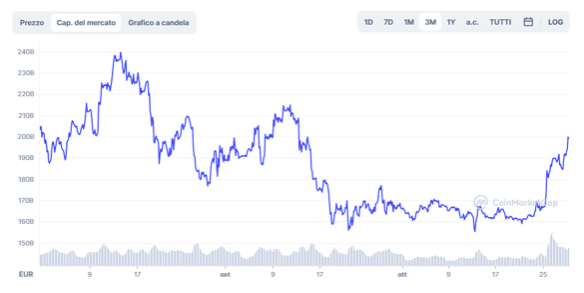
The ETH asset, the native cryptocurrency of the Ethereum ecosystem, has a market value of around $190 billion today and counts tens of billions of value based on the network itself. The risks that have been explored and tested are certainly many, and this is one of the main reasons why the Merge has taken so long to be perfected.
Below is the graph representing the Market Cap of ETH (October 2022 data):
Impact on ETH’s value.
The Merge had a massive impact on the economy of ETH, and for investors, this aspect of the Merge is one of the most significant.
The ETH economy has changed in two ways:
Reducing the issuance of ETH Transforming ETH into a native productive asset
The Merge reduced the annual issuance of ETH from 4.3% to 0.43%; this is due to the fundamental improvements in efficiency that a PoS consensus mechanism brings. PoS is designed to provide the highest level of blockchain security at a lower cost. These savings are transferred to ETH, reducing the quantity of ETH to be issued to pay for security.
The previous PoW mechanism is costly and requires significant resource overhead to compensate “security providers,” i.e., miners, for their services. In contrast, the cost of security in a PoS system is simply the opportunity cost of capital, which represents no tangible good or real-world cost. Unlike PoW, PoS does not need to issue significant amounts of currency to pay for security, so this cost reduction leads to greater efficiency of PoS consensus mechanisms.
Thanks to the decreased need to pay miners, Ethereum is able to reduce its annual issuance by over 90%. The reduction in new ETH issuance is generally considered extremely positive as the asset does not lose value over time.
ETH becomes a deflationary asset.
About a year ago, on August 5th, 2021, Ethereum introduced EIP-1559, an upgrade that changed the way transaction fees are handled. Ethereum Improvement Proposal (EIP-1559) eliminates the auction as the method for calculating gas fees in transactions. Previously, people would bid for the processing of their transaction, with the highest bidder winning.
With EIP-1559, there will be a discrete “base fee” for making transactions. Users or applications that want to prioritize their transactions can add a “tip”, called a “priority fee”, in order to pay a miner for faster inclusion of their transaction.
After the merge took place, the issuance of ETH decreased by over 90%, increasing the proportional amount of ETH being burned with each block.
With the resulting reduction of ETH issued under the new consensus algorithm, in cases where gas fees for transactions are equal to or greater than 7 gwei, the rate of ETH burned for validation will be higher than the rate of ETH issued, thus decreasing the supply of ETH in circulation.
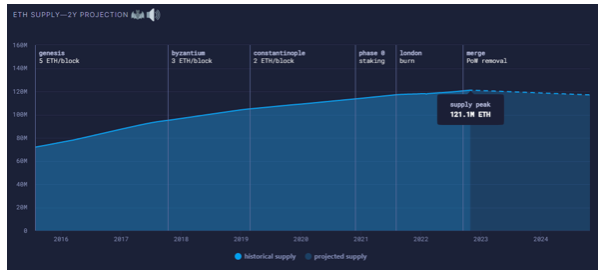
With this new mechanism, the maximum supply of ETH on the market will peak in 2022/2023 and then gradually begin to decrease, making ETH a deflationary asset in every respect.
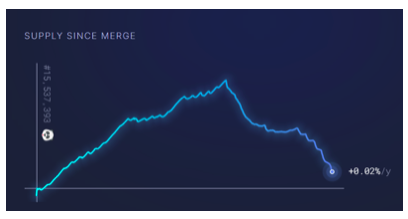
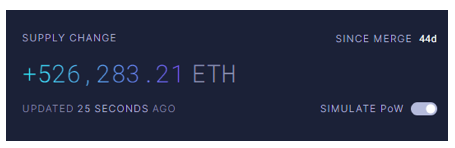
The following figure represents the new quantity of ETH issued since the date of the Merge:

Below is the projection of ETH issuance in the case of PoW:
With the consequent reduction of ETH issued under the new consensus algorithm, in the event that transaction gas fees are 7 gwei2 or more, the rate of ETH burnt for validation will be higher than the rate of ETH issued, thus decreasing the supply of ETH in circulation.
With this new mechanism, the maximum supply of ETH on the market will peak during 2022/2023 and then gradually start to decline, thus making ETH a deflationary asset in its own right.
Reduced energy consumption.
Following the merge, Ethereum has reduced the network’s energy consumption by 99.95%, reducing its carbon footprint to 0.1 million tonnes of CO2 (MtCO2) per year. Now, a single transaction on Ethereum consumes about 0.03 kWh, with a carbon footprint of 0.01 kgCO2, which is equivalent to the energy used to watch two hours of YouTube video.

Misconceptions.
The Merge does not increase transaction throughput, i.e. the number of transactions per unit of time, nor will it reduce gas fees, which will be reduced with a new ecosystem update called “sharding”. Currently, Ethereum can process up to 20/30 transactions per second, which is insufficient for global use of the entire system. For comparison, VISA can process up to 1,700 transactions per second.
In this article, I have tried to highlight some of the key points presented by the Ethereum Blockchain with its new consensus algorithm. My invitation is to try to deepen the functionalities of this incredible ecosystem, in order to appreciate its infinite potential.
1 The so-called “Staking”. Staking means locking up one’s tokens in order to participate in the block validation process.
2 A gwei is one billionth of 1 ETH and is the unit of measurement used to pay fees on the Ethereum ecosystem. During the peak of the 2021 bull run, gas prices sustained 200 gwei or more for many months.
3 Carbon footprint refers to the total greenhouse gas emissions caused by the entire Ethereum ecosystem.
4 Sharding is a database partitioning technique that allows for more transactions to be processed by dividing the entire network into smaller partitions, known as “shards”. Sharding will reduce Ethereum gas fees on L1, but the true minimization of gas fees for end users will occur on L2 such as Optimism, Arbitrum, Polygon, StarkNet, zkSync, or other L2s.
Fonti:





 Market and Data
 _old_Become an author
 Wallet


