


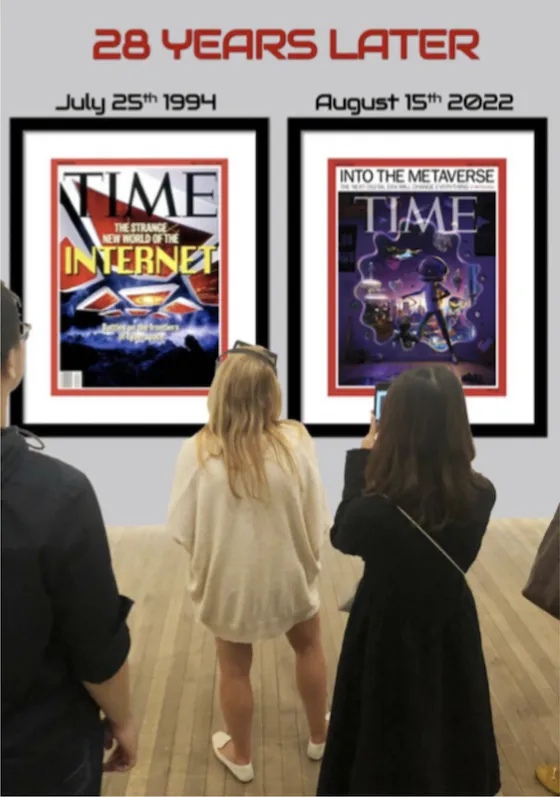
Web1 – The internet brought us to be digitally connected. Web2 – Social media brought us to digitally interact between people. Web3 – Into the Metaverse – digitally allows us to do something more: Co-create an idea, a goal, a future together.
This is what I have appreciated in the last 8 months in which – boldly – I threw myself into the blockchain and crypto world, testing and understanding directly on my skin the modes, reactions of people (experts or neophytes), feedback from companies.
The first thing I realized is a strong lack of education. I think it’s normal – it’s a new world in the making and in the growth phase, but Web2 has led us to follow buzz words, superficial news, which in the process of change towards a new philosophy of interaction can only help confusion.
When we talk about NFT, Metaverse, Blockchain, crypto, DAO… all of these are the infrastructures and modes (growing and improving) of interaction of a new experience created by real people; they are the building blocks that support a new system. Building blocks that may be made of clay at the moment but are shaping up to become concrete, steel, titanium in the coming years. Thanks to whom? To the co-owners community. We are only at the dawn of Web3!
Let’s start with the Blockchain technology and smart contract that has allowed people to interact uniquely and perpetually in the creation of a value that is shared digitally. This is the real innovation and uniqueness. Using the internet to connect people and enable the creation of a new goal through infrastructure. The goal can be charity, investment, IRL, art – but the concept is always the same. Blockchain is the infrastructure.
A group of people who interact through ownership.
So what are NFTs then? Paid Jpgs, art? In reality, NFTs become at this point the real key to access this reality. An access key linked to the utility of the community and its development goal. Their value is not connected (or only) to the quality of the design, of the Bored Ape – but to the fact that this becomes the way to become part of a community aggregated through Blockchain and that interacts digitally.
And the Metaverse? Which is often confused with the concept of Web3 itself by the masses? MetaVerse is only the first version of how these co-owner groups will be able to meet, interact, and co-create. Technology evolves and helps us enter through virtual, mixed, augmented realities, and will always improve over time. But the concept is always the same. A place where co-owners meet to interact on a goal.
And cryptocurrencies. In my opinion, they were launched as the first phase, but actually, in the logic of creating a community, they are the last. A new group of people who interact in a reality, for a goal – needs a way to make transactions. So at this point, the need for the concept of cryptocurrency arises – an innovative, technology-based (blockchain) way of making transactions in a new world (metaverse) with new access keys (NFTs).
And the concept is always the same. A group of co-owners who must interact by making transactions.
And finally, with DAOs (Decentralized Autonomous Organizations). A group of people united by a common goal – needs over time a way to structure themselves to decide, regulate, and guide development.
Leveraging the mindset of co-ownership and co-building, the structure itself decides how to regulate itself with a process and methodology that leverages all the building blocks of this new world. Therefore, a DAO is a blockchain-based organization that allows access and decision tokens through NFTs, rewards participants through cryptocurrencies, and eventually decides where to meet – possibly in the Metaverse.
The real engine of web3 is therefore all those people who appreciate its potential, understand the power they have in hand to co-create, develop their own fortune. Why? Because they are a group that works together for a goal that they know they own.
People may initially be frightened by all of this, by the volatility of change (and consequently currency fluctuations), by a new experience of interacting – but in fact – thinking about it – it’s all part of a normal process of creating a new country – just like a newborn is scared to take its first steps.
The process has just begun and will be an interesting, exciting journey with many developments. Just as a baby starts crawling, then standing up and taking its first steps and can eventually run a marathon – in the same way, I think it’s important to offer people a simple and gradual way to take the first steps towards this world – starting with a step-by-step process of experiencing this new model, using its building blocks to appreciate its benefits and gradually building together; using some web3 jargon – LFB (Let’s Fu**in’ Build).
What are the opportunities? Infinite, in my opinion. Starting from art – aggregating people through love for it – donations, circular investment funds, digital fashion, and much more!
As a long-term vision – I like to dream and think that – in a few years – there will be a true group of bold people who, through the web3 philosophy of co-ownership and co-participation, will do what Balaji Srinivasen defines as the new State Nation.
“A network state is a social network with a moral innovation, a sense of national consciousness, a recognized founder, a capacity for collective action, an in-person level of civility, an integrated cryptocurrency, an archipelago of crowdfunded physical territories, and an on-chain census that proves a large enough population, income, and real estate footprint to attain a measure of diplomatic recognition.”
Web3, DAO, and co-ownership are the new way of creating a nation?
Terenzio once said, long before web3, “Fortune favors the brave.” Today – the web3 community, the community of people who mentally understand the value of co-ownership, is guided by a new motto:
Fortune Belongs To The Brave Fortune belongs to us because, as early and bold adopters of web3, we co-create as a community our fate.
Credits: Credit to the team at TIME magazine. I loved the cover for August, ‘Into the Metaverse The Next Digital Era Will Change Everything.’ by Matthew Ball, and 28 years earlier, “The Strange New World of The Internet: Battles on the Frontiers of Cyberspace” by James Porto
A Network State: how to start a country https://thenetworkstate.com
Balaji Srinivasen




 Market and Data
 _old_Become an author
 Wallet


