


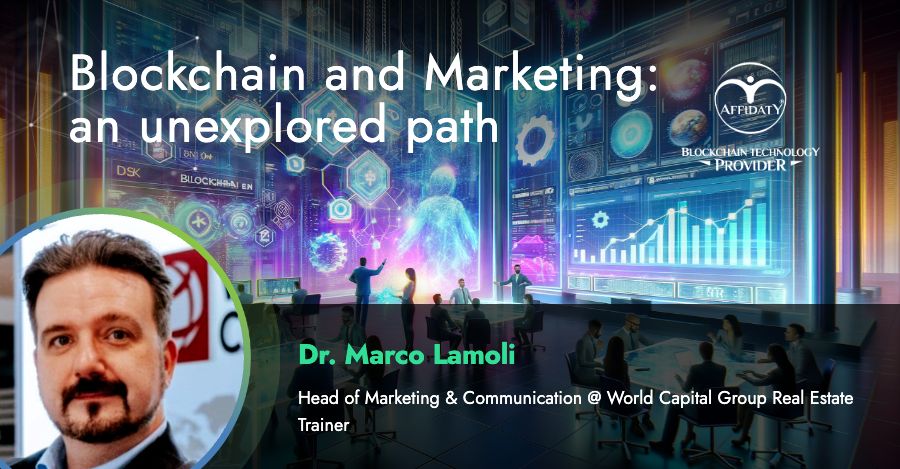
Transparency, security, and message customization: that’s why companies should use this technology for their advertising campaigns.
There was a time in the realm of marketing when blockchain technology seemed to be “The Next Big Thing.”
A period easily memorable, albeit unfortunate, better known as the pandemic biennium, 2020 – 2021. The potential synergies between marketing and blockchain were the main reasons keeping CMOs awake, both in Italy and worldwide. Like other sectors, however, marketing is exceedingly sensitive to technological innovation – hence the more impactful term “MarTech” today – and already, between 2022 and 2023, another innovation, also “larger than life,” became the fixation of those operating in this field: generative AI.
Does the tsunami of generative AI sweep away blockchain?
The rapid proliferation of solutions like ChatGPT, Dall-E, and Midjourney, as well as Gemini and Bard, swiftly shifted the focus of industry operators towards the use of artificial intelligence in advertising. The echoes of the initial academic studies on the use of blockchain technology in marketing quickly dissipated, leaving this area of study in a doubtful limbo. However, researches persist today, aimed at demonstrating that a fusion between blockchain and marketing will, and in some cases already has, opened new possibilities for advertising, introducing an unprecedented level of transparency, security, and personalization.
“As companies begin to explore these technologies, we will witness a radical transformation in advertising strategies.”
(Toufaily, 2021, A framework of blockchain technology adoption: an investigation of challenges and expected value).
Blockchain and Marketing: a potent synergy, at least in potential
Blockchain, if systematically used, could bring a level of security and transparency never seen before in advertising. It is legitimate to wonder why, especially advertising agencies, but also major players in strategic consulting, have not developed, except in rare cases, services capable of combining blockchain and marketing to offer to their clients and prospects. This legitimate question, however, cannot find an answer simultaneously concise and exhaustive in this discussion. Certainly, generative AI has sidelined the development of advertising models based on blockchain, and it is likely the companies themselves have not been educated on an approach that links blockchain and marketing strategies. Let us limit ourselves, then, to assert that companies could now precisely track the effectiveness of their advertising campaigns, ensuring that every euro spent on advertising reaches the target, significantly improving ROI, a fundamental pillar for any effective marketing strategy. Limited case studies related to effective synergies between blockchain and marketing render this analysis speculative. At least in three segments of strategic marketing, however, blockchain, already today or potentially, could make a difference:
- Personalization of advertising messages and privacy;
- Loyalty programs;
- “digital advertising” campaigns.
Advanced Personalization of Advertising Messages and Privacy
Blockchain offers new opportunities to personalize consumer experiences while respecting their privacy. By using smart contracts, companies can create advertising campaigns that activate only when certain criteria are met, ensuring that advertising messages are highly relevant to the target audience. Furthermore, since blockchain allows consumers to control their own data, they can choose to share specific information in exchange for personalized advertising content while maintaining a high level of privacy.
High Loyalty
Another area where blockchain is finding application in marketing is the management of loyalty programs. Due to its decentralized nature, blockchain can facilitate the creation of more efficient and transparent reward systems. Consumers can receive tokens or cryptocurrencies as rewards for their loyalty or for performing certain actions, such as sharing content on social media. These tokens can then be spent or exchanged, adding a new level of interaction between brands and consumers. Even charity fundraising campaigns promoted by brands – if we can consider them, albeit vaguely, marketing actions – can become more transparent by leveraging the potential of blockchain.
Blockchain and Digital Advertising
The real challenge of the possible, if not desirable, combination of blockchain and advertising is the use of this technology in advertising campaigns.
Blockchain, with its decentralized and immutable structure, offers a solution to the reliability and traceability issues plaguing the world of digital marketing. Transactions and interactions between consumers and brands can now be securely and verifiably recorded, almost completely eliminating the risk of advertising fraud. This would not only ensure advertisers a more efficient use of their advertising budgets but also strengthen consumers’ trust in companies adopting this technology. Now more than ever, to intercept a liquid and disillusioned consumer, brands have a great need to regain the trust of their audience. So why isn’t blockchain technology widespread in digital advertising? Simply put: the vast majority of companies’ promotional budgets in the digital realm belong to only three entities, namely Google, Meta, and Amazon, who have preferred to develop AI-based solutions to reach the target audience. However, these services, like Google Ads’ AI-based Smart Bidding or Meta Advantage’s AI Sandbox, seem to be effective magic boxes, yes, but not transparent.
Blockchain and Advertising: a Missed Opportunity?
Not entirely, but certainly the potential synergy between blockchain and marketing has experienced a considerable slowdown compared to the recent past. However, the benefits of this technology are so many that, in the not-too-distant future, brands capable of systematically combining blockchain and advertising will sail long in the Blue Ocean hypothesized by Chan Kim and Mauborgne. These are benefits that have become, nowadays, primary needs of consumers: transparency, security, and message personalization. The path to complete adoption is fraught with challenges, but undeniably leads to a new way of marketing.
Source:
https://www.amazon.it/Renée-Mauborgne/e/B001K8CCF2/ref=dp_byline_cont_book_2


 Market and Data
 _old_Become an author
 Wallet


