


The blockchain technology has been hinting at its potential to revolutionize various sectors for years, from the financial sector to gaming, through production supply chains and digital identity.
Furthermore, the advantages are undeniable and intrinsic to the very nature of this technology, such as the encryption system that makes it resistant (except in extreme cases) to tampering or censorship, data transparency, the absence of a third-party entity governing its activity (decentralization), and lower intermediary costs.
The natural application of blockchain technology has been evident since its inception in the crypto sector, with cryptocurrency opening up a new way of conceiving the exchange of value in relation to modern-era monetary policies, especially with the advent of Bitcoin. It introduced a new peer-to-peer (P2P) payment method, essentially without intermediaries or fees imposed by them, offering greater privacy and the potential to create new business models, as demonstrated by its applications in decentralized finance.
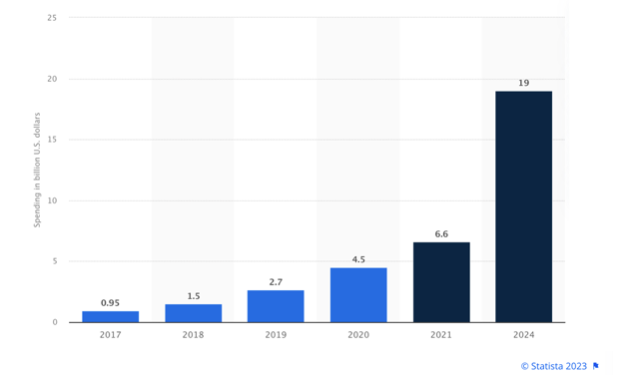
In 2021, Statista and the International Data Corporation (IDC) suggested that spending in the blockchain sector could reach $19 billion annually by 2024.
While the entire sector is currently experiencing a slowdown in crypto adoption cases (partly due to a long bear market), these numbers could still be confirmed by the cross-sector development of blockchain.
From this perspective, Central Bank Digital Currencies (CBDCs) weigh heavily, offering a potentially revolutionary tool for central banks to approach P2P payments, at the expense of cryptocurrencies and physical cash. They do this in a much more significant way compared to other application cases such as DeFi, NFTs, and Autonomous Decentralized Organizations (DAOs).
CBDCs, in fact, could make blockchain the foundation of a new institutional and global payment system, combining the “stability” of fiat currency with the efficiency of cryptocurrencies in transactions. The issue is still open, and while many countries are making progress in their development, like China, Sweden, the Bahamas, and Nigeria, there are also notable drawbacks, such as potentially erasing the principles associated with Bitcoin, particularly concerning privacy and decentralization.
Regardless of these challenges, blockchain seems poised to emerge as the winner, no longer dependent on parallel development in the crypto sector but facing new challenges related to scalability solutions, environmental impact, and regulations.
Despite the automatic association with the crypto sector, blockchain is by no means synonymous with Bitcoin. Instead, cryptocurrencies are just one of the countless applications of blockchain technology.
The fundamental aspect lies in the versatility of blockchain as an innovation in all types of businesses. Its foundations are rooted in “consensus,” “replicability,” “immutability,” and “security.” In other words, it thrives in transactions validated by network participants, database replication to record changes in the network (a key feature of distributed ledgers), the immutability of these changes, and ultimately the security derived from these dynamics.
It’s no coincidence that one of the most popular applications of blockchain is serving as the technological infrastructure for monitoring production chains in various sectors, including logistics, manufacturing, and healthcare.
In the US, Walmart has embraced this technology to promote transparency in the retail sector by tracking the origin and quality of products and identifying potential issues with reliable data. This approach also brings cost-saving benefits by eliminating data reporting and control activities.
Alternatively, blockchain can offer new operational solutions through “smart contracts,” which are self-executing agreements on the network, eliminating the need for intermediaries like regulators or government officials to resolve disputes.
Even more intriguing are the prospects of blockchain technology converging with the traditional financial sector, particularly the “tokenization” of financial assets into “native” or “non-native” tokens. This recreates the assets on a blockchain or issues them once a relevant entity becomes the “custodian,” in an on-chain form (such as NFTs or tokens).
A glance at the World Real Assets (RWA) market reveals a range of traditional investment instruments already migrating to blockchains, including government stocks and bonds, real estate, commodities, and even luxury collectibles. DeFi entities like Backed Finance have launched “tokenized bonds” on Layer-2 Base with the involvement of asset manager BlackRock.
In this environment, significant liquidity flows from Traditional Finance (TradFi) into the crypto ecosystem, and conversely, major international institutions are adopting blockchain technology for investments in tokenization.
At the forefront of this trend is JPMorgan, leveraging its years of experience in blockchain, notably with JPM Coin, and achieving significant results with the first transactions of tokenized stocks used as collateral for OTC derivatives trades, involving entities like Barclays and BlackRock.
Expanding horizons further, there are fundamental developments from the Society for Worldwide Interbank Financial Telecommunication (SWIFT), in collaboration with Chainlink. They are working on transferring cross-chain tokenized assets, creating a global infrastructure for such transactions, prefiguring technology that could revolutionize wealth management in terms of efficiency and costs.
This view is shared by most institutional investors, leading to a multitude of global and national initiatives, including those in Italy.
UBS Asset Management, for example, with its UBS Tokenize pilot project, has already launched a money market fund tokenized on Ethereum, demonstrating the feasibility of adopting one of the industry’s most significant chains. This example is being followed worldwide, starting from Italy.
In this context, it’s worth noting the developments of BlockInvest, a Milan-based fintech startup that has entered into various collaborations with prominent institutions. Specifically, they are working with Crédit Agricole for the tokenization of bonds and minibonds, and with Deloitte for the financing of a dedicated platform for this procedure to offer to institutional clients later on.


 Market and Data
 _old_Become an author
 Wallet


