


From Data Governance to Data Science
In an era where data science, algorithms, and machine learning are part of everyday life, whether we’re talking about businesses or individuals, the data used must be prepared, cleaned, and organized. In this context, data governance plays a role in supporting data science by collaborating with data engineers to structure data architecture, standardizing terms, designing data quality controls, and mapping out data lineage. Data lineage allows for tracking data from its source system to its destination, ensuring its compliance and absence of alteration – a crucial aspect when considering the need to certify both native information (such as demographic data) and calculated data (financial or credit-related, to name a few) present in reports and data delivery tools.
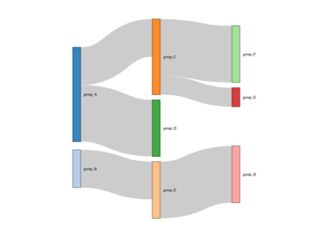
Example of a data lineage represented by a sankey diagram
In summary, data governance’s role is not only to ensure that data for data science is consistent and clean but also to certify it to make analyses and algorithms reliable.
The Role of Blockchain
Blockchain, through Distributed Ledger Technology (DLT), can assist data governance by ensuring the traceability of data considered most significant for the company or institution, safeguarding its distribution and sharing. This would provide certainty that information delivered automatically through reports or business intelligence tools has not been altered at any point in the process, thus certifying the related data lineage. Without a doubt, blockchain also benefits data quality by pinpointing the exact point (system or computation engine) where remediation should take place, following the path outlined by data lineage.
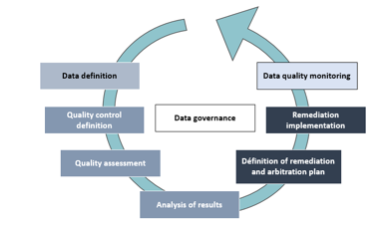
Data quality cycle
For example, in the case of banks and financial institutions sending data to regulators in an automated manner and according to well-known reference standards, blockchain would assure the recipients of data accuracy, excluding any manual or artificial manipulations.
Additionally, in enterprise architectures where data is accessed through Application Programming Interfaces (APIs) using access methods and functions, the blockchain would also guarantee that the obtained data is either native or calculated based on shared parameters and rules.
Open Data and Blockchain
Using blockchain makes the role of data governance simpler in providing open data, thus allowing for certifying and ensuring a quality service for entities, companies, or citizens, increasing trust in its use and encouraging its distribution and sharing.
Open data have an evaluation system based on a star rating (from 1 to 5). Being able to assure the accuracy of data extracted from sources would undoubtedly add value. Therefore, the blockchain not only certifies the source data but also the input system, ensuring the overall validity of the contained information (for example, in the case of recording a traffic accident, there would also be evidence of the device where the information was recorded and the corresponding time of entry). Furthermore, ensuring traceability would also allow keeping track of any steps where the source open data was used to generate new open data, thus obtaining certified data lineage through this mode as well.
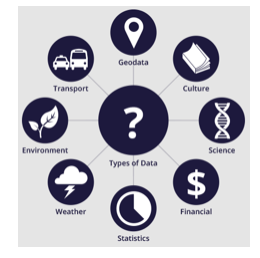
Types of Open Data
Consequently, while in a closed context (whether corporate or institutional), blockchain would help avoid additional costs related to penalties or impacts caused by erroneous data delivery, considering open data as a strategic asset would enable the generation of greater economic (and social) value linked to the creation of new products and services.
Sources:
“The culture of data. Strategies and tools for the future of organisations” – FrancoAngeli editore – Stefano Gatti, Alberto Danese
www.blockchain4innovation.it/esperti/blockchain-perche-e-cosi-importante/
https://arxiv.org/pdf/2112.13956.pdf
tdan.com/data-and-trending-technologies-data-in-blockchain-technologies/22447#/
www.dataversity.net/blockchain-101-next-database-management-evolution/#
https://www.linkedin.com/pulse/blockchain-managing-data-lineage-partha-dutta/



 Market and Data
 _old_Become an author
 Wallet


