


Introduction
The Dencun upgrade marks the beginning of the “The Surge” era in Ethereum‘s roadmap, paving the way for mass scalability through layer two rollups that will make Ethereum more accessible and easier to use, promoting adoption and utility across various sectors, including the so-called DeFi 2.0 (Decentralized Finance).
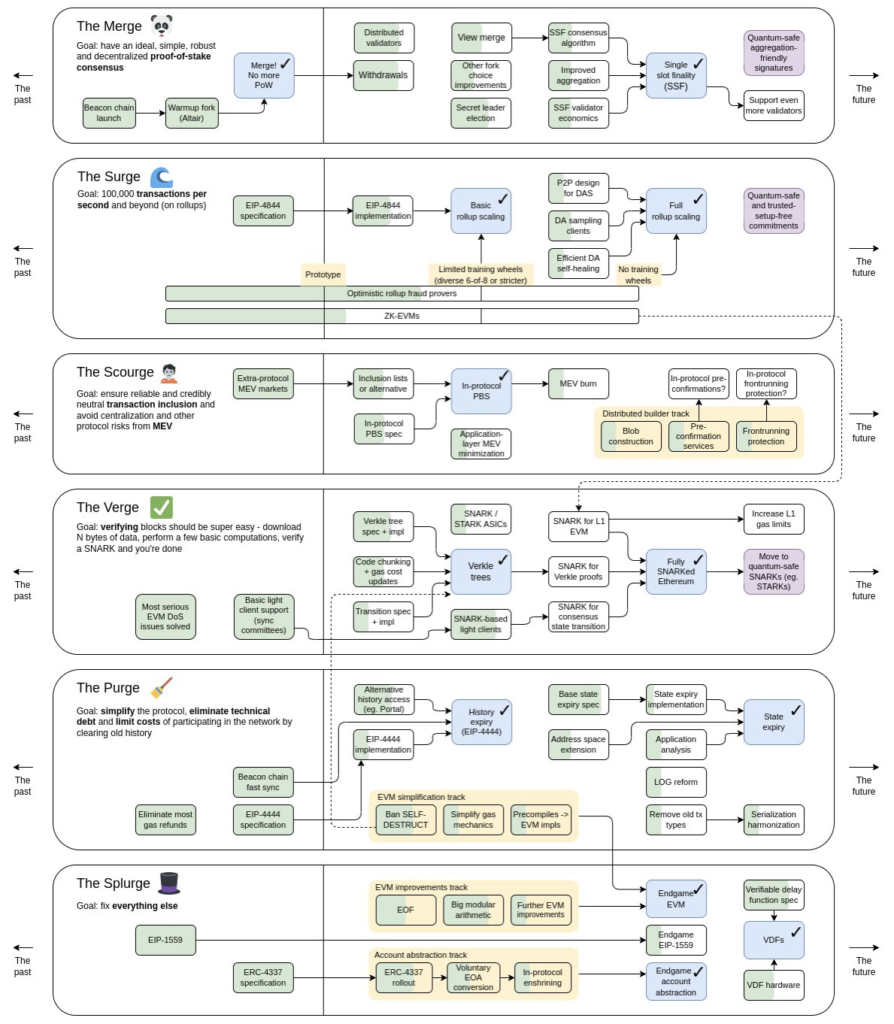
IMG RODAMAP Ethereum SRC Vitalik Buterin
Scalability of Ethereum is one of the major limitations for the blockchain, and attempts to address it have evolved from sidechains and state channels to rollups and sharding.
Rollups effectively tackle scalability on the execution front but fail to address challenges related to data availability. Sharding is the idea that network data can be divided into “shards,” each containing its own set of blockchain data, including balances and smart contracts.
Enter the Dencun upgrade, which concerns Proto-danksharding, a precursor to full danksharding, a type of sharding architecture that divides Ethereum‘s blocks.
(Full danksharding is the ultimate goal.)
What Dencun Entails
Dencun is a mix of the “Deneb” and “Cancun” upgrades and aims to improve Ethereum‘s execution efficiency and data availability within the network, with a particular focus on proto-danksharding.
Proto-danksharding is the first upgrade to achieve full sharding and will make more block space available so that layer 2 scalability solutions can process more off-chain transactions economically.
Dencun focuses on so-called rollups, which are used to execute transactions from Ethereum‘s main chain, handling execution and verification costs and increasing efficiency. But the data underlying such transactions must also be referred back to layer 1.
This becomes costly because it’s processed by Ethereum nodes and generally bulky because the data resides on the blockchain forever. Proto-danksharding introduces a new type of transaction that carries “blobs” or large binary objects. These blobs temporarily store data for short-term transaction verification and discard data to prevent network overload.
Let’s see what this means with an urban planning analogy proposed by Jesse Leclere, an analyst at CertiK. It’s a bit like introducing a new public transportation system into a city, faster and more cost-effective. Currently, Ethereum uses “calldata” for transactions, akin to using taxis for every single person in the city. It works, but it can become quite costly and congested during peak demand. Leclere likens blobs to buses that can carry many people (or data) simultaneously. These blobs will be used by Layer 2, which can be thought of as different neighborhoods or suburbs around the main city. Instead of driving into the city with your own car (as with calldata), suburban residents can now take one of these new buses (blobs). This will save a lot of fuel, not that of cars, but the fees paid for Ethereum transactions. This should make life in Ethereum City and its environs much more enjoyable and affordable.
In addition, Dencun consists of a series of minor upgrades respectively to the Consensus Layer (CL) and the Execution Layer (EL) of Ethereum, in Leclere’s metaphor:
an accompanying improvement to the city’s roads and electrical infrastructure.
Layer-2 rollups improve Ethereum‘s scalability and efficiency by processing off-chain transactions while preserving the security guarantees of Ethereum‘s main blockchain (Layer-1). Let’s summarize their key features:
- Off-Chain Execution: Transactions are processed outside Ethereum‘s main blockchain, allowing for faster throughput and lower costs. There’s no competition for storage space on the main blockchain, favoring greater speed and fluidity.
- Transaction Aggregation: Results of various transactions are grouped into a single compressed form, optimizing blockchain space usage. This reduces congestion and transaction costs for users.
- Publication on the Main Blockchain: Compressed transaction data (rollups) are published on Ethereum‘s main blockchain for verification and validation, ensuring the security and integrity of all transactions.
- Data Availability: Despite off-chain processing, all transaction-related data remains accessible and verifiable by all validators, maintaining transparency and accessibility for the entire network.
- Security: Layer-2 rollups inherit the security guarantees of the Ethereum network. Various cryptographic techniques are used to protect transactions and prevent fraud.
In summary:
Layer-2 rollups offer a solution for Ethereum‘s scalability, combining greater efficiency and speed while maintaining a high level of security.
We’ve briefly seen what the Dencun upgrade entails and how it improves Ethereum. Let’s also recall the steps that led to this upgrade before delving into Dencun:
- December 2020: The Beacon chain was launched, introducing Proof-of-Stake (PoS) and enabling ETH staking, laying the groundwork for Ethereum‘s transition from Proof-of-Work.
- September 2022: The Merge merges Ethereum‘s main network with the Beacon Chain, fully transitioning to PoS.
- April 2023: Marks the Shanghai upgrade, allowing withdrawals of previously staked ETH.
- September 28, 2023: Holesky, Ethereum‘s new public testnet, was activated. Supporting 1.4 million validators, it’s a vital foundation for the Dencun upgrade.
The Dencun upgrade is highly focused on scaling Ethereum‘s data availability portion, which is expected to have a positive cascading effect on transaction costs and speed.
Previous upgrades did not directly address Ethereum‘s scalability issues. The Merge primarily focused on transitioning to a more sustainable and secure consensus mechanism, while the Shanghai upgrade aimed at improving the staking experience.
Both were crucial steps in Ethereum‘s journey but did not directly address scalability.
All Dencun EIPs (Ethereum Improvement Proposals)
Now let’s delve into the Dencun upgrade‘s EIPs (Ethereum Improvement Proposals) attempting to provide a high-level overview of what they mean for Ethereum:
- (EIP-4844) Better Data Availability: Proto-danksharding introduces blob data (Binary Large Objects), improving layer 2 solutions’ throughput and efficiency.
- (EIP-1153) Temporary Data Storage: allows smart contracts to delete intermediate data after transaction completion, reducing overall permanent storage costs.
- (EIP-6780): restricts the SELFDESTRUCT function in smart contracts to specific conditions, improving contract stability and predictability.
- (EIP-5656) Memory Copy Instruction: aims to simplify memory management in the Ethereum Virtual Machine (EVM), leading to more efficient smart contract processing.
- (EIP-4788): makes Beacon Chain block roots accessible to the Ethereum Virtual Machine (EVM) by storing them in a smart contract on the Execution Layer. Essentially, it’s an oracle integrated into Ethereum‘s main network, enabling smart contracts direct access to the network’s consensus state without the need for external oracles.
- (EIP-7045, EIP-7044, and EIP-7514) Better Validator Management and Efficiency: These three EIPs collectively contribute to optimizing the validator lifecycle and operations on the Ethereum network.
- EIP-7045 extends the maximum slot to include validation attestations on the Beacon Chain.
- EIP-7044 simplifies the exit process for validators and ensures their actions remain valid across future forks.
- EIP-7514 limits the timeout for Ethereum validator activations to 8 per epoch to help maintain a stable and manageable validator set size.
- EIP-7045 extends the maximum slot to include validation attestations on the Beacon Chain.
- (EIP-7516) Reliable BLOB Fees: introduces the BLOBBASEFEE opcode in Ethereum, allowing smart contracts to directly access the current base fee for data blobs on the chain. This enables rollup smart contracts to manage and predict data blob costs more effectively.
- (EIP 4844): Proto-danksharding is an upgrade aimed at improving Ethereum‘s scalability and data management. It introduces the concept of transactions carrying blobs, designed to handle large data packets more efficiently than traditional transactions carrying CALLDATA. BLOBs or large binary objects are large data packets (~125 kB) distinct from Ethereum‘s normal calldata, as they’re stored off-chain and referenced in the transaction. Technically, they’re data vectors represented as polynomials, allowing for simple references and cryptographic verifications. The primary goal of using BLOBs instead of CALLDATA is to increase the amount of data that can be included in a block, simplifying processing and storage. BLOBs themselves are stored off-chain, reducing the load on Ethereum.
Benefits of proto-danksharding
Layer 2 rollups are one of the main beneficiaries of proto-danksharding. With proto-danksharding, rollups can use data blobs to publish transaction data in batches more economically, significantly reducing operational costs and improving scalability.
Blockchain efficiency and decentralization are balanced by proto-danksharding. By keeping blob data transient and limiting their size, proto-danksharding ensures that even smaller node operators can still participate in the network.
Ethereum‘s throughput increases as the introduction of data blobs allows for more data to be included in a block without overloading the blockchain.
It’s worth noting that layer 1 sharding is not expected in proto-danksharding.
It does not involve breaking Ethereum‘s network into multiple fragments. It introduces a new type of transaction for handling large data packets, laying the groundwork for full sharding implementation.
What Experts Think
Jesper Nielsen, Chief Operating Officer of Northstake, observed that:
“Previous Ethereum upgrades tended to address limited issues, such as reducing gas price volatility, but stated that EIP-4844 “could take Ethereum to the next level by substantially improving its scalability and efficiency through significantly lower settlement fees. This not only fills gaps but enhances Ethereum‘s core capabilities.” “If EIP-4844 can deliver on its promise of reducing costs by 10 or 100 times as hoped, it could trigger a Cambrian explosion of activity and use cases across Layer 2 networks.”
Jeff Owens, co-founder of the Haven1 Foundation, stated that:
“Dencun introduces a new data format called ‘blob’ transactions, which will allow temporarily storing transaction data at the consensus layer before being deleted.”
“This will make the entire process cheaper and reduce congestion, thus increasing throughput on Layer 2 Ethereum networks like Arbitrum and Optimism, and reducing their fees by up to 90%.” “For now, this only applies to Layer 2: widespread sharding will apply to the same Ethereum network.”
Looking to the future, besides Ether, other Layer 2 blockchains will also benefit from the Dencun upgrade.
Wilfred Daye, CEO of Samara Alpha Management, predicts that Layer 2 networks like Arbitrum (ARB) and Optimism (OP), which aggregate transactions before sending them back to the main chain, will derive significant benefits from the introduction of data blobs.
What to Expect from the Dencun Upgrade?
Faster and more convenient transactions, increased scalability: Ethereum will be able to handle more transactions per second, paving the way for new applications and use cases while maintaining Ethereum‘s security.
In conclusion, Dencun is a crucial step forward for Ethereum and the future of Web3.
With this upgrade, Ethereum is poised to become the premier platform for decentralized applications (dApps) and decentralized finance (DeFi).
For more:
- ETH roadmap: https://ethereum.org/en/roadmap/
- Introduction to Ethereum Improvement Proposals EIP: https://ethereum.org/eips
- EIP-4844: Shard Blob Transactions https://eips.ethereum.org/EIPS/eip-4844
- EIP-6780: SELFDESTRUCT only in same transaction https://eips.ethereum.org/EIPS/eip-6780
Some interesting reading that helped inspire this article:
- https://www.kitco.com/news/article/2024-02-21/ethereums-dencun-upgrade-explained-how-it-could-reduce-ethereum-l2-fees-90
- https://www.coindesk.com/tech/2024/01/30/ethereums-dencun-upgrade-goes-live-on-second-testnet-with-just-one-remaining/
- https://www.coindesk.com/tech/2024/01/25/ethereum-developers-set-timeline-for-final-dencun-testnet-upgrades/





 Market and Data
 _old_Become an author
 Wallet


