


Introduction.
The advent of the Internet has ushered in a new and ever-evolving technological landscape. This evolution has allowed for the realization of highly complex projects, such as renowned e-commerce platforms like Amazon, as well as recent innovations like the Internet of Things (IoT), artificial intelligence (AI), and blockchain. In this article, I will focus on the latter technology, emphasizing its fundamental concepts and providing an overview of the various applications of blockchain in multiple sectors.
What are the uses of blockchain, and, more importantly, how can it contribute to and facilitate digital evolution?
First and foremost, let’s start by defining blockchain, which is a technology that serves as a decentralized, immutable, and persistent digital ledger that operates without a central authority. Unlike traditional ledgers, which focus on a central actor, blockchain is based on a network of interconnected computers, technically referred to as “nodes,” that collaborate to authenticate and validate transactions. This architecture eliminates the need for intermediaries in exchanges, making it extremely secure and transparent to anyone.
Blockchain technology has the potential to radically change existing business models, create new ones, accelerate transactions, and even increase production and reduce costs in various sectors. Furthermore, thanks to its attributes of immutability, traceability, and transparency, blockchain allows for the creation of certified and reliable documents, consequently enhancing trust among all parties involved.
It is evident how this technology aligns perfectly with the previously described scenarios when considering its intertwining with digital innovation. Blockchain creates a solid foundation for the establishment of highly secure digital ecosystems, enabling the automation of various processes and information exchange.
Today, numerous companies have been attracted to the decentralized, secure, and traceable transaction capabilities of blockchain, leading them to redirect their business models towards this technology.
In fact, let’s look at some data:
- According to DevSkiller, the demand for blockchain programming skills has increased by 552%.
- A report by DappRadar and the Blockchain Game Alliance (BGA) revealed that Web3 gaming and metaverse projects raised $7.6 billion, representing a 59% increase compared to the previous year.
It is important to note that these figures are representative of the year 2022, a year in which the cryptocurrency market, closely related to blockchain technology, experienced a declining phase with widespread skepticism.
The proper development in transitioning from Web2 to Web3: The path to follow.
Recent years have witnessed significant progress in digital innovation, giving rise to technologies that have shown the concrete potential to redefine the entire architecture of the web. This new generation of the internet fully embodies and embraces the philosophy and foundations of blockchain and other decentralized technologies.
But what sets Web2, the version we are accustomed to, apart from Web3, and how can the transition from one model to another bring about a significant paradigm shift in the digital era?
Comparison between Web2 and Web3:
The current generation of the Internet, known as Web2, is characterized by hierarchically structured centralized applications. Big technology corporations such as Google, Facebook, and Amazon play a dominant role in this context, maintaining exclusive control and management of user data through obligatory voluntary consent. The main features of Web2 include centralized access, limited transparency, and dependency on intermediaries for transactions, requiring users to place their trust in them.
In contrast, Web3 is based on decentralized technologies like blockchain. In this web model, users become the main protagonists, obtaining ownership and control over their data.
The comparison between the two generations of the Internet highlights a shift from a centralized paradigm to a decentralized one, transferring control power to the users’ favor.
The transition to Web3 and the paradigm shift:
The transition from Web2 to Web3 can bring about a paradigm shift in digital innovation in various aspects:
- Digital sovereignty: Users possess their data and maintain full control over their digital identities. The blockchain offers a secure and immutable infrastructure that allows for self-management of data, enabling users to independently decide how and when to share their information.
- Decentralized economy: This characteristic paves the way for a new economic model based on decentralization and tokenization of assets. For the less familiar, tokenization refers to the process by which a physical asset is represented in a digital token. Decentralized applications (DApps) enable direct interactions between users (peer-to-peer), eliminating the need for intermediaries.
- Open and collaborative innovation: The transition to Web3 fosters open and collaborative innovation. DApps are built on open-source protocols, allowing developers to contribute to the improvement and growth of existing applications. Furthermore, it promotes the creation of dedicated social channels where an entire community based on the project can grow and actively participate. This facilitates the creation of digital ecosystems where ideas and skills converge and flow freely, encouraging innovation and continuous evolution.
- Security and transparency: As mentioned earlier, one of the main purposes of blockchain is to provide a high level of security through its decentralized structure and the use of advanced encryption systems. Data stored on the blockchain is immutable and traceable, reducing the risk of fraud and manipulation. Moreover, the transparency of the blockchain allows all users to verify and control transactions, fostering trust in digital operations.
However, not everything that glitters is gold. Despite its numerous potential benefits, transitioning to Web3 also poses significant challenges, including scalability, management and self-management of digital identity, and compatibility with laws and regulations across the world.
To ensure that the transition from Web2 to Web3 is not only effective but also efficient, it is vital for collaboration to take place among all parties involved, such as companies, developers, regulators, and users. It is of fundamental importance to establish common standards and protocols to promote interoperability between different blockchains and to build a solid, reliable Web3 infrastructure that complies with laws worldwide.
A first step towards initiating this necessary change could be to promote awareness and education about this technology so that users can fully understand the advantages and challenges of this new digital era.
Blockchain: The Cornerstone of Digital Innovation through Decentralization.
Blockchain technology was born in 2008 as the foundation of the cryptocurrency Bitcoin, and since then, its applicability has expanded beyond the financial sector. Today, its presence can be found in various sectors, including trade, logistics, healthcare, and many others, offering improvements in terms of efficiency, transparency, security, cost reduction, and presenting new opportunities. The following are the main reasons why the use of blockchain has become so widespread.
Security and Decentralization.
Thanks to its distributed nature, the blockchain proves to be extremely resilient to failures and attacks by malicious actors. If a node were to fail or be compromised in any way, the remaining nodes would continue their activity regularly, ensuring the availability and integrity of all data contained within them.
In addition to security, the blockchain offers data immutability. This means that once data is recorded within a node, it becomes permanent and cannot be changed in any way. Essentially, no one can access it and modify or alter it without the consensus of the majority of the network. This characteristic ensures transparency and integrity of information, instilling trust in the entire system.
Elimination of Intermediaries.
Another significant advantage of blockchain is the elimination of intermediaries or central authorities in data management. On the contrary, we are accustomed to a model in which three main actors are present:
- The owner: Generally, the individual or company that owns and manages the platform.
- The advertiser: Usually an individual or company that pays to advertise their product or service on a platform.
- The user: Those who make use of the platforms offered by the owners.
In this model, the product used by users depends entirely on the actions and decisions of a single actor, the owner. By eliminating intermediaries, the number of actors decreases to two, where both are essentially users (peer-to-peer model), and the product grows and adapts based on the interests of the entire user community.
Furthermore, the security and distributed nature of the blockchain allow organizations to collaborate and exchange value directly and transparently, reducing costs associated with mediation.
Consensus Algorithms.
When discussing blockchain, it is inevitable to refer to consensus algorithms. These procedures are the core of the blockchain and its security, as they ensure the validity and integrity of all data recorded on it.
Among the most popular consensus algorithms, we find Proof of Work (PoW) and Proof of Stake (PoS):
- Proof of Work (PoW): Introduced with Bitcoin, Proof of Work is used to confirm new transactions and produce new nodes. The confirmation process involves requiring “work” from one of the two parties, which is then verified by the entire network. When referring to “work,” it means the search for a value called a “nonce,” which, once combined with the data of a block, creates the hash code. Consequently, the party with the most computational power is also the one most likely to find that value.
- Proof of Stake (PoS): Proof of Stake, on the other hand, is a consensus algorithm based on participation in the network. The operation is straightforward: those who want to participate in the network lock (stake) N tokens as collateral, and the protocol randomly assigns the right to validate the next node to one of the participants, thereby obtaining transaction fees.
As both consensus algorithms, they ensure the validity of data and the uniform distribution of the ledger among the various nodes. Thanks to consensus algorithms, the blockchain guarantees inviolability, transparency, and the elimination of the need for intermediaries.
Decentralization as a Competitive Advantage.
It is well known how competitive the world of work is in order to beat the competition. Being the first to bring an innovative product or service to the market or improving an existing one is necessary, but easier said than done, isn’t it? Well, in the world of technology, there is another small possible solution: integrating new technologies into your business model.
Incorporating new technologies into your business model is essential to remain competitive in the world of work. This has always been the case, and it is even more true today with cutting-edge technologies like blockchain, which allows for process optimization, improved efficiency throughout the production process, and the creation of new opportunities through Smart Contracts.
It is necessary to dedicate a small digression to Smart Contracts to make this point understandable to all readers. Smart Contracts are nothing more than algorithms, pieces of encrypted code, usually written in Solidity, used to automate the execution of a specific agreement described within the code. By implementing a Smart Contract in every contractual phase of any process or intention, both parties involved can be certain of the correct execution of the contract.
Obstacles and Limits of Blockchain: A Path to Follow.
Despite the enormous potential of blockchain and its ability to revolutionize various sectors, the road to widespread adoption is filled with technical challenges to overcome. This section highlights the main limitations of blockchain technology, possible solutions, and the contribution that stakeholders can offer to overcome these challenges.
Concrete Regulation: The Foundation for Safe Mass Adoption.
In an era dominated by technological acceleration, increasing digitization, and the emergence of new technologies, it becomes essential to establish a solid regulatory framework to guide and control these developments. This concrete regulation, understood as a set of rules, guidelines, and standards, serves as the foundation for the safe mass adoption of these technologies.
The revolutionary potential of blockchain lies in its ability to guarantee transparency, security, and traceability of transactions. This creates an environment of digital trust that can overcome geographical and organizational barriers. Concrete regulation should first establish security and guarantee standards for transactions executed on the blockchain. A good regulation should also include provisions for the proper everyday use of cryptocurrencies.
Another crucial aspect of blockchain regulation concerns the prevention of illicit activities. To achieve this, transaction control mechanisms and Know Your Customer (KYC) and Anti-Money Laundering (AML) procedures may be necessary. Digital financial crimes such as money laundering exploit these new technologies. It is worth noting that the estimated global amount of money laundering is about $2 trillion per year, a figure that nearly matches the GDP of our beloved country.
Tokens like Monero (XMR) continue to raise controversy due to their anonymous nature. These privacy coins have often been used to finance terrorism or launder money. It is evident to all readers that concrete, consistent, and non-contradictory regulations must be in place worldwide.
To address the aforementioned issues, the EU, in order to ensure traceability of crypto-asset transfers, proposes MICA (Markets-in-Crypto-Assets Regulation), which will be applied to all 27 member states. This new regulation will introduce a comprehensive legal framework that dictates the regulatory requirements for all cryptocurrency-related services. To achieve this, MICA will focus on the following areas of competence:
- Issuance and trading of crypto-assets.
- Authorization and supervision of crypto-asset service providers and issuers of tokens in relation to assets and electronic money.
- Consumer protection.
- Prevention of market abuse.
There is much to say about cryptocurrency regulation and MICA, but it is best to leave these matters in the competent hands of those operating in the sector in order to fully grasp the benefits and challenges of this new digital era.
Energy Efficiency: Tackling the Challenge of Energy Consumption.
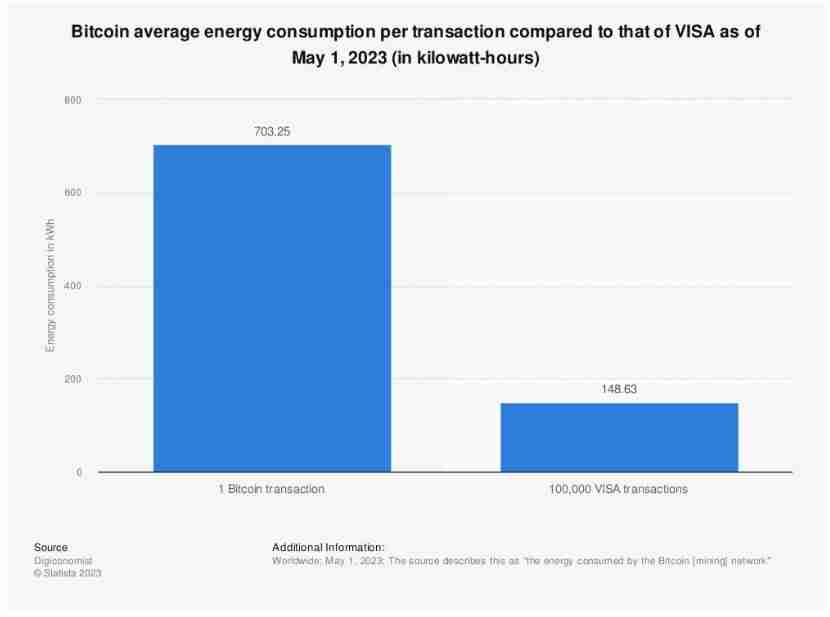
The advent of Bitcoin has brought forth as many opportunities as it has challenges, and among them is the challenge of energy efficiency. Unfortunately, mining 1 BTC requires a significant amount of energy expenditure. The Bitcoin Energy Consumption Index by Digiconomist estimates that a Bitcoin transaction consumes approximately 1,544 kWh to be completed (as of 2022 estimate). To put this into perspective, it would be equivalent to about 53 days’ worth of energy for an average US household.
In order to understand the evolution of the problem, below is a representative graph depicting the energy consumption of Bitcoin, considering the period from February 2017 to May 1, 2023.

I would like to draw your attention to an important graph that highlights the difference in average energy consumption per transaction between Bitcoin and VISA. Statistics updated as of May 1st, 2023.
Many researchers in the field are working to solve this problem, and several solutions have been proposed, from more efficient mining algorithms to the use of renewable sources to perform all the computational operations required to validate transactions on the BTC network.
Although we have praised Bitcoin and Blockchain for their undeniable qualities of security and transparency, it is undeniable that there are still many challenges to overcome before achieving widespread adoption of this incredible technology.
Technological Complexity: An Obstacle to Overcome.
Blockchain is a complex technology that requires specialized technical skills to be implemented and managed correctly. This complexity can be a challenge for small and medium-sized enterprises that may not have the resources to train or hire blockchain experts.
The Role of Stakeholders in Addressing Challenges.
As mentioned at the beginning of the article, to effectively tackle new challenges and improve existing solutions, a concrete and coordinated effort is required from companies, researchers, and users. Each actor has a fundamental and distinct role in the optimization and mass adoption of blockchain.
For example, companies, by investing in research and development, can constantly propose innovative solutions or enhance existing ones.
On their part, users can adopt the blockchain over centralized solutions, contributing through the development of projects they regularly use via appropriate community channels. They can also participate as nodes and participants in consensus algorithms to assist in the management and security of the network.
Conclusion: Blockchain and the Future of Digital Transactions.
In conclusion, we can say that digital innovation and blockchain are driving a fundamental transformation from the era of Web2 to the era of Web3, offering greater security, transparency, and control over data and transactions. Once energy efficiency is achieved, along with effective and up-to-date regulations in a collaborative approach among developers, companies, institutions, and end-users, the blockchain will finally be able to fully express its potential. We are moving towards a future where the blockchain will be at the center of digital transactions, bringing constant innovation and broader decentralization, leading to a more autonomous, secure, and transparent digital future.


 Market and Data
 _old_Become an author
 Wallet


