


Where does the idea of Bitcoin come from?
The intuition behind cryptocurrencies is rooted in the desire to create applications that protect users’ privacy and freedom, taking power away from governments and giving it to citizens. Cryptocurrencies are undergoing a rapid evolution, making it increasingly difficult to understand which direction they will take. However, we must keep in mind that what is happening today is the result of decades of work and in-depth study. Before analyzing the birth of Bitcoin and cryptocurrencies in general, we need to understand what happened from a historical, sociological, and technological perspective in the preceding years, starting with the development of cryptography.
Until the 1970s, cryptography was mainly practiced by military organizations and spy agencies. With the publication of the text “New Directions in Cryptography” (by Whitfeld Dife and Martin Hellman), things changed. Before then, no written materials had been divulged on the topic. In the 1980s, David Chaum, a well-known American computer scientist and cryptographer, began to address topics such as anonymous digital money. He is the inventor of E-cash, an electronic payment app that aims to preserve the user’s anonymity (we are in 1983!). Chaum believed that the privacy of transactions was essential to guarantee democracy. And perhaps he was right. All the innovative ideas concerning these issues led, at the end of 1992, to the birth of a small group that began to meet monthly at Gilmore Cygnus Solutions in the San Francisco Bay Area.
The union was humorously defined as Cypherpunk, a crasis between cypher, meaning cipher or code, and cyberpunk (the literary and artistic movement of the 1980s).
Cypherpunks can be defined as activists who aim for social and political change through the use of computer cryptography and respect for privacy. Their main goal is to take power away from governments and return it to individual citizens.
Historical and philosophical-economic thought
The Austrian School of Economics is a current of economic thought that developed in Austria in the 19th century. Austrian economists are known for their libertarian positions and their opposition to Keynesian policies. In particular, many Austrian economists see Bitcoin and cryptocurrencies in general as a form of money free from state interference and as a form of money that can be used to protect individual privacy and freedom.
Austrian economists argue that the free market is the best mechanism for allocating resources and producing goods and services. In this context, Bitcoin represents a form of money free from state interference and manipulation by central banks. They emphasize the importance of prices as signals for economic operators and argue that state intervention in the market can cause distortions and inefficiencies. In relation to Bitcoin, Austrian economists argue that the decentralized nature of cryptocurrencies allows prices to faithfully reflect supply and demand, without artificial interference.
Austrian economists criticize Keynesian theory and argue that increased public spending and reduced interest rates cannot stimulate long-term economic growth. In this context, Bitcoin represents a currency that does not depend on government and central bank monetary policies but is based on market demand and supply. Moreover, being decentralized, it does not depend on a single entity that controls it and guarantees its stability, but its stability depends on users’ trust and the strength of its network.
Austrian economists also argue that central banks that manipulate interest rates can cause speculative bubbles and economic imbalances. In this sense, Bitcoin does not depend on monetary policies and therefore cannot be manipulated by a single entity, making it less susceptible to speculative bubbles.
In general, Austrian economists view Bitcoin as a form of money that can protect individual freedom and privacy, and can operate in a free market without state interference. However, it is important to note that the Austrian school does not represent the unanimous view of economists, and there are some who have expressed doubts about the long-term sustainability of Bitcoin.
In contrast…
The Keynesian theory, developed by the English economist John Maynard Keynes, argues that active state intervention in the economy can help stimulate economic growth and reduce unemployment. The Keynesian theory is based on the idea that in periods of recession, increasing public spending and reducing the interest rate can increase demand and stimulate the economy.
In relation to Bitcoin, Keynesian theory could be seen as contrasting. Bitcoin is a decentralized currency and does not depend on the monetary policies of governments and central banks. Additionally, being a digital currency, it does not depend on physical laws such as the amount of money in circulation. Keynesian economists may argue that the government should intervene to regulate cryptocurrencies like Bitcoin to prevent fraud and protect investors. However, the decentralized nature of Bitcoin could make effective regulation difficult.
In general, Keynesian theory and Bitcoin represent two different views of the economy and the role of the state. While Keynesian theory advocates for active state intervention to stimulate the economy, Bitcoin represents a currency that does not depend on state policies and is based on market demand and supply.
First steps.
The first members of the group worked elbow to elbow in a climate of collaboration and great intellectual fervor.
In 1997, Adam Back, a cryptographer and cryptohacker, created Hashcash: a mechanism designed to limit email spam, later reused as part of the algorithm for mining bitcoin and other similar cryptocurrencies. Later, in 1998, Wei Dai published the proposal to create b-money, a practical way to enforce contractual agreements between anonymous users. The concepts he presented would later be taken up and used in the Bitcoin project. Ten years before Satoshi, another computer scientist, cryptographer, and researcher, Nick Szabo, began conceptualizing and programming a decentralized monetary system. Szabo worked on the Bit Gold currency until 2005. The idea was to overcome some problems related to so-called legal currencies (such as the dollar), such as the fact that they are subject to numerous risks, including inflation. However, Bit Gold never saw the light of day.
The engine is the 2008 crisis.
The creation of Bitcoin strengthened the entire cypherpunk movement, as it allowed entities like WikiLeaks to continue operating thanks to donations in bitcoin, even after the banking block that excluded the organization from the global financial circuits.
Many clues suggest that some cypherpunks may be hiding under the name Satoshi Nakamoto, the inventor of Bitcoin. In fact, the structure of Bit Gold is the one that comes closest to Bitcoin of all other existing or only theorized cryptocurrencies. The innovative ideas that were initially set aside due to technical difficulties and other contingent reasons suddenly came back to life through the Bitcoin project, immediately after the financial crisis of 2008. Satoshi, or whoever he is, took up and perfected the work of his predecessors, quickly realizing what has turned out to be the cryptocurrency par excellence. In the Cypherpunk Manifesto by Eric Hughes, it reads:
“Privacy is necessary for an open society in the digital age. We can’t expect governments, corporations, or other large, faceless organizations to grant us privacy. We must defend our own privacy if we expect to have any. Cypherpunks write code. We know that someone has to write software to defend privacy, and we’re going to do it.”
The technology
Here’s the future! This extraordinary technology, which many consider so important as to compare it to the internet, is based on cryptography and is secure and inviolable. So there’s no trust problem. Blockchain technology can be defined as an online data registry, a sort of inviolable ledger where any type of information is recorded. Its functioning eliminates the problem of trust in other elements of the network.
Here’s how it works with bitcoin. A Blockchain transaction database is an MIT-licensed protocol (created by the Massachusetts Institute of Technology), so it’s an open-source program (anyone can work with it if they’re capable) and free. This allows the Bitcoin Core software to be easily downloaded onto a PC. Having it available is equivalent to having the entire ledger of bitcoin transactions at your fingertips with a click.
The blockchain is the true beating heart of Bitcoin. Without it, this cryptocurrency would be just a number without value. To better understand, keep in mind that the ledger pages are defined as blocks, and each block records multiple operations. Furthermore:
All members of the Bitcoin network around the world keep the entire chain of blocks with all executed transactions. New blocks are added gradually at the end of the chain. When added, they are considered verified and no longer modifiable. The blockchain is based on cryptography, so mathematical laws determine the system‘s operations, ensuring that everything works and nobody cheats. Remember that the values and information written inside the blocks cannot be modified once the transaction is confirmed. At the moment a transaction is processed, every node in the network that participates in the system updates the register: this is the reason for its inviolability.
The role of miners.
Bitcoin transactions are confirmed by miners. These are individuals who use specific hardware to mine and provide their computing power to keep the entire system running. No node in the network keeps track of the balance of different wallets: the ownership of a certain amount of bitcoin is demonstrated by all previous transactions. The number of bitcoins within a single wallet is, therefore, the result of incoming and outgoing transactions, and the difference between the two values generates the wallet’s bitcoin balance.
A thousand applications.
As we have already emphasized, Blockchain can be employed in multiple sectors, not only for managing payment methods. This extraordinary technology, which many believe has a revolutionary scope as much as the Internet, solves a huge problem that has always plagued us: trust. It allows, for the first time, the transfer of a digital product, ensuring its uniqueness, without needing to trust a third party. Let us give an example: an .MP3 format song can be duplicated infinitely many times, and each copy will be identical. It will not be possible in any way to trace the original.
Blockchain can do the opposite, it can move a digital product, in our case a cryptocurrency, guaranteeing that it is precisely and only that one, with its documented, certified history, and without the possibility of error. As we can well imagine, a register of this type could keep track of all the ownership transfers of an apartment, storing notarial deeds. We can imagine how many applications it could have. One of the many uses of Blockchain provides the possibility of digitizing people’s identities. It will serve to provide advanced services to citizens, such as electronic voting, access to digital administration, online residency certificates, tax payments, refund requests, and so on.
And this is just one of the many possible uses of this technology that will shake up the near future.
Theories in comparison.
The blockchain system eliminates control centers, putting all the parties involved on the same level. Let us discover which rules it will break… The Blockchain technology is based on a system of rules (or governance) different from those we are used to. To understand even better why the invention of Blockchain is so powerful, let us first define which governance it breaks down, and therefore of which set of rules it is a promoter.
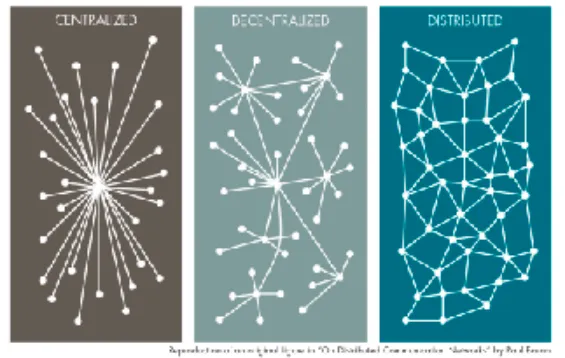
We are talking about centralized logic, decentralized logic, and distributed logic.
Centralized logic.
Centralized logic is represented by the traditional Centralized Ledger: a system in which everything is managed by referring to a central authority. Trust is in the authority, in the system‘s authority at the center of the organization. As it happens with our government.
Decentralized logic.
In decentralized logic, there are multiple local command centers. Trust is delegated to a central but closer subject. Then there is coordination between the different authorities. Let us think about our regions.
Distributed logic.
Distributed logic refers to the concept of distributing power and control among many different entities in a system, rather than concentrating it in a single centralized authority. In this model, decisions are made by a group of participants and not by a single authority, and it is designed to function autonomously and independently.
Distributed logic differs from decentralized logic because, while decentralization focuses on distributing power and control in a system, distribution focuses on the physical distribution of resources and information in a system. In the world of cryptocurrencies, distributed logic is the basis of the functioning of cryptocurrencies themselves. For example, Bitcoin uses a distributed consensus system called Proof of Work (PoW) that allows all components to participate in the creation and verification of transactions.
The system is designed to operate autonomously and independently, without the need for a central authority to control it. Distributed logic is often associated with the resilience and robustness of the system, as it does not depend on a single source of authority and all resources and information are fairly distributed among participants. The governance system is built around a new concept of equality among parties. No one can prevail.




 Market and Data
 _old_Become an author
 Wallet


