


Innovation is the driving force of human progress, a catalyst that pushes us to explore uncharted territories, overcome challenges, and create a better future. It is essential to approach innovation with curiosity and an insatiable desire to learn, for it is through this mindset that we can pave new paths and transform the present. As American psychologist Daniel Goleman famously stated: “Innovation and insight flourish when our minds are in a state of greater openness.”
We should not fear innovation but embrace it as an integral part of our history and evolution. Looking back, we see how every great advancement was driven by the boldness of those who dared to challenge the status quo and embrace new ideas. It is this spirit of openness and courage that enables us to adapt to changes, embrace the exponential growth of new technologies, and create innovative solutions for today’s and tomorrow’s problems.
Specifically, exponential growth is a mathematical phenomenon that occurs when a quantity grows proportionally to its current size, demonstrating that the rate of growth increases as the quantity becomes larger. Futurist Ray Kurzweil, with his “Law of Accelerating Returns” (2001), asserts that the rate of technological progress is exponential and not linear, and that each new advancement enables various higher-level advancements.
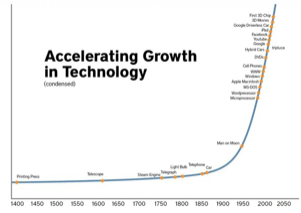
Source: https://www.chartwellspeakers.com/speaker/john-nosta/
Now imagine applying this law to Web 3.0 and understanding the growth potential of this sector, and especially how it can impact our daily lives, making the “human-machine” synergy increasingly understood. Web 3.0 has emerged as a network where content and services no longer reside on servers and platforms owned by centralized entities but are homogeneously distributed across the network. Its philosophy aims at democratization, giving users control over their data, even up to monetization. The undisputed protagonist of Web 3.0 and the main reason for its fame is Blockchain.
Blockchain has permeated many sectors of our era: from the financial sector (payments, exchanges, etc.), through art and music (NFTs, smart contracts), the education system (authenticating titles and certificates), the electoral voting system, to the buying and selling of cars, etc. We can no longer close our eyes to the advent of this technology; instead, we must approach it with curiosity, humility, and recognition of its transformative nature.
One sector that could benefit from this technology, which is not yet fully explored but has much growth potential, is healthcare.
Why use blockchain technology to innovate the healthcare system?
Introducing innovation in such a conservative sector as healthcare might seem tortuous, but it is equally challenging and complicated to remain immobile in the face of evident potential benefits inherent in the technology. Despite the technology’s greater fame being tied to cryptocurrency applications, blockchain carries a promise that, if understood and embraced, can lead us to a revolution in data management: the decentralization of the data economy.
“Data is the new oil!” “Yes, but Blockchain is democratic.” As British mathematician Clive Humby said in 2006: “Data is the new oil,” the market today is dominated by big companies that accumulate and monetize vast amounts of data. According to some estimates, the Big Data analytics market will exceed the $100 billion mark by 2027, with global spending reaching $500 billion by 2024.
Blockchain’s promise is to return control to the user over how their data is managed, shared, and used. It is precisely data management in the healthcare sector that makes blockchain so suitable for developing solutions.
Our National Health System faces several issues due to patient management, lack of funds and personnel (as well as psychological problems such as burnout syndrome), excessive bureaucracy, etc. A crucial but often overlooked problem for the system’s proper functioning is the doctor-patient relationship. Studies have shown that a lack of a healthy and satisfactory doctor-patient relationship results in:
- Poor therapeutic compliance or treatment abandonment;
- Greater patient dissatisfaction with the service provided;
- Poor patient collaboration regarding their medical condition;
- Lack of trust in their doctor and the National Health System.
On the other hand, the effects on healthcare professionals exposed to poor relational and management quality with patients and their conditions include:
- Development of burnout syndrome;
- Possible lawsuits from patients and/or families.
In this context, Blockchain could provide a new model compared to Health Information Exchanges (HIE), making data management more efficient, disintermediated, and secure, placing the patient at the center of the care process, and reducing healthcare professionals’ stress.
Differences between HIE and Blockchain implementation in the National Health System:
Health Information Exchanges:
- Centralization: Creation of a trust network dependent on HIE, acting as an intermediary in data sharing;
- Increased costs for both patients and healthcare personnel;
- Importance of the Master Patient Index (MPI): Need to synchronize multiple patient identifiers between systems while ensuring privacy;
- Limited access to population health data;
- Undefined rules and authorizations: Inconsistent and non-uniform regulations prevent healthcare organizations from accessing patient data securely.
National Health System + Blockchain:
- Decentralization: One of Blockchain’s more or less utopian promises is decentralization. In this context, an intermediary (HIE) would not be required because all network participants would have access to the distributed ledger, ensuring secure information exchange in a trustless manner.
- Cost reduction: Introducing blockchain in healthcare can significantly reduce costs. By reducing the risk of errors and data duplication, healthcare providers can optimize the use of time and resources (also reducing the risk of psychological pathologies such as burnout). Additionally, eliminating intermediaries in the healthcare system can result in financial savings for both patients and healthcare providers.
- Distributed frameworks for MPI: The distributed framework for patient digital identities, using private and public identifiers protected through encryption, creates a more secure method for protecting patient identity.
- Distributed and secure access to patients’ longitudinal health data through the distributed ledger.
- Smart contracts for defined regulation: Smart contracts create a uniform rule-based method for accessing patient data, which can be made accessible to certain healthcare organizations.
Below are some current applications of Blockchain in the healthcare system:
- Creation of Electronic Health Records (EHRs): This refers to the digital version of a patient’s entire medical history. These records contain data on a patient’s illnesses and treatments, providing a holistic view of their health status. Using these tools within a Blockchain creates decentralized and secure medical data storage, putting the patient at the center of the care process, reducing the bureaucratization of the healthcare system, and giving patients greater control over the sharing and management of their data.
- Drug traceability: How often have we wondered about the origin of a medication we take without finding an answer? In this context, Blockchain acts as a “tracker” that follows the drug’s journey from manufacturer to consumer, verifying its authenticity and avoiding counterfeiting. Blockchain is used as the basis for a supply platform where all steps of the drug supply chain are securely tracked, providing consumers the ability to identify, track, and verify the products they are about to take.
- IoT security for remote patient monitoring: Today, many IoT devices are used for remote monitoring of patients’ medical conditions by collecting sensitive data from monitoring devices. Blockchain encryption ensures that only authorized parties can access the data, while its decentralized nature protects against DDoS (Denial of Service) attacks, ensuring that devices can operate securely and reliably.
- Use of DAO (Decentralized Autonomous Organization) for the treatment and monitoring of diseases requiring a multidisciplinary approach: DAOs allow healthcare providers to have a holistic and integrated view of some diseases that require a multidisciplinary approach to care.
- Improving interoperability between healthcare providers: Through a decentralized system, sharing patient data among different organizations is made simpler and more secure. Greater interoperability leads to better coordination between systems and improved patient outcomes.
Source: Canva Created by me
Integrating blockchain technology into the healthcare sector is leading to a secure and transparent future. This progress signifies a significant change in how our healthcare system operates, offering greater efficiency and reliability in the process. Our task is to continue exploring, learning, and creating possible blockchain applications in healthcare and other sectors, aware that we are moving toward a future where healthcare is not only safer but also more effective and accessible to all.
Sources
Argentero, P., Bonfiglio, N. S., & Pasero, R. (2006). Il burnout negli operatori sanitari volontari. G Ital Med Lav Erg, 28(3), 77-82. (link: https://www.puntosicuro.it/_modules/download/download/080128_Burnout_operatori_sanitari.pdf)
Balint, M. (1964) Medico, paziente e Malattia, Franco Angeli 2014 (link: https://www.simpitalia.com/medico-paziente-e-malattia/)
Campanella, P., Lovato, E., Marone, C., Fallacara, L., Mancuso, A., Ricciardi, W., & Specchia, M. L. (2016). The impact of electronic health records on healthcare quality: a systematic review and meta-analysis. The European Journal of Public Health, 26(1), 60-64.
Cannavo, M., Fusaro, N., Colaiuda, F., Rescigno, M., & Fioravanti, M. (2017). Studio preliminare sulla presenza e la rilevanza della violenza nei confronti del personale sanitario dell’emergenza. Clin ter, 168(2), e99-112.
Humby, C. (2006). Data is the new oil. Proc. ANA Sr. Marketer’s Summit. Evanston, IL, USA, 1.
Kurzweil, R., Richter, R., Kurzweil, R., & Schneider, M. L. (1990). The age of intelligent machines (Vol. 580). Cambridge: MIT press.
Minoli, D., & Occhiogrosso, B. (2018). Blockchain mechanisms for IoT security. Internet of Things, 1, 1-13.
Zhang, Y., & Wen, J. (2017). The IoT electric business model: Using blockchain technology for the internet of things. Peer-to-Peer Networking and Applications, 10, 983-994.
https://www.sciencedirect.com/science/article/pii/S266660302100021X
https://www.ncbi.nlm.nih.gov/pmc/articles/PMC9000089
https://builtin.com/blockchain/blockchain-healthcare-applications-companies


 Market and Data
 _old_Become an author
 Wallet


