



Blockchain technology is one of the most significant innovations of recent years, with an impact that extends beyond the world of cryptocurrencies. Its ability to create decentralized, secure, and transparent ledgers has caught the attention of businesses and governments, aiming to improve efficiency and security in processes. It can be asserted with absolute certainty that this technology will have a revolutionary impact previously seen only with the creation of the internet and even before electricity.
Gone are the days when, in 2008 following the economic disasters caused by the Lehman & Brothers speculation and not only in the USA, a whitepaper by Satoshi Nakamoto on a decentralized system based on a distributed ledger, namely blockchain technology, emerged. This technology would allow ordinary people to exchange value without intermediaries and especially without the use of inflationary currencies, controlled by centralized entities that cyclically, for at least 5000 years, have always caused economic, geopolitical, and even war-related imbalances.
Bitcoin, the first cryptocurrency, was born with noble purposes (e.g., digital exchange of goods and services without intermediaries, decentralized, secure, accessible to the public blockchain, and transparent) and has demonstrated the potential of blockchain technology, with significant growth over the years. Its market capitalization and price have reached record levels, attracting the interest of investors and speculators, thanks to its deflationary nature, rarity, and intrinsic value as digital gold.
However, it is relevant to note the currently highest price reached by Bitcoin: $74,000.
It was reached before the Halving (i.e., the halving of the amount extracted every 4 years per single block in the blockchain), this anomaly does not find confirmation in previous Halving processes and could be connected to behavioral changes of investors, such as: institutional ETF funds, shifting from BTC largely to meme coins instead of Ethereum.
Below is the chart showing how the price reached its peak only after the Halving and not before.
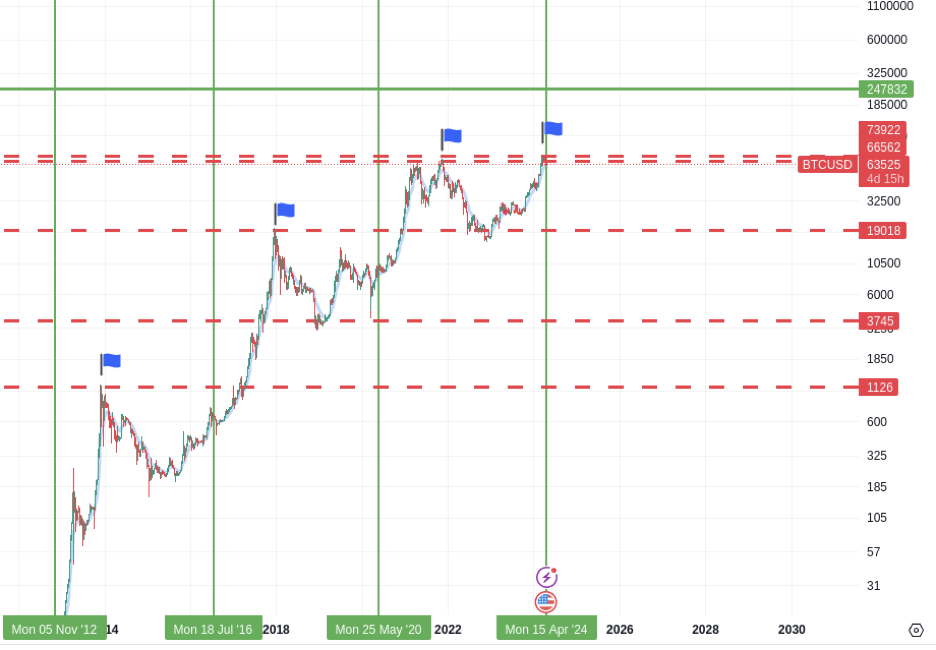
Chart developed on tradingview.com
https://www.tradingview.com/chart/BTCUSD/PE4cmFkA-Pre-halving-bitcoin-anomaly/
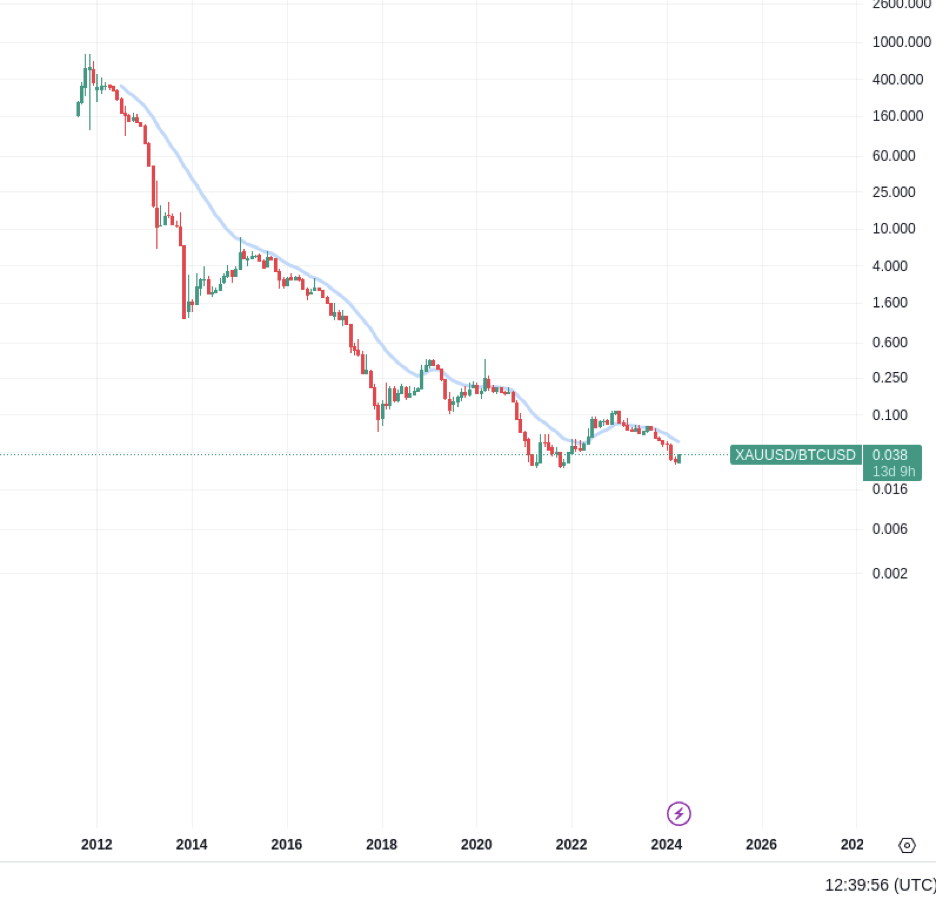
The chart represents the price growth trend of Bitcoin, but upon closer analysis, it can be understood that, besides providing a forecast estimate of price development, it can represent an economic indicator. Therefore, the chart indicates the representation of the BTC/USD ratio; the continuous upward accelerations of the curve indicate that Bitcoin is growing and worth more and more compared to the USD, which loses significantly and continuously against BTC. This condition can be represented by the GOLD/BTC ratio indicator.
The GOLD/BTC indicator shows, in fact, that gold (in the numerator) and Bitcoin (in the denominator of the ratio) only move downward, meaning gold loses value against Bitcoin. In 2012, about 1000 BTC were needed to buy an ounce of gold; today, instead, to buy an ounce of gold, only 0.038 Bitcoin is sufficient, all purged by the presence of a FIAT currency like the USD.
If the previous observations put Bitcoin in a positive light, negative evaluations are certainly not lacking. In fact, being considered as digital gold and not as a currency, also undergoing continuous price fluctuations (volatility), it cannot be easily used as a digital payment method (e.g., USDT, USDC, EUR, USD, or other stablecoins).
At the base of Bitcoin is the blockchain technology, which has the potential to revolutionize the world of digital payments. Blockchain-based transactions offer significant advantages over traditional payment methods, being faster, cheaper, and more secure. Furthermore, the decentralization of blockchain technology allows eliminating intermediaries, reducing costs, and increasing efficiency.
Despite the Bitcoin protocol bringing innovations with the Lightning Network (a layer 2 solution for high-speed, low-cost commercial transactions), the system struggles to take off precisely because its value is so volatile that it continues to affect the payment in USD equivalent.
The Digital Euro, the CBDC (Central Bank Digital Currency) of the European Union, is another example of the evolution of digital payments that use as a basis the concept of stablecoins from the world of cryptocurrencies, such as USDT and USDC. The Digital Euro will be a digital version of the euro, issued and managed by the European Central Bank. This CBDC will offer the advantages of blockchain technology, increasing the efficiency and security of digital payments, although cryptocurrency decentralization maximalists highlight the issues related to centralization in the hands of a single entity (ECB) that issues and manages it in a centralized manner.
The goal of using cryptocurrencies is to change the financial world, which now shows itself to be a giant with feet of clay. It will be up to politics, in fact, to try to design a CBDC capable of maintaining privacy, protecting data, guaranteeing private ownership rights over such digital currencies, and, no less importantly, avoiding the creation of an inflationary currency.
The design of a deflationary digital currency, or at least not inflationary like current currencies, could be based on an algorithm that takes into account a basket of commodities, bitcoin, algorithmic stablecoins, and/or other components, which could mitigate any inflationary effects.
Another complex issue concerns sector regulation. Governments and financial institutions must work together to create a regulatory environment that promotes innovation and growth in cryptocurrencies and blockchain technology. Furthermore, greater collaboration between companies and developer communities is needed to create innovative and sustainable solutions, avoiding “persecution” by institutions in any way, as happened with Coinbase, XRP (Ripple), and most recently UNISWAP, where the possibility of finding a technical framework followed by a regulatory framework was not exploited. To date, this is proving difficult to implement, especially in DeFi (Decentralized Finance).
In this regard, it is worth remembering that the world of cryptocurrencies has recently been shaken by the legal battle between UNISWAP Labs and the United States Securities and Exchange Commission (SEC). The SEC claims that UNISWAP, a decentralized exchange (DEX), violated securities laws by not registering its offerings. 1
The case between UNISWAP and the SEC represents a significant development in the cryptocurrency industry. The SEC’s allegations raise crucial questions about the responsibilities of decentralized platforms and the need for clear and concise information. Although UNISWAP has denied the allegations, the case highlights the challenges of regulating the cryptocurrency industry and the need for clear guidelines to protect investors. 2
A careful analysis focuses on the further concept of the UNI utility token present on the platform. For the SEC, this token should be considered as a stock, that is, a nominal and unitary value representative of the UNISWAP company; but in reality, the value, management, and possession of it depend not on UNISWAP’s commercial development and growth actions but solely and exclusively on the holders (that is, the customers who buy, sell, and exchange it).
It is precisely this circumstance that increases or decreases the value. For this reason, even though UNISWAP has proposed to register UNI, the SEC has not approved it. Therefore, on the one hand, there is the SEC, which asserts that UNISWAP has not registered its offerings; on the other hand, UNISWAP asks to register them but is not granted. It is evident that the SEC will never approve the registration of something that is not actually a stock and, above all, that is not endorsed by a law of the American Congress.
The regulation phase is stuck in the period of a few years ago’s CeFi (Centralized Finance of cryptocurrencies), before the MICA in Europe. In fact, we are in a phase without laws and without the presence of commonly shared terminology. UNISWAP is certain that its products are legal and transformative to the extent that the SEC and governments must change the laws to properly understand UNISWAP’s products and not just them.
UNISWAP Labs Foundation claims that the SEC has jurisdiction only over securities or investment contracts and that token regulation should require a new law from the American Congress before proceeding, given that the definitions of wallets and their apps do not meet the legal definitions of exchange, broker, etc.
There is no offer of stock shares, in fact, the UNI token is not a stock since it does not meet the relevant legal definition (of stock), nor the definition of investment contract. According to US law, an investment contract is a money transaction in a common enterprise, with the expectation of making profits. Therefore, there is no contract and no promise of profits between UNISWAP Labs and the other token holders, and the token’s value ultimately does not depend on UNISWAP Labs’ “efforts.”
Despite the SEC’s stance, which has also tried to investigate ETHEREUM, the Commodities Future Trade Commission (CFTC) immediately stopped the SEC by declaring that Bitcoin and Ethereum are not securities and also UNISWAP is decentralized like Bitcoin and Ethereum. Currently, UNISWAP finds itself in the position of fighting against a government agency that is legally pursuing it without having the right to do so, that is, it does not have laws, definitions, and above all the support of other institutions, such as the American Congress, behind it. 3
As the case proceeds, it would be important to monitor the legal arguments and implications for the cryptocurrency industry. The outcome of the case could have significant consequences for decentralized platforms and the future of the cryptocurrency industry.
In conclusion, the future of blockchain technology and the use of cryptocurrencies are promising. However, to realize their full potential, it is necessary to address the challenges and work together to create a regulated and technologically favorable environment. The mere action of “persecution” only drives companies in the sector away from hostile countries, such as the USA, pushing them towards other countries that are more “crypto-friendly.” All this could technologically impoverish the USA and all other nations that choose to go down this path.
Source:
1 https://it.cointelegraph.com/news/sec-issues-wells-notice-defi-protocol-UNISWAP
2 https://it.cointelegraph.com/news/sec-issues-wells-notice-defi-protocol-UNISWAP
3 https://it.cointelegraph.com/news/sec-issues-wells-notice-defi-protocol-UNISWAP





 Market and Data
 _old_Become an author
 Wallet


