



Introduction
Already in 2021, I wrote an article on my blog dedicated to this topic, which I will now delve into, enriching it with details, data, and updates.
Given the scope of the changes that Cryptocurrencies and Blockchain are bringing to society, the aspect of their ecological sustainability cannot be ignored.
The question I pose is: are we so enthusiastic and fascinated by the Cryptocurrency revolution and the many facets of innovative Blockchain technology that we have lost sight of such an important and impactful issue in our lives?
We certainly cannot ignore this aspect if we want this technology to truly be part of our future.
In this article, we will therefore delve into many aspects, aware also of the fact that too often the topic has been addressed with unaware superficiality or conscious partiality.
Premises
Before delving into the discussion, some premises are necessary, which I list below.
In this context, I will talk about Cryptocurrencies, implying those that use Blockchain technology, as from a certain point of view, it is the technology used that is under scrutiny. Blockchain is the first and most used among them and therefore representative of the Crypto phenomenon. This assumption may seem trivial, but it is not at all, as there are Cryptocurrencies that use alternative technologies to Blockchain, sometimes extremely interesting, although they are still a small part.
I will also assume knowledge of some terms and their meanings to avoid dispersing the focus of the article and keep it as concise as possible. Many of the data and graphs proposed also refer to different years, only partially overlapping: this is due to an intrinsic difficulty in retrieving the data, but this does not detract from the overall considerations that will be expressed.
But the most important premise to be made is about the meaning of pollution. We all perceive it as something wrong that harms people and the ecosystem.
In reality, however, there is always a level of pollution commonly accepted because it evidently associates with great benefits.
For example, we can highlight how the production of any good (not only on an industrial level), including those for food use, implies a consumption of “non-clean” energy and often the use of materials that harm Mother Earth.
Clearly, if we were to start from this assumption, we should consider almost everything as polluting, but this would not help us to answer the title of this article.
The point that needs to be addressed is not so much whether, but how much Cryptocurrencies pollute in relation to what they produce.
Let’s try to find out using mainly concrete data.
The Critique: Miners’ Consumption
The certainly legitimate criticism is that Bitcoin or rather the miners, using the Proof of Work mechanism as a consensus mechanism, consume a huge amount of electric energy to support the network. In an interesting scientific publication from 2021 titled “An analysis of energy consumption and carbon footprints of cryptocurrencies and possible solutions”, it is highlighted how indeed, the main cause of the enormous energy consumption is precisely the PoW consensus mechanism.
In extreme synthesis, Proof of Work, literally proof of work, is the mechanism that ensures consensus among the various parties (the miners) for writing on the blockchain. In practice, this mechanism ensures that none of the participants supporting the decentralized system cheats, perhaps by creating some malicious transaction, spending, for example, the same sum twice (Double Spending problem).
Proof of Work solves this problem by putting the various participants in competition, racing to solve increasingly complex mathematical puzzles over time, hence the significant consumption of electric energy.
In fact, as I write this article (February 2024), Bitcoin alone (that is, the miners supporting the system), if it were a country, would rank 24th in the world for energy consumption estimating about 170.4TWh per year.
In practice, in a virtual ranking, it would be between Egypt and South Africa
(Here is the source of the list of countries).
So from this point of view, at least for Bitcoin, the answer would be: Yes, Bitcoin pollutes!
Now, however, returning to the premise, the point is not whether it pollutes or not, but whether it pollutes too much or not in relation to what it produces, right?
Perspective is everything
Changing perspective by introducing other elements may allow for a better understanding of each argument. For example, let’s analyze new comparisons taken from the excellent website of the Cambridge Centre for Alternative Finance (here), which offers an interactive graph (of which I provide an excerpt at the end) representing the consumption of other activities:

Highlighted in yellow is Bitcoin with 170 TWh of consumption, in orange are activities related to residential use, and in yellow-gold are industrial production activities, for example:
- The consumption of refrigerators and TVs combined in the United States is comparable to that of Bitcoin
- The consumption for iron and steel production is about 7 times higher
- The consumption of air conditioners (AC) is almost 13 times higher
Interesting, isn’t it?
Now let’s take another step forward: is it correct to consider electricity consumption a measure of pollution?
The answer is negative!
Electric consumption does not necessarily mean pollution; it is only partially responsible for a country’s greenhouse gas emissions, whereas it is one of the main factors for Bitcoin if it comes from non-renewable sources.
In other words, if only electricity from renewable sources were consumed, there would be no polluting greenhouse gas emissions.
And so, if we were to consider emissions rather than consumption, the ranking that compares Bitcoin with the countries of the world would see Bitcoin not in 24th place but much further down in 64th place!
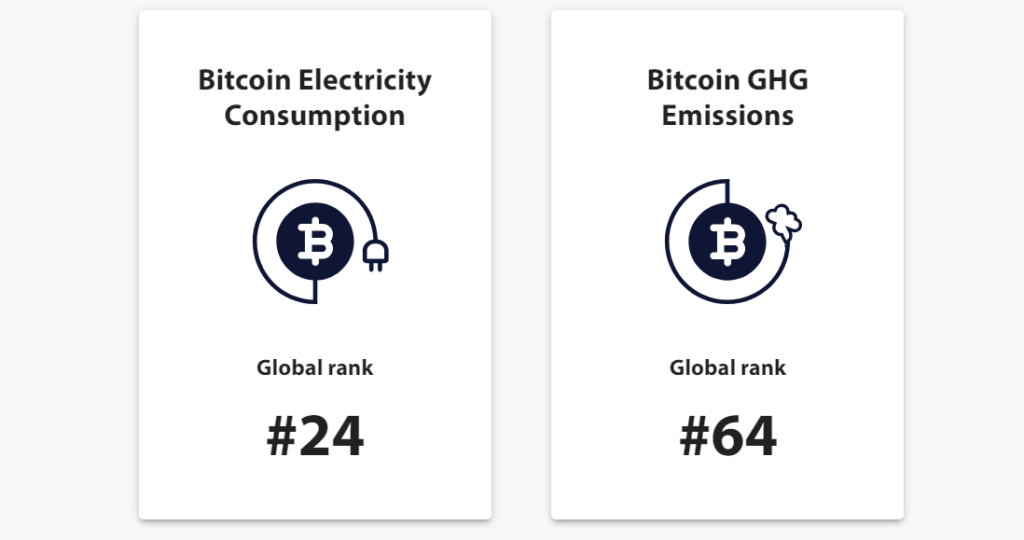
Now let’s make the most of this important distinction (emissions rather than consumption) and go further, making an even more coherent and suitable comparison by comparing Bitcoin with the pollution caused by gold mining or that of the banking/insurance system.
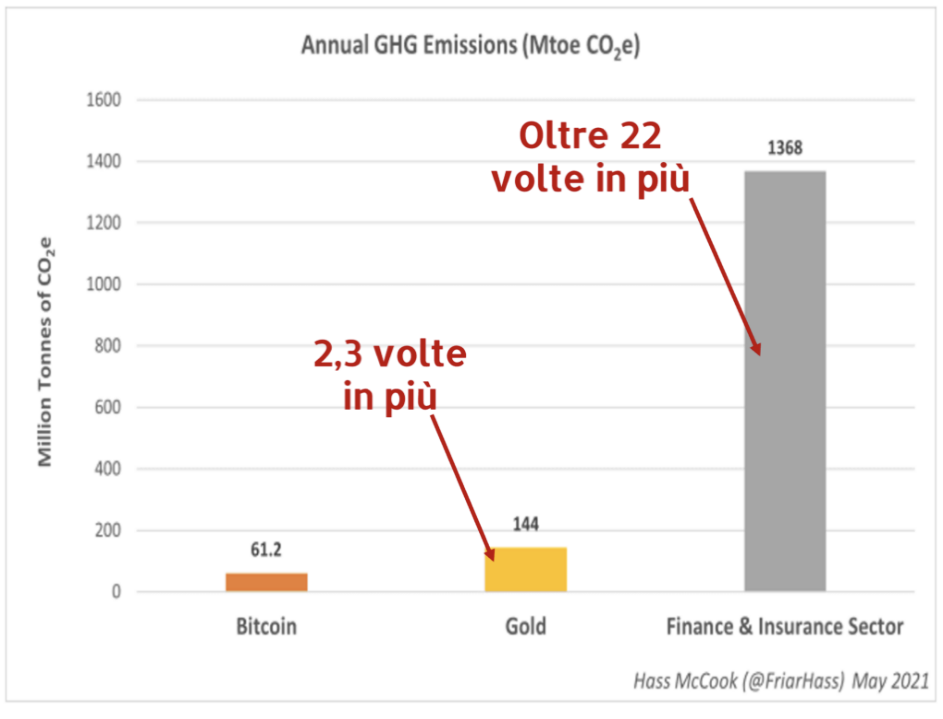
From the above graph, it is evident how such a comparison becomes rather damning for the latter:
- Gold mining would emit greenhouse gases about 2.3 times more than Bitcoin
- The banking system would emit greenhouse gases even about 12.8 times more than Bitcoin
The comparison with VISA, the famous credit payment network, would certainly be even more pertinent, but unfortunately, it is not easy to evaluate.
In the many examples found online, too many elements are missing for some reason (consciously or unconsciously) excluded, thus falsifying the comparison:
ATM consumption, payment devices used in stores, all auxiliary information exchanges between issuers and banks, the consumption of servers in the involved bank branches, and so on.
Moreover, as if that were not enough, the “consumption/emission per transaction” is often used as a term of comparison between VISA, Bitcoin, and other Crypto, without considering an aspect that is quite significant: the function that associates precisely the consumption with the number of transactions is not linear in the case of Bitcoin and generally for cryptocurrencies based on PoW. In other words, as the number of transactions on Bitcoin increases, consumption does not increase proportionally but tends to remain constant or move within a range dependent on other factors (see here for further details).
Miners Prefer Green Energy
There is another aspect, already present in an article from 2019 (here), where it was emphasized that 74% of mining activity drew from renewable sources.
In reality, looking at more updated data (2020-2022), Bitcoin’s electricity consumption from renewable sources fluctuates between over 50% in September 2020 and over 30% in January 2022 (here).
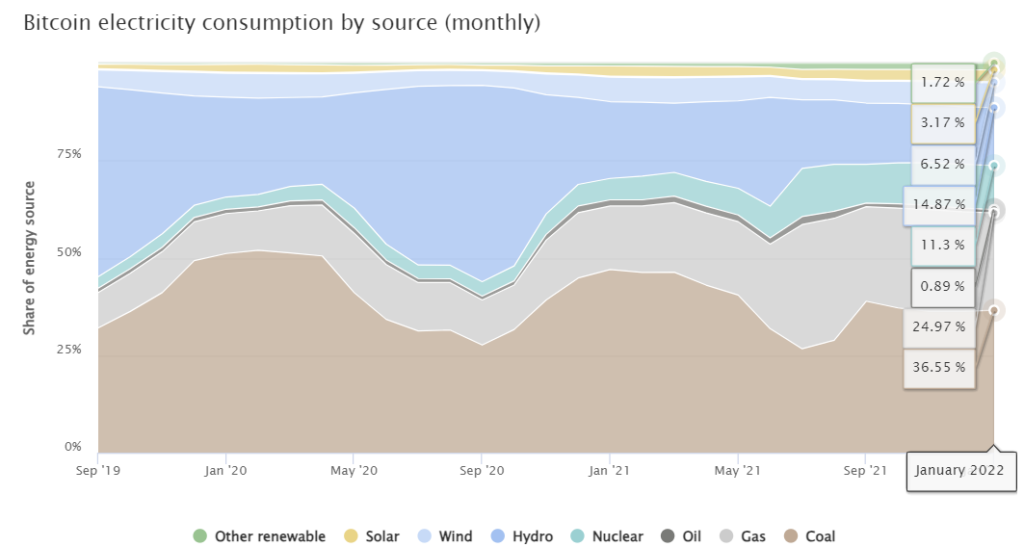
It is clear, therefore, that renewable sources play a fundamental role, and this is obvious for those in the industry, as the main cost for a miner is electric energy, and those who want to mine must start from this aspect to assess economic returns.
So a nice Mining Farm connected to renewable sources is, for a miner, a choice primarily economic, not just environmentally sustainable.
The “Bitcoin Mining Council” (BMC), which brings together almost half of the global Bitcoin node network, in its 2022 report highlights the importance of renewable sources used by its members on the total.
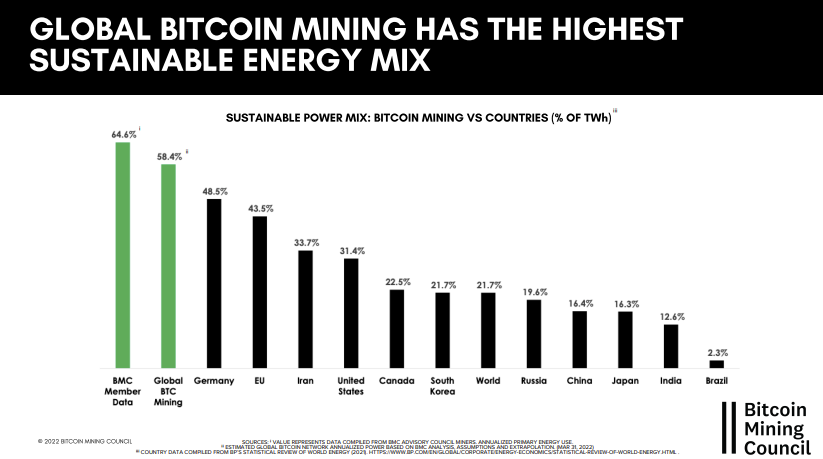
In the figure, it is seen, precisely, how BMC miners use over 64% of energy from “sustainable” sources which, compared to states, would make the “Bitcoin nation” the most sustainable country on earth.
Other interesting examples that allow for nearly 100% renewable production include an all-Italian mining farm operating within a dam (see here), or even better in Iceland where electricity costs are very low thanks to geothermal plants, and savings are also made on cooling systems by already operating in cold areas (here), or a reality that exploits hydroelectric power on Lake Ontario (here).
Some Considerations on Bitcoin
We have seen how, to be properly evaluated, pollution should be measured in terms of emissions and not consumption. But if this is not always easy to measure, then the emphasis should be on the consumption of electric energy from polluting productions like fossil ones, excluding precisely those from so-called sustainable sources.
Using what has been discussed so far and the data collected, we can summarize everything as follows:
- Bitcoin consumes a lot of electric energy for its operation (mainly due to the PoW mechanism)
- Consumption remains comparable or even much lower than other productive or consumption activities, even considering those with similar purposes and/or scopes.
- Renewable sources play an important role (from 30% to over 50%, and in some cases up to 100%)
In this perspective, it is clear that the criticisms show all their unfoundedness, especially considering the product of this effort:
the first decentralized and disintermediated payment system (functioning) in history.
The Elephant in the Room

That said, you will have noticed that in the title, I meant to talk about Cryptocurrencies and Blockchain in general and not just Bitcoin, even though it is obviously extremely representative for obvious reasons. It is indeed true that Bitcoin is the initiator of the phenomenon and still (February 2024) covers alone 52% of the entire market capitalization, therefore it was right and proper to start with it, also considering the fact that many of the criticisms have been directed primarily against Bitcoin.
Cryptocurrencies in general are over 9000 (at least those registered on Coinmarketcap.com) and differ greatly in terms of technologies used, so although many use the same high-energy consumption consensus mechanism, a large portion deviates from it. And that’s precisely the point, the bulk of consumption is linked to the PoW consensus mechanism, which, however, is only one of the possibilities.
The real elephant in the room, the one that completely changes the game, is called Proof of Stake (and related variants), the consensus mechanism that does not use computational power but the concept of immobilization of the currency (Stake) to secure the entire system.
Without going into detail (whether it is better or worse than PoW), we can safely say that such a mechanism (PoS and non-energy-consuming variants) is already widely used. For example, (in February 2024) among the top 20 Cryptocurrencies by market capitalization, there are 11 that use PoS: Ethereum, Solana, Cardano, Avalanche, ChainLink, Tron, Polkadot, Polygon, Toncoin, InternetComputer, ShibaInu (I excluded stable coins that by their nature run on different networks).
Crypto projects that use PoS or variants already account for over 50% of the top 20 Cryptocurrencies by market capitalization worldwide. Well, Proof of Stake has extremely lower consumption than Proof of Work, just think that the Ethereum network, moving from PoW to PoS in September 2022, saw its energy consumption reduced by 99.95%!
Cryptocurrencies and Blockchain Consume More
To be precise, any cryptocurrency, including those based on blockchains with non– energy-consuming mechanisms like PoW, is inherently inefficient when compared to other computer systems that perform transactions or applications (Apps) of the same type. This inefficiency, which obviously translates into higher consumption and potentially higher polluting emissions, is due to the redundancy that implicitly characterizes the technological systems underlying Cryptocurrencies: distributed ledger and therefore redundant on various nodes, extensive use of broadcast on the network, extensive use of encryption, etc.
Such characteristics are not surmountable without giving up the very essence of Cryptocurrencies: decentralization, security, disintermediation, irreversibility, etc.
In a sense, redundancy (of data and logic) is the distinctive and characteristic sign of Cryptocurrencies and represents the price to be paid to have this revolutionary product in countless aspects.
It is clear that in the case of enterprise blockchains for purely non– public use (permissioned), such as industrial or state applications (but always permissioned), it is possible to give up part of the redundancy (primarily the decentralization of nodes), and this would lead to further improvement in terms of consumption.
In the following graph, I show an interesting estimate of consumption per transaction in various cases: from a simple server to a systemic but centralized management, up to a system that uses the Blockchain in an enterprise manner (permissioned), public (or permissionless) Non-PoW, and public PoW (here for further details):
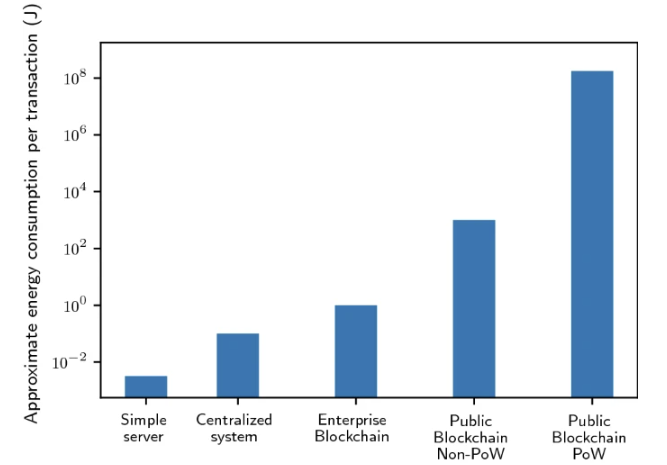
If we consider that the scale in the graph above is logarithmic, it is clear how PoW is the decidedly crucial element in the increase in consumption of a public Blockchain: a PoW blockchain implies consumption about 10,000 times higher than a Non-PoW blockchain.
Final Conclusions
In conclusion, I hope to have been able to highlight how what appeared critical has taken on very different connotations when all perspectives have been analyzed.
Pollution comes from emissions and not from consumption in general, therefore higher consumption can be considered acceptable if derived from renewable sources: We have seen that this is already a consolidated reality for Bitcoin and certainly to a greater extent than many other systems, applications, or even nations.
Furthermore, it has become clear how the main element, the source of higher consumption, is the PoW consensus mechanism, while it is already a reality to see how PoS (and non-energy-consuming variants) has established itself and continues to establish itself so much as to be used by most of the top twenty cryptocurrencies by market capitalization. In my opinion, PoS is the elephant in the room for those who raise their voices criticizing Cryptocurrencies and blockchain in general on this issue.
Although I have shown how redundancy, which necessarily implies higher consumption, is a foundational and indispensable characteristic of Cryptocurrencies and blockchain in general (regardless of the consensus mechanism), it is clear how such an aspect is irrelevant when compared to the impact of PoW on consumption.
Finally, the most important aspect of all remains the evaluation of costs and benefits: the benefit must be considered higher than the cost incurred, including environmental costs and not only, but also considering all current and potential benefits.
In my opinion, the verdict is clear: having the first completely disintermediated and functioning payment system in history (Bitcoin) would suffice in itself to overcome the costs incurred.
But the horizon is decidedly broader, so much so that Cryptocurrencies and blockchain can only be considered a decisive and important revolution for the future of global society.
Sources
All references in the article:
- https://ccaf.io/cbeci/index/comparisons
- https://www.agendadigitale.eu/smart-city/bitcoin-allarme-inquinamento-un-mito-ecco-perche/
- https://ark-invest.com/articles/analyst-research/bitcoin-myths/
- https://bitcoinmagazine.com/business/bitcoin-vs-financial-sector-energy-use
- https://it.ihodl.com/technologies/2018-05-04/mining-miniera-bitcoin-altcoin-genesis/
- https://bitcoinminingcouncil.com/wp-content/uploads/2022/04/2022.04.25-Q1_2022_BMC_Presentation.pdf
- https://biomine.it/it/
- https://www.genesis-mining.com/
- https://www.terawulf.com/lake-mariner-mining/
- https://metacoinics.com/2022/12/08/by-the-numbers-how-much-energy-did-the-ethereum-pos-merge-save/
- https://bitcoinminingcouncil.com/wp-content/uploads/2022/04/2022.04.25-Q1_2022_BMC_Presentation.pdf
- https://www.sciencedirect.com/science/article/pii/S2352864822001390
- https://hackernoon.com/the-bitcoin-vs-visa-electricity-consumption-fallacy-8cf194987a50
- https://link.springer.com/article/10.1007/s12599-020-00656-x
- https://d-central.tech/the-future-of-bitcoin-mining-efficiency-a-deep-dive-into-asic-evolution/


 Market and Data
 _old_Become an author
 Wallet


