


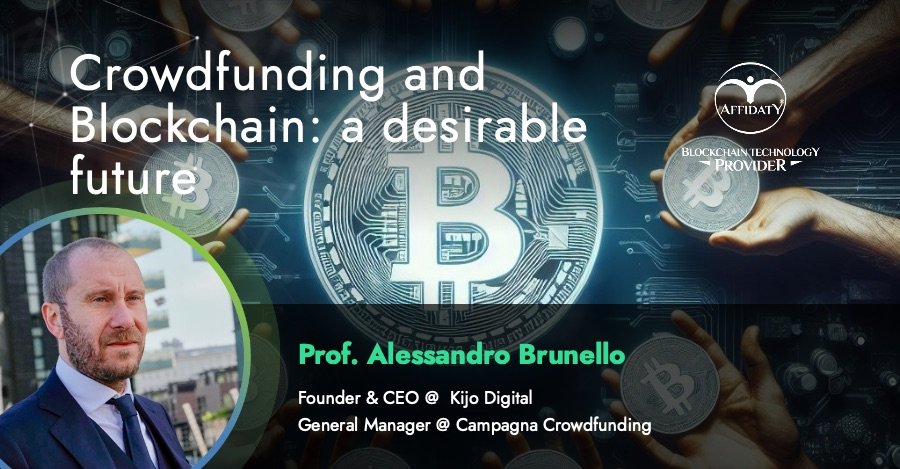
In recent years, blockchain technology has made significant strides in evolving key sectors, bringing transparency, security, and decentralization. One of the areas that has greatly benefited from this innovation is crowdfunding and fundraising more generally. Leaving behind the unfortunate and definitively outdated era of ICOs, we are now facing scenarios where uniqueness expressed through cryptography can be harnessed through well-established and well-regulated tools, such as crowdfunding.
Crowdfunding, with its ability to engage a wide audience and finance projects of any size, is indeed poised to be substantially transformed by blockchain. The use of smart contracts, a key feature of blockchain technology, has simplified and made many transactions more secure. Direct transactions, without intermediaries, reduce costs and increase trust between funders and project proposers. It’s a love story that goes back a long way, perhaps even to the microcredit initiatives of Nobel laureate Muhammad Yunus, involving small sums moving quickly and new technological supports capable of breaking free from monopolies and inefficiencies.
Famous crowdfunding platforms like Kickstarter are exploring blockchain integration to improve transaction transparency and introduce new functionalities. Imagine a future where Kickstarter utilizes the Ethereum blockchain to immutably track every transaction, ensuring that funds reach the intended recipient and that the process is not only fully transparent to all stakeholders but also complemented with elements of gamification, voting, and community building.
In traditional fundraising, although transaction security may not be a major concern, blockchain utilization would eliminate many potential pitfalls through decentralized information storage. Every transaction is permanently recorded on distributed nodes, making it extremely difficult to alter or corrupt data.
On the other hand, crowdfunding can also contribute significantly to blockchain.
A technology that is by definition trustless and permissionless has much to gain from a tool like crowdfunding, where trust is everything. Personally, I believe that humanization, in the simplest and most direct sense of the term, is desirable in a phase like the one cryptography is experiencing today. Moving away from the misunderstanding of the primary value of speculation is a challenge for all industry operators. Instances and trends that have permeated crowdfunding since its inception, now twenty years ago, have not aged poorly; on the contrary, they can be fundamental in preparing the ground for mass adoption of blockchain and proposing dynamics that presuppose trust as highly useful antibodies to problems we have already encountered. For example, I think of supply chain certifications.
Imagine a future where charitable organizations issue blockchain-based tokens to represent shares of charitable actions. Donors can purchase and trade these tokens on the blockchain, gaining greater liquidity and transparency in the virtuous action itself.
This form of tokenization could increase participation and enthusiasm in fundraising for important causes.
Looking to the future, the possibilities are exciting. Blockchain could enable participation from investors worldwide, breaking down geographical barriers in fundraising.
The tokenization of real assets could make investments more accessible and expand the supporter base for innovative projects.
Imagine a decentralized crowdfunding platform that uses a system similar to Polkadot and allows for the creation of specific sub-chains for individual projects. This would enable greater scalability and customization, allowing each project to have its own community of supporters on the blockchain and access to tools never explored in some sectors.
Blockchain technology has already brought significant improvements to crowdfunding and fundraising, providing security, transparency, and reducing financial burdens. As we explore the future, it’s clear that blockchain will continue to be a driver of innovation in these sectors, opening up new opportunities and making participatory financing an even more accessible and global process. With decentralized platforms and tokenization, the crowdfunding of the future could radically transform our ability to support projects and causes that truly matter to people. Perhaps one day we will even talk about blockchain and crowdfunding as tools of subsidiarity.
Alessandro Brunello


 Market and Data
 _old_Become an author
 Wallet


