


Technological prostheses between philosophy and Myth
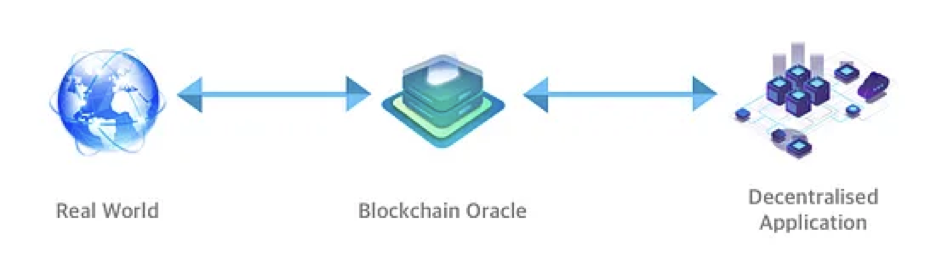
To approach Blockchain, I would like to attempt a “mythological” path, without exclusively confining myself to the term Oracles1 : the bridge services that connect Blockchain and the external world, just as oracles in ancient times served as intermediaries between gods and humans, seeking meaning that eluded them 2.
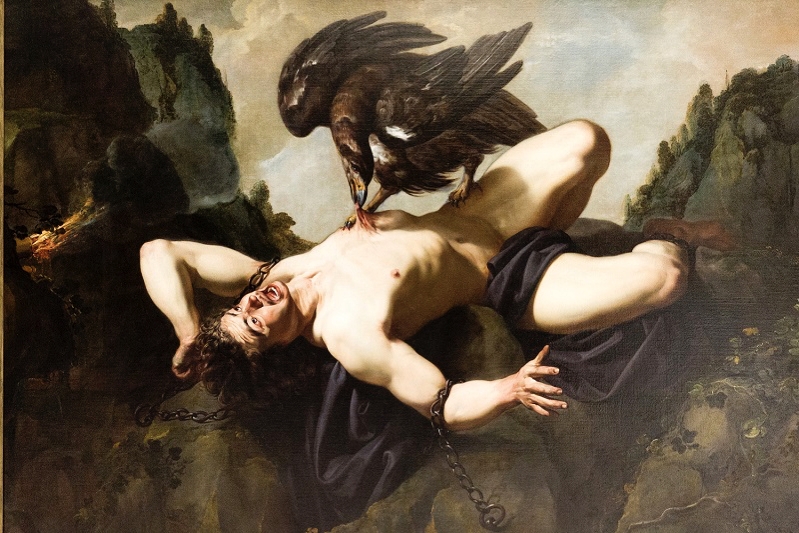
Instead, I opt for a form, aiming at the essence of the chain by associating it with the one to which Zeus resorted to punish Prometheus 3, bound in chains in a horrific and irreversible sentence, with an eagle tearing his liver every day, only to have it regenerate at night.
He was guilty of having stolen fire and teknai4 from him, given to the human species.
A fragile and miserable species, ephemeral and atopic, due to the “distracted lightness” with which Prometheus, after molding us from mud and clay, left us in the hands of his brother Epimetheus: etymologically, the one who understands “epi” – that is, after – depicting the fool of the titanic village!
Unfortunately, when the turn of the human species came in the lottery, nothing remained at the bottom of the bag for the poor fool: to reveal his folly but unfortunately also to deny foresight and prescience that understanding “pro” should have ensured to our alleged benefactor Prometheus.
Therefore, we descend from Epimetheus even before Prometheus: we are human in the fire and in the “metico transformative” capacity that he gave us, with the complicity of Athena, always our ambiguous protector and patroness of Metis 5.
Given the price the Titan paid for his benevolence towards humanity, from the Prometheus chains and the background of guilt and atonement, I decline Blockchain, as well as any other technological “mirabilia”: techniques to “plug” and remedy our ontological lack, which they try to remedy.
They belong to us and define us: far from being a disaster, something exogenous that has fallen on us to uproot us from the Edenic state of nature, in good faith of the myth of Rousseau’s noble savage!
To emphasize it, for those who doubted, I pivot on the stick as the first and existential technological prosthesis, sentenced to us by the famous Sphinx riddle that Oedipus first solved: its support function defines the human, in the tool to go three-legged in old age when ontological weakness inevitably knocks 6.
painting by Gutave Mourearu, 1864, “Oedipus and the Sphinx”
Our technological history unfolds from these premises, which serve as a backdrop to the stage where the miraculous prosthesis that is Blockchain moves.
A miraculous “in-between,” which we could truly assimilate to the Latin Janus bifrons, which, in addition to symbolizing the transition from old to new, personifies the moment in between and precisely the condition of the “between.”
Every technology exists outside, among us and the world: in the case of Blockchain, something trying to “solidify and agglutinate,” in creating a chain that claims the attributes typical of gods: above all, immutability and irreversibility, through which to try to balance the dizzying and disorienting acceleration to which we are exposed.
A support between a user and a technological advisor, to give us a clear example of third-order technology if we follow the captivating Floridian taxonomy, where each term of the triad user-intermediary-advisor now becomes technology.
Abundance and scarcity in the digital realm: the fourth evolution and the “divine promises”
A technology that we could therefore assimilate to an anchor in a stormy sea to protect us from the volatilization of the real and hold onto something stable and lasting, to trust.
Better yet, something to entrust trust to due to machine computation, to instill security in a global transactional world to protect exchanges, safeguarding the value that digital abundance sometimes seems to undermine.
How indeed to assure value without scarcity? How to protect an increasingly intangible and immaterial capital? How to manage trust in the flight towards the hyperhistoric era? How to guarantee and certify relationships that move frictionless in the infosphere? And again, how to protect the “physical” world, certifying its local values, and “stand” without being overwhelmed by a disruption that has abundance as its decisive hallmark?
An epochal transformation, centered on a simple but exponentially amplified phenomenon: hysteresis, as explained by Ferraris and his rigorous interpretation of the digital 8.
A term derived from the Greek ὑστέρησις, hystéresis, meaning delay: to be understood as the ability of effects to survive and accumulate, even in the absence of causes, or more rigorously in mathematical terms, a phenomenon whereby the value assumed by a quantity dependent on others is determined not only by the instantaneous values of these but also by the values they had previously assumed.
In simple terms, it is the characteristic of a system to react late to applied stimuli and depending on the previous state, introduced into the theory of dynamic systems by James Alfred Ewing in 1890.
Therefore valid in physics as well as in biology and economics, and what is more dynamic than the digital?
Indeed, with the digital, we go through that “change” that on the industrial side is now consolidated as the Fourth Industrial Revolution: after steam, electricity, and early computing, thanks to the pervasiveness of ICT, we are now surpassing mass production to evolve towards profiling and personalization 9.
Even on the socio-anthropological side, the term Fourth Industrial Revolution seems to hit the mark.
After discovering that we are not at the center of the world with Copernicus, having abandoned the claim of uniqueness in the theory of evolution with Darwin and lost the center in our own home with Freud’s bifurcation that deprives the Subject of total control 10, in today’s Fourth Revolution, we also detach ourselves from the presumed ontological primacy that remained!
Datafication and hyperconnection deliver us to a multisystemic reality, where we are homogenized in a weak “dataifying” ontological status at Inforg: agents capable of interacting and producing data and value like sensors, processors, AI actors with which we are equated, one among the other nodes in the network.
The ongoing metamorphosis thus pivots on a new form of interaction: a constant engagement – empowerment of people and objects, which reconfigures the foundations of our old “ontology” and subjects us to continuous “detachment” of our conceptual categories, reshaping our way of being in the world.
These detachments bring with them a “uprooting from analog senses,” where the anchor is lost – especially for those, like myself, who do not boast digital nativity in their demographics and are therefore “migrants” to the new dimension.
Space and time detach, and following, to mention only the most recognized, norm and territoriality, use and ownership, coexistence of action and agent, physicality and identity.
If for space we speak of the infosphere, on the temporal axis, we are on the threshold of Hyperhistory: in alliance with computer science, ICT becomes predominant over any other technology, so much so that human well-being and balance necessarily pass through our relationship with their “computational/connective” power.
This was not intended in the era of history, where writing evolved us from pre-history with meager traces and cave paintings: because it is from the multiplication of traces and signs
, from the exponential growth of our ability to leave remains, that transformation occurs, in this hysteresis that involves and “valorizes” everything.
To avoid getting lost, puppets in the modern Vuca theatre where everything rushes and wanders, one must “resist” that lightness and evanescence that alarms against the “distracted awareness” of digital phenomenology 11, because without awareness, goodbye responsibility, and above all, bye bye governance.
A term that recalls the need to give a human center to what is on the air, balancing development goals that impact on the economy, society, environment, creating complex plots that only the hands of Arachne 12 can dare to handle.
For this reason, I believe that a curious and transversal “technical-philosophical” perspective can help bring out the sense by extracting it, like miners do with digital gold: a sense that is always in question wherever there is a technique/technology.
A sense that philosophy must contribute to questioning, investigating the “phenomenology” of the “Digital Revolution”: seeking traces and guarding passages and transitions.
With a happy expression by Mauro Barberis 13, a sort of Gatekeeper philosophy, guardian of systematic reflections from multiple disciplines that connect and contaminate, involving finance and economics, law and medicine, engineering, biology, politics, sociology, and anthropology, ethics, and of course, computer science.
This is the background in which Blockchain shines today, resonating with divine promises that retrodate to myth: immutability, irreversibility, for chains of blocks that aspire to be plausible anchors.
DLT and Blockchain: Digital Anchors
“Anchoring” myself to a minimal historiographical zeal, the advent of decentralized “Ledgers,” on whose disseminated morphology Blockchain undermines in the form of the Block, is linked to the Internet and the 90s: when the first countermeasures to overcome the danger of dreaded Denial of Service 15 attacks were discovered – with Hashcash 14, for example.
In 2002, Mazières and Shasha introduced blocks as a data storage system on a network, and in 2005, Szabo was the first to propose a decentralized currency, named “bit gold.”
But if terms like Blockchain, Hash, Fork, Proof of Work/Proof of Stake emerge from technical niches and contaminate everyday language, it is thanks to Sakamoto.
Starting from his White Paper, they find fertile ground beyond the original financial context – guilty of the risk of cannibalization in a rough Blockchain = Bitcoin equation – into a variety of areas: all united by the need to ensure data security, streamlined processes, fraud minimization, and the protection of digital identity and privacy.
An identity still anonymous for the one who 16 solved the double-spending 17 problem along with that of the Byzantine Generals, borrowed from logic and Game Theory by computer science: a demonstration of how Blockchain is a frontier land for pioneers and explorers – from computer science to cryptography, from algorithms to modern computer science.
And as a frontier land, understandable as it may unfortunately also allow refuge for smugglers and traffickers of extreme finance and digital money laundering, as seen by detractors who see a small but decisive crack in the system in the supremacy of stronger computational power.
Reality says that with Bitcoin, Sakamoto implemented the potential of DLTs and encrypted blocks, creating the first true decentralized cryptocurrency on Blockchain and legitimizing Bitcoin as the new technological gold: digital fiat 18 money to be mined on the wings of the punk anarchist revolutionary dream of total, transparent 19, democratic decentralization and disintermediation, which raised its voice at the end of the colossal financial crisis of 2008.
By definition, Blockchain technology falls under the broader category of Distributed Ledger Technology: network systems based on a geographically distributed register in multiple nodes that have the same copy of the database, independently modifiable by them without a central authority.
It presents itself as a data structure consisting of growing lists of records, called “blocks,” linked together by a cryptographic hash as a trace of the previous block; a timestamp and transaction data, combined in a concatenation where data, once inserted and recorded in the block, cannot be modified without causing alterations in the chain, which occur due to algorithmic adjustments based on consensus logics and cryptographic keys.
It is, therefore, obvious that it is perfect for preventing the risk of fraud, tracking sales processes, and avoiding scams, appearing as a decentralized register endowed with miraculously “divine” properties of immutability and irreversibility.
And above all, it is trustless, where agents do not need to trust each other but interact in the name of a machinist-technological trust that records transactions of both virtual and physical assets.
There are two types:
- Permissioned ledger, where the network is private, and registration and authorization by a central entity or the network itself are required, generally institutions and large companies that need greater control thresholds.
- Public: open and free networks where anyone can access without prior authorization, provided they respect the protocol.
Blockchain has withstood seasons of disillusionment winters and summers of easy infatuations and enthusiasms, where the weather has often been conditioned by the narrow association with mere Cryptocurrency: now the sun shines, especially for permissioned ones, on which the attention of the EU and the European Parliament is focused.
In conclusion, due to the proposed “mythological” juxtaposition, Blockchain is changing its skin and form: it perhaps leaves behind some of the subversive charge of the punk flag to defeat the Surveillance Capitalism20 loudly proclaimed from various quarters, and in reality gives up something of the ideal of absolute transparency, which is the worse remedy for evil.
It integrates, intersecting the different perspectives of the Digital Transformation with a metamorphic attitude worthy of Proteus 21: it enables new applications, processes, and supply chains, thanks to that “anchoring” digital tracking that I hope to have unveiled in my own way, and that speaks of an almost boundless transversality, so much so that the WEF predicts that 10% of the global GDP could transit on this technology by 2030.
And since light always needs darkness and freedom refers to the chain as a limit, I close in the name of Hölderlin and the splendid maxim that I make mine: “where danger is, grows also what saves.” 22
1 A type of third-party technological service that provides external information to a smart contract deployed on the Blockchain to connect the exogenous to the chain in order to implement the conditions of the if clause followed by the automated execution then.
2 Blockchains and smart contracts cannot access off-chain data, i.e., data outside the network.
However, for many contractual agreements, it is crucial to have relevant information from the outside world to execute the agreement. Oracles come into play in blockchain since they offer a connection between off-chain and on-chain data. Oracles are essential within the blockchain ecosystem as they expand the scope in which smart contracts can operate. Without them, smart contracts would have very limited use, as they could only access data within their networks. It’s important to note that a blockchain oracle is not the data source itself but rather the layer that requests, verifies, and authenticates external data sources before transmitting the information. The data transmitted by oracles can take different forms: information about price, successful completion of a payment, or the temperature measured by a sensor.
3 From the Greek, ancient Greek: Προμηθεύς, Promētheús, “he who thinks ahead”: a central figure in Greek mythology, brother (he had 3) of Epimetheus, who instead is “he who thinks afterward.”
4 Techniques in Greek.
5 The practical-transformative intelligence of which she is a champion, as attested by her birth from Zeus’s skull. She had indeed swallowed Metis, pregnant with her, whom Zeus greatly feared as “intelligence.” For this reason, Athena, virginal and proud, rises as the emblem of Metis, of which our champion is the hero dearest to her, the Greek Odysseus/Ulysses.
6 When we return to being fools, precisely in-baculus without a stick, which precisely indicates in the original meaning something weak, feeble, infirm: one without a stick, needing it, appears fragile, powerless, without strength. Thus is the intelligence or judgment of a fool; it is not steady on its own legs, impotent.
7 Floridi recognizes different layers and hierarchies of technologies depending on the different configurations of the user-intermediary-advisor triad, where first-order technologies – “earth that suggests the plow” or the sun that “promotes” the hat and sunglasses, or even the scorching sand that leads to the sandal – transition to technologies that suggest technology through technology, for those called third-order technologies. In the first order, they are placed in the middle, between humanity and nature, while in the second order, the used technology is placed in the middle between humanity and other technology, where above all, the screwdriver enlightens us to screw in a screw or a key compared to the lock. Second-order technologies have a certain degree of dependence on those of the first order, as demonstrated by a key that would be useless without a lock to open. Finally, the last step, technology positions itself as a means between technology and other technology for the most advanced ones, which deal with “removing” us from the process: think of self-driving cars that “drive themselves,” interacting with other cars and the road. It’s worth noting that this taxonomy is not fixed but contextual. For example, scissors are a first-order technology if they cut a rose and second-order if they cut paper. They can also be third-order if used by a robot cutting a piece of fabric in a factory. Furthermore, today technology and the user usually have an interface, and the same happens between it and the advisor, which today, with the spread of user-friendly culture, magnetizes attention to user needs. To delve into Floridi’s thought, see “The Fourth Revolution: How the Infosphere is Transforming the World” or “Ethics of Artificial Intelligence” or “Green&Blue, Thinking the Infosphere.”
8 In particular, I draw on the insights from the recently published text “Documanità.”
9 Steam, electricity, and early computing mark the three slow stages.
10 Split between conscious and unconscious.
11 Reference here to the philosopher Byung Chul Han and his recent popular works, including “The Society without Pain,” “Psychopolitics,” “The Disappearance of Rituals.”
12 Arachne was transformed into a spider for challenging Athena in weaving.
13 Mauro Barberis, rector of the University of Udine.
14 Proposed in 1997 by Adam Back to protect against DoS and limit email spam.
15 A cyber attack that makes a network or service inaccessible.
16 Pseudonym concealing an identity still anonymous despite numerous speculations.
17 It is a risk associated with virtual currencies, specifically the possibility of spending the same amount multiple times, thereby increasing the number of circulating currencies and obtaining money illicitly. Centralized systems like payment circuits overcome this problem by relying on an intermediary. Decentralized systems like blockchains, on the other hand, adopt consensus mechanisms like Proof-of-Work and Proof-of-Stake.
18 Fiat currency, the opposite of commodity money, is a national currency not anchored to the price of a commodity like gold or silver but whose value is intrinsic. The value of fiat money is largely tied to trust in the issuing authority, typically a state or central bank.
19 And to which I add in the margin, unable to grant total approval, as too much transparency, let’s say, leads to death, just like darkness, while truth always resides in the unveilings that call for lights and shadows, chiaroscuros as life is.
20 For the term, it’s right to mention the sociologist Shoshana Zuboff and her text.
21 Proteus was a mythical Greek sea deity, probably of Egyptian origin, capable of changing shape through the depth of the sea and predicting the future to those who could capture him.
22 From “Patmos,” a poem by Hölderlin from 1803.


 Market and Data
 _old_Become an author
 Wallet


