


Introduction
Energy is a fundamental resource for economic and social development, but the way it is produced represents a significant component of the environmental impact of human activity. Tracking the sustainable origin of the energy we consume is a key element both from the perspective of informed consumers and that of producers and distributors who genuinely want to position themselves as honest players in the market and avoid the phenomenon of falsely attributing ecological characteristics to products or services, including energy. This phenomenon, known as greenwashing, essentially involves making people believe that a company is doing much more for the environment than it actually is.
In this context, blockchain emerges as an innovative technology that can improve energy traceability, i.e., the ability to reconstruct its origin and path along the supply chain. The main value of blockchain is to provide mathematical proof of the state of data so that different parties in a transaction can agree on the result even if they do not know or trust each other. While commonly associated with cryptocurrencies like Bitcoin, blockchain technology can be used for virtually any type of transaction involving the digital ownership of a good or service. These technologies rely on cryptography and established consensus mechanisms to ensure that transactions remain secure, and an entire industry has emerged to apply blockchain technology to real-world challenges.
In the context of energy tracking, blockchain can facilitate the recognition and valorization of energy produced from renewable sources (RES) and contribute to countering all practices in the energy sector. This article aims to analyze its potential and challenges concerning energy traceability, a very important use case in a context where it is complex for users (citizens and businesses) to evaluate and valorize the use of energy produced from RES in their activities.
The Electric Grid: Architectures and Research Areas
The traditional electric grid is currently characterized by a centralized architecture, where a single utility manages the entire network. However, the future electric grid is expected to be characterized by greater decentralization and a higher number of participants, such as Distributed Energy Resources (DER) 1 and consumers. This transition towards a more decentralized grid presents a series of challenges, including the need to ensure trust and transparency. Blockchain is a promising technology to address these challenges and can be used to securely and immutably record energy transactions, allowing all participants to access the same information. This can help reduce costs, improve efficiency, and increase network security.
Among the numerous actors involved in researching technological advancements in the energy sector, the American National Renewable Energy Laboratory (NREL) 2 stands out. For example, it is developing systems that use blockchain to manage energy transactions, with the potential to revolutionize the energy sector by making the electric grid more efficient, reliable, and sustainable. In the scenario of a future electric grid, this technology could undoubtedly provide the following advantages:
- More transparent and reliable energy transactions, securely and immutably recorded.
- Automation of energy transactions, reducing costs and human intervention.
- Increased protection of the electric grid from cyber attacks.
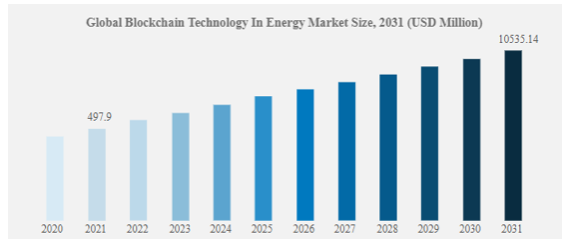
Chart: Blockchain technology and energy – Market size in M$
As highlighted in the preceding graph, the market size for blockchain applications in the energy market was $797.9 million in 2021 and is estimated to reach $10,535.14 million in 2031, considering a Compound Annual Growth Rate (CAGR) of 35.7% during the period considered 3.
Recording the Origin of Energy: Mechanisms, Criticisms, and Perspectives
Traceability of renewable energy is essential to ensure consumers the sustainable origin of the energy they purchase and to encourage producers to invest in clean sources. However, traditional systems of renewable energy certification are often inefficient, expensive, and vulnerable to fraud and manipulation. Additionally, the increasing prevalence of prosumers, users who produce and consume energy independently and distributedly, requires greater flexibility and reliability in managing energy flows.
Creation and Exchange of Energy Attribute Certificates
Energy Attribute Certificates (EACs) aim to demonstrate that a specific unit of energy is generated from clean energy sources and serve as a market tool to promote the spread of clean energy. The holder of an EAC can prove compliance with regulatory targets or voluntary commitments. Although EAC systems, especially in the renewable electricity sector, are mature and widespread, the sector faces several challenges:
- Lack of transparency and easily verifiable information throughout the entire lifecycle of EACs.
- High complexity due to the involvement of numerous stakeholders.
- Manual processes inhibiting the ability to handle transactions with high granularity and volume.
- Entry barrier for small operators, as systems are designed for large utilities.
Blockchain offers significant advantages to address the above challenges, which is why there have been multiple initiatives in various stages of development implementing blockchain to enhance EAC markets. The advantages of using blockchain to improve this market are increasingly recognized in the industry, as this technology allows:
- Accurate and verifiable tracking of each unit of energy throughout its lifecycle.
- Real-time issuance and transfer of EACs, as generators produce electricity rather than the current monthly issuance.
- Automation of EAC trading through smart contracts and reduced dependence on a centralized entity for transaction verification.
- Efficient cost management of the ever-growing number of small generators and consumers with high granularity and accuracy.
- Creation of new market opportunities based on digital data acquisition and reduction of EAC issuance costs.
In light of this promising potential, it is not surprising to see an abundance of blockchain applications in the EAC market, demonstrating a more mature adoption of the technology: FlexiDAO, Foton, Powerledger, ReAcc, and TEO are among the most advanced and operational projects focusing on the two main use cases. Foton and ReAcc are growing voluntary renewable markets in developing countries, providing a blockchain-based market with simplified device registration, data collection, EAC issuance, trading, and redemption, following the I-REC standard. FlexiDAO, Powerledger, and TEO, in particular, leverage blockchain to offer advanced features for clean energy traceability, particularly relevant in developed markets. Of course, there are many other similar projects and initiatives.
Focus on Europe: Guarantees of Origin
In the specific European context, the EU has established common rules to certify the renewable origin of electricity produced and consumed by Member States. These rules are contained in Directive 2009/28/EC 4 and its subsequent amendment RED II. Additionally, the Renewable Energy Directive RED III was approved by the EU Council on October 9, 2023, and constitutes the latest legislative act in promoting the use of renewable energy in Europe and reducing dependence on fossil fuels.
The European certification model for energy from RES is based on the Guarantees of Origin (GO) 5 system, electronic documents attesting to the share or quantity of energy from renewable sources in a supplier’s or final customer’s energy mix 6. GOs are issued, transferred, and canceled through web portals managed by competent national authorities. In Italy, the role of issuing and managing GOs is performed by the Gestore dei Servizi Energetici (GSE) 7, which issues a GO certificate for each MWh of renewable electricity fed into the grid by qualified IGO plants. Selling companies are required to cancel an amount of GOs equal to the renewable electricity sold by March 31 of the following year it was supplied to final customers. The cancellation of GOs generates a Cancellation Certificate, which includes the ID code of the plant from which the canceled GOs originate and a unique code identifying the certificate.
There have been several criticisms of this mechanism, voiced by organizations such as the Bureau Européen des Unions de Consommateurs (BEUC) and the Consiglio Europeo dei Consumatori (CEC), as well as major NGOs like Greenpeace. In particular, GOs are criticized for the following reasons:
- They do not reflect the real environmental impact of consumed electricity, as they do not consider CO2 emissions and other environmental impacts associated with the production, transport, and distribution of energy.
- They do not guarantee that consumed electricity actually comes from renewable sources but only that an equivalent amount of renewable energy has been produced somewhere in Europe.
- They do not stimulate investments in renewable sources, as they do not provide an adequate and stable price signal for renewable energy producers.
Moreover, the CEC has expressed additional concerns about the transparency, reliability, and credibility of GOs, arguing that:
- They are often sold separately from electricity, creating a disconnect between the production and consumption of renewable energy.
- They are subject to poor harmonization and supervision at the European level, with significant differences between Member States regarding GO issuance, transfer, and cancellation criteria.
- They are frequently used as a “marketing” tool to attract consumers to green tariffs without providing clear and complete information on the characteristics and impacts of GOs. In the described scenario with repeatedly highlighted issues by major stakeholders in the sector, blockchain has entered as a promising technology to evolve the energy market.
It is therefore apparent that new solutions and system architectures are needed. In this regard, blockchain can offer an innovative solution for the traceability of renewable energy by:
- Securely and immutably recording the production and consumption of energy from renewable sources, creating a kind of “digital footprint” of energy that attests to its origin and quality.
- Eliminating the need for intermediaries and centralized authorities, reducing verification costs and times, and making the process more transparent and democratic.
- Ensuring flawless division of energy assets, creating unique certificates on the blockchain that show consumers the origin of energy and allow them to choose the most sustainable suppliers.
- Enabling new models of energy exchange and trading among prosumers, facilitating coordination between supply and demand and creating a more dynamic and resilient energy market.
The Energy Market and Blockchain: Beyond Renewable Energy Traceability
To give an idea of the current situation and the ongoing trend, according to a Global Market Insights report, the global market for blockchain-based services and projects in the energy sector was $220 million in 2018 and is expected to grow at an annual rate of 50% until 2025 8. Several energy providers have already used blockchain to make a significant impact on society. Among them, ING, the French giant, has invested over 1.5 billion euros in digital transformation. Let’s see the main ones and how they are experimenting with this technology 9:
- ING: To manage energy transactions (supply, distribution, consumption), for renewable energy certificate trading, and peer-to-peer energy trading.
- Enel: For managing medium and low-voltage networks, experimenting with a peer-to-peer trading platform for commodity and energy markets, and enabling payment systems on microgrids for renewable energy.
- Iberdrola: To ensure real-time verification of the origin of supplied and consumed energy and link electricity production plants to specific consumption points.
- Shell: To validate carbon credit programs, avoiding double counting, and encourage the adoption of sustainable fuels.
Blockchain, therefore, is a promising technology for the energy sector, but it is not without challenges and limitations that must be addressed for its full implementation and diffusion in this area. Some of the main challenges are:
- Scalability, i.e., the ability to handle a high number of transactions quickly and efficiently. Blockchain requires high computational and bandwidth resources, which can slow down the validation process and increase operational costs. Additionally, blockchain must be able to integrate with existing networks and systems, which are often heterogeneous and fragmented.
- Interoperability, i.e., the ability to communicate and exchange data between different blockchain platforms and protocols. Interoperability is essential to create a global and open energy market where different actors can interact smoothly and securely. However, there is currently no universal standard for blockchain, only various proprietary or consortium-based solutions 10.
- Security, i.e., the ability to protect data and transactions from cyber attacks or human errors. Blockchain relies on cryptographic principles and a distributed consensus mechanism, ensuring a high level of security and immutability. However, blockchain is not immune to vulnerabilities or failures, such as the risk of 51% attacks, theft or loss of private keys, or the presence of bugs in the code 11.
- Regulation, i.e., the ability to comply with regulations and laws in different countries and contexts. Blockchain is an emerging and evolving technology, posing new legal and ethical challenges. For example, blockchain raises issues related to privacy, liability, governance, taxation, and compliance 12.
Conclusion: A Key Technology for the Sustainable Future of Energy
As we have seen, blockchain is an emerging technology with the potential to revolutionize the energy sector on various fronts, offering new solutions for the traceability and certification of renewable energy, as well as for energy sustainability. It can contribute to creating a more secure, transparent, efficient, and democratic energy system, where different actors can interact directly and participatively. For example, it can be used to trace the origin of renewable energy, ensuring consumers that the energy they purchase comes from sustainable sources, or to create peer-to-peer energy markets, where consumers can sell and buy energy among themselves without intermediaries.
However, blockchain is not a panacea and still presents several challenges and limits that must be overcome for its full implementation and diffusion. We have seen how scalability, interoperability, security, and regulation are aspects that still need work. Despite these challenges, the potential that blockchain offers for the future of the energy sector, especially in energy traceability and the democratization of its management, is becoming increasingly clear. Personally, I believe that blockchain has the potential to positively revolutionize the energy sector. It will be a powerful tool for the energy transition towards a cleaner, more inclusive, and innovative system.
The final question is: are we ready to embrace this challenge? As a society, are we ready to adopt a technology that has the potential to transform our energy system? I believe the answer is yes; the opportunities and advantages far outweigh the risks.
Sources:
1 https://corporate.enelx.com/it/stories/2020/12/distributed-energy-resource-management
2 https://www.nrel.gov/news/features/2020/blockchain-not-just-for-bitcoin-nrel-researchers-demonstrate-collaborative-energy-transactions.html
3 https://www.businessresearchinsights.com/market-reports/blockchain-technology-in-energy-market-100801
4 Direttiva 2009/28/CE del Parlamento europeo e del Consiglio, del 23 aprile 2009, sulla promozione dell’uso dell’energia da fonti rinnovabili, recante modifica e successiva abrogazione delle direttive 2001/77/CE e 2003/30/CE (gse.it)
5 https://www.mercatoelettrico.org/it/Mercati/GO/MGO.aspx
6 https://www.gse.it/servizi-per-te/fonti-rinnovabili/garanzia-dorigine
7 https://www.mercatoelettrico.org/it/Mercati/GO/MGO.aspx
8 https://www.blockchain4innovation.it/mercati/energy/energia-e-blockchain-come-cresce-il-mercato-e-in-quali-ambiti-applicativi/
9 https://www.bitmat.it/tecnologie/sostenibilita/il-settore-energia-si-rivoluziona-con-la-blockchain/
11 vocedelnordest.it/blockchain-e-transazione-energetica-rivoluzione-per-il-settore-energia/
12 https://www.bitmat.it/tecnologie/sostenibilita/il-settore-energia-si-rivoluziona-con-la-blockchain/


 Market and Data
 _old_Become an author
 Wallet


