


The 4th Industrial Revolution
The ongoing fourth industrial revolution is creating a new socio-technical paradigm based on:
- Physical, digital, and biological technology;
- Digitized and globalized business world with possibilities of new business models;
- Governance of policies, regulations, and a trust system;
- A new society with new skills and roles, solutions readiness, and technology accessibility;
- Close connection with the environmental context, characterized by climate changes, sustainable development goals (SDGs), and Responsible Innovation.
The components of Industry 4.0 include digital identity, content and digital applications, cybersecurity, and research and development. The sectors most impacted by this process include healthcare, education, financial services, public administration, agriculture, and, of course, industry.
The Role of Blockchain in Industry 4.0
Beneath the European-level regulations and policy imperatives are specialized technologies that are part of Industry 4.0: drones, autonomous vehicles, predictive medicine and agriculture, robotics, virtual/augmented/mixed realities, and 3D printing.
The main pervasive technologies at the core are:
- Big Data & Analytics
- AI & Machine Learning
- Internet of Things (IoT)
Blockchain
In particular, blockchain protocols provide the trust foundation for various ecosystems. For example, when used in the supply chain, they ensure that collected data can be verified. Additionally, they enable traceability, tracking, transparency, fairness, and efficiency.
Big Data & Analytics can be used to facilitate operational efficiency and cost reduction through increased data-driven decisions.
AI and Machine Learning are essential for real-time decision-making automation, such as through Smart Contracts.
IoT devices can track, measure, monitor, and authenticate environments, products, and services to create smart environments.
Some current challenges in the global industry that integration with distributed ledgers can address include:
- Disruption in the supply chain;
- Lack of traceability;
- Entry of counterfeit goods;
- Lack of accessibility and visibility of suppliers to committing businesses;
- Lack of protection of Intellectual Property;
- Difficulty in reducing operational and fixed costs.
Materials, products, parts, and money are exchanged through supply chains, and blockchain technology can provide better visibility, scalability, and security, generating trust in previously opaque and fragmented value chains.
Use cases for blockchain also include additive manufacturing: the piece can be traced from production (printing) to delivery to the committing company. This allows:
- Peace of mind for the requester regarding the validity of the component;
- Protection of intellectual property;
- Digital twins;
- Machine-controlled maintenance;
Protection against counterfeiting.
Manufacturing-as-a-Service (MaaS) in advancing servitization
“Manufacturing as a Service” is a business model in which companies can access on-demand production services from external providers. This approach to supply chains, especially in a period of tactical reshoring rather than strategic, offers flexibility and agility as its main benefits. This allows companies to adapt more quickly to market needs without having to invest in internal production capacity.
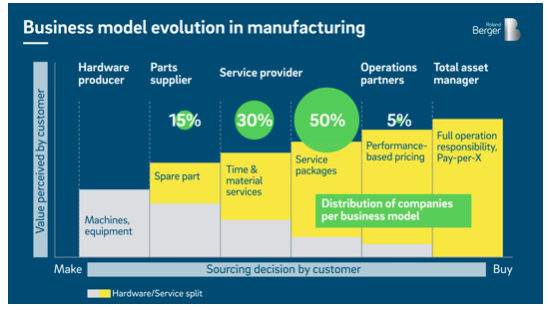
Manufacturing as a Service and servitization are two related concepts in the industry. Servitization is part of a business strategy where companies focus not only on creating and selling physical products but also offer additional services related to those products, aiming to create greater value for the customer.
Manufacturing as a Service is one way companies can implement servitization by offering a customized processing service, in addition to the simple sale of standard products.
In servitization, companies seek to offer complete solutions to customers rather than just products. Outsourcing the creation of goods can be a means to achieve these complete solutions, where custom manufacturing is a key component of the overall value chain offered to B2B customers.
The goal is to create a long-term business relationship where the company provides not only high-quality products but also services that meet the evolving needs of the customer. Flexible manufacturing services, with their ability to adapt to the specific production needs of committing partners, contribute to creating stronger ties with their supply chain partners.
Strategic Advantages of MaaS
- Softer and less impactful reshoring of entire production chains or its parts on business models;
- Supplier risk diversification across multiple committing companies;
- Possibility for manufacturing startups to access complex and specialized production processes;
- Lower incidence of fixed costs and shorter return on initial operational investment;
- Ability to perform various product tests simultaneously;
- Maintain integrated supply chains, especially in a historical period of longer average lead times, due to increased border controls, and risks of cyberattacks, counterfeiting, and technological leakage;
- Keep the industrial sector connected to the ongoing servitization of the European economy;
- Mitigate geopolitical risk, which causes supply chain disruption due to transport risks and geopolitical tensions with offshoring countries;
- Obtain unique spare parts from external manufacturing companies.
Operational Benefits of MaaS
The most significant advantage for a company from using customized manufacturing is flexibility. Here’s why:
Companies can increase or decrease volumes based on market demand fluctuations.
This adaptability helps avoid over – or under – production, reducing waste and improving operational efficiency. Investing in expensive plants and equipment, as well as bearing the fixed costs associated with maintaining and managing such activities, can be avoided.
On-demand adaptable manufacturing allows companies to access specialized suppliers with hyper-specific skills in the manufacturing sector. It accelerates time-to-market for quality products, utilizes existing supplier capacity, and initiates value chains quickly without waiting for the construction of new structures and facilities.
Risks associated with large-scale production are also mitigated. Companies can test new products or markets more agilely, reducing financial risks. All of this simplifies and streamlines the supply chain, allowing companies to focus on innovative design and product development.
Finally, outsourcing manufacturing offers the opportunity to customize products more agilely and creatively, contributing to improving customer satisfaction.
The Benefits of Blockchain for Businesses Adopting MaaS
One of the most significant advantages of distributed consensus protocols in targeted production outsourcing is process transparency. Companies can monitor every phase in real-time, improving visibility and security in the supply chain. The blockchain network uses advanced encryption to ensure the authenticity of the involved parts and products. Secure distributed databases help reduce the risk of counterfeit products pervasive in manufacturing, reassuring about quality in contexts discouraging trust in third parties.
Smart contracts are autonomous programs that execute specific actions when certain conditions occur. In customized manufacturing services, smart contracts can automate payment, delivery, and quality assurance processes, reducing time and costs associated with transactions and encouraging adherence to contractual agreements.
Shared ledger technologies also allow complete traceability of the supply chain. This is particularly important for the industry, where the origin of materials and their compliance with European and national regulations is crucial. A distributed accounting system provides an immutable record of supply chain information, simplifying compliance checks.
Decentralization can also effectively prevent industrial espionage. A decentralized blockchain system securely and transparently records all transactions and activities, including the purchase of materials, technical process steps, and product distribution, ensuring there are no unauthorized intrusions or data manipulations.
Blocks allow the establishment of permission-based access controls. This means that only authorized parties will have access to relevant information. For example, companies can authorize their service providers to view only specific data necessary to perform their task. The distributed transaction network ensures the integrity of recorded data, preventing malicious activities and protecting business data.
Smart contracts can be used to automate agreements and processes with precise conditions and deadlines, ensuring that the involved parties adhere to preset agreements.
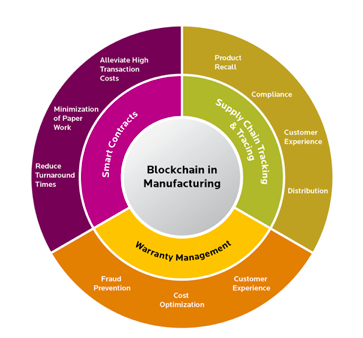
Real life use cases of how blockchain is set to disrupt the manufacturing world
Taken from:Three blockchain use cases that will accelerate Industry 4.0 journey for manufacturers, 2020
Challenges in Adopting Blockchain in MaaS
Implementation requires initial investments in infrastructure and staff training. Companies must carefully consider these costs when deciding to adopt this technology, as their financial plan and business model can be heavily impacted.
Some types of blockchain networks may have scalability limitations. When dealing with large output volumes, network congestion issues and longer processing times may arise, requiring careful selection of the tool based on its scalability capabilities.
Managing data on the distributed network may raise privacy and regulatory compliance concerns. Some business data may be sensitive or subject to specific regulations, such as the General Data Protection Regulation (GDPR) in the European Union. Companies must be aware of these considerations and implement necessary measures to ensure compliance upstream.
The vexata quaestio: blockchain networks for handling large volumes of data
Starting from the final answer: yes, a distributed system can support the management and analysis of large amounts of data in custom production processes because:
- It is a decentralized network of nodes that store a copy of all data. This makes it easier to manage large amounts of data because there is no need to rely on a single server or central repository.
- It is possible to trace all the details of previous production processes and material or financial exchanges, which is particularly useful in audits or compliance monitoring.
Conclusion: Choice of Technological Stack
An authorized or private blockchain may be more suitable as it would allow involved parties (suppliers, customers, partners) to participate in a controlled manner and share sensitive information only with authorized counterparts.
The size and number of data to be recorded on the blockchain network must be evaluated. If large volumes are expected, it must be ensured that the chosen blockchain can handle them efficiently. Some shared registries have scalability limits that may require customized solutions with higher initial costs.
Outsourced manufacturing may require rapid transaction management, especially in high-speed production processes. It is necessary to ensure that the distributed database can process a sufficient number of transactions per second to meet the demands of the most demanding industrial systems.
Data security is fundamental in safeguarding the business model and investor confidence, and it must be ensured that the consensus protocol provides robust security and encryption mechanisms to protect sensitive information.
It should also be checked whether the chosen ecosystem can integrate with existing systems and applications used in Manufacturing-as-a-Service, such as ERP (Enterprise Resource Planning) and other business solutions in use.
And what about costs? Carefully evaluate the costs associated with the implementation and management of the technological stack, including transaction fees, maintenance costs, and computational resource requirements.
In outsourced productions, there are often different parties involved in the supply chain. It is worth analyzing whether blockchain technology can be used to create a consortium or a trust network with other involved production stakeholders to improve transparency and collaboration.
Last but not least, it must be ensured that there is solid technical support and an active community of developers for the chosen type of distributed ledger, enabling anomaly resolution, updating ecosystem parts smoothly, and ensuring professionalism and planning for upstream and downstream partners in the chain.
Reference:
- La blockchain realizza la servitization in ambito manifatturiero, 2022
- Blockchain in Manufacturing: How Tech Is Changing the Industry, 2023
- How can blockchain power industrial manufacturing?, 2019
- Hybrid Blockchain Architecture for Cloud Manufacturing-as-a-service (CMaaS) Platforms with Improved Data Storage and Transaction Efficiency, 2021
- A Comprehensive Review of Blockchain Technology-Enabled Smart Manufacturing: A Framework, Challenges and Future Research Directions, 2023
- Blockchain-empowered Distributed Additive Manufacturing-as-a-Service: An Architectural Perspective, 2023
- Blockchain and Industry 4.0: Why Blockchain is at the heart of the Fourth Industrial Revolution and Digital Economy?, 2018
- The evolution of business models in manufacturing, Roland Berger, 2019
- Three blockchain use cases that will accelerate Industry 4.0 journey for manufacturers, 2020


 Market and Data
 _old_Become an author
 Wallet


