


Introduction
In the dynamic world of technology, two powerful forces have emerged as catalysts for transformative change: blockchain and artificial intelligence (A.I.). These cutting-edge technologies have captured the attention of industries worldwide, with the potential to revolutionize processes, enhance security, and drive innovation. This article explores the intersection of blockchain and A.I., examining their possible synergies, practical applications, and future implications of this formidable alliance.
The Convergence of Blockchain and A.I.
The integration of these two innovative technologies presents an unprecedented opportunity to transform industries and business processes. Blockchain provides a robust foundation for ensuring data reliability, transparency, and immunity to tampering, while A.I. offers the ability to analyze vast amounts of information and make intelligent decisions. Together, these technologies can address critical challenges such as data privacy, supply chain management, financial protection, and process clarity.
Blockchain ensures data integrity and traceability, while A.I. provides advanced analytics to unveil patterns and anomalies. This opens up new possibilities like decentralized markets, automated smart contracts, and secure data sharing for A.I. model training. However, the convergence of these two technologies still requires further technological advancements and appropriate regulations to maximize their capabilities and tackle challenges arising in practical implementation.
The intersection of A.I. and blockchain also has the potential to reshape the legal landscape and the Web3 ecosystem. Automating legal activities and ensuring secure record-keeping through integration can simplify the legal sector and enhance productivity. In the Web3 ecosystem, this convergence can enable decentralized applications that provide personalized services while maintaining privacy and security. Additionally, blockchain can address data challenges in A.I. systems, offering transparency and accountability. As these technologies continue to advance, their integration holds immense promise for the future.
A study predicts that by 2033, the global A.I. and blockchain industry will be worth $3.536 billion, growing at a CAGR of 22.9% from 2023 to 2033.
Enhancing Privacy and Data Security
The combination of blockchain and artificial intelligence significantly enhances data privacy and security. Blockchain, with its decentralized nature and cryptographic techniques, provides a secure environment where data can be stored immutably and shared only with authorized users. This ensures sensitive data is protected from unauthorized access and unwanted manipulation.
Furthermore, the integration of artificial intelligence can provide additional layers of data reliability and protection. A.I. algorithms can be used to detect anomalous behaviors, identify potential threats, and improve the ability to respond to cyberattacks.
The combination of A.I. and blockchain creates a robust system where data is reliably protected, and potential vulnerabilities are proactively addressed, offering significant benefits across various sectors.
Artificial intelligence can benefit from the integrity and trustworthiness of blockchain data, enhancing the conscientiousness of A.I. models. The decentralized nature of blockchain ensures the privacy and reliability of data, safeguarding sensitive information used by A.I. systems. Collaboration and data sharing through blockchain incentivize participation and drive A.I. innovation. Blockchain integration also enhances evidence and understanding, making A.I. more reliable. Sectors such as healthcare, supply chain management, finance, and cybersecurity can be transformed through the synergistic application of A.I. and blockchain.
The convergence of cybersecurity with networking, including A.I. and Blockchain technologies, has led to the emergence of the Secure Access Service Edge (SASE) market. SASE is projected to become a $15 billion market by 2025, with about half of it related to security. This trend highlights the increasing importance of security as a fundamental feature in various domains and sectors.
Transformation and Supply Chain Management
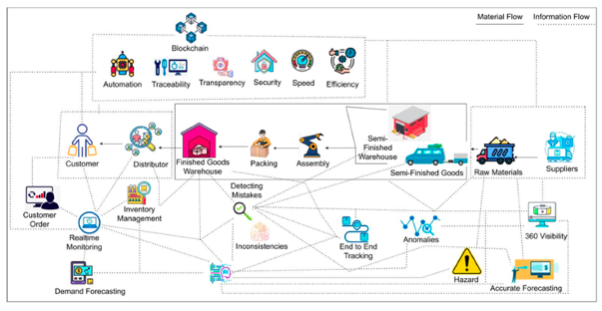
The integration of these technologies is revolutionizing supply chain management by enhancing efficiency, transparency, and collaboration. Blockchain offers evidence and traceability, enabling monitoring of the entire supply chain from production to distribution. Artificial intelligence, fueled by data collected from the blockchain, can analyze demand patterns and optimize logistics processes. This results in increased yield, cost reduction, and improved product quality. Additionally, blockchain can ensure the authenticity of products, preventing fraud and counterfeiting. The integration of blockchain and A.I. in supply chain management opens new opportunities for creating more transparent, secure, and sustainable supply chains.
Real-time data analysis, predictive analytics, and automation simplify processes, reduce costs, and improve customer satisfaction. Blockchain technology ensures clarity and data trust among supply chain partners. The future management of these chains lies in the use of intelligent machines and the adoption of innovative technologies to create more efficient and sustainable supply chains.
Figure 1 illustrates an advanced scenario with blockchain implementation in a smart supply chain.
Revolutionizing the Financial and Banking Sector
Financial and banking institutions are experiencing the disruptive force of the collaboration between blockchain and A.I. A.I. algorithms analyze large volumes of financial data to detect fraud and manage risk more accurately and efficiently. The reliability and transparency offered by blockchain enable safer and faster financial transactions, reducing costs associated with international payments.
Furthermore, automation provided by A.I. improves the customer experience by offering personalized and timely services. The collaboration between blockchain and A.I. opens new opportunities for creating decentralized business models and open markets where buyers and sellers can interact directly without traditional intermediaries. This technology combination is redefining the concept of efficiency in the financial and banking sector, allowing for more efficient transactions, better risk management, and more convenient customer services.
A.I.-based chatbots and virtual assistants provide personalized customer service, while A.I. algorithms detect fraud and ensure regulatory compliance. Blockchain technology guarantees secure and transparent transactions by eliminating intermediaries.
In 2023, venture capital invested $422 million in A.I.-related Crypto applications. Projects like Worldcoin and Auradine are already making significant strides in verification, identity, and privacy-focused Web3 infrastructure, respectively. With the advancement of A.I., blockchain technology has the potential to harness A.I.’s power while mitigating risks.
Opening New Markets and Business Models
The convergence of these two technological innovations paves the way for new markets and decentralized business models that can radically transform economic dynamics. Blockchains enable the creation of peer-to-peer markets, where participants can interact directly without the need for traditional intermediaries. A.I., integrated into these decentralized markets, brings additional benefits by enabling process automation, data analysis, and personalized recommendations. This improvement in service yield and customization opens new opportunities for businesses to reach customers directly and provide tailored solutions to their needs. Additionally, blockchain provides evidence and security in transactions, ensuring product traceability and authenticity. This is particularly important in sectors like e-commerce, the food industry, and luxury goods, where product origin and quality are crucial for consumers.
The reliability and transparency of blockchain, combined with the A.I.’s ability to generate intelligent solutions, pave the way for a new era of open, efficient, and personalized markets, creating unprecedented opportunities for innovation, economic growth, and technology professionals. These technologies, when combined, can enhance operational efficiency, streamline processes, and provide innovative products and services. Furthermore, the integration of blockchain and A.I. into mobile applications improves user experience and opens new revenue streams for developers.
Blockchain, with its decentralized nature, disrupts traditional business models by eliminating intermediaries, while A.I. optimizes processes based on it for increased productivity and cost savings. As companies increasingly embrace these technologies, the future for technology professionals appears bright and promising.
The convergence of Artificial Intelligence (A.I.) and Blockchain has the potential to create new markets and business models across various sectors. Some examples include:
- Energy management benefits from A.I.-optimized energy consumption and blockchain-enabled peer-to-peer energy trading.
- Agriculture sees improvements in irrigation, crop monitoring, and supply chain transparency through the integration of A.I. and Blockchain.
- In education, artificial intelligence offers personalized learning experiences, and blockchain secures academic credentials.
- In supply chain management, A.I.-based predictive analytics and secure data sharing through Blockchain enhance transparency and efficiency.
- In the healthcare sector, A.I. analyzes medical data while Blockchain ensures data integrity and privacy, leading to personalized medical solutions and telemedicine.
- Financial services leverage A.I.-based smart contracts and Blockchain transparency, enabling decentralized lending and automated investment advisory systems.
Impact on the Healthcare Industry
Blockchain and artificial intelligence (A.I.) together are having a significant impact on the healthcare industry. The use of blockchain can enable secure and transparent sharing of health data, ensuring patient privacy and improving accessibility to critical information. At the same time, A.I. can analyze large amounts of medical data, identify patterns, and provide more accurate and personalized diagnoses. Additionally, A.I. can be used to enhance drug discovery, accelerate research and development of innovative therapies, and improve patient management. This combination of technologies can lead to better quality of care, reduced medical errors, and promotion of innovation in the healthcare industry. However, addressing challenges related to sensitive data privacy and ensuring the implementation of these technologies in compliance with regulations is crucial to ensure patient and healthcare provider trust and confidence.
This fusion provides increased security, improved data integrity, and advanced analysis capabilities, enabling healthcare practitioners to provide personalized and precise care. Harnessing the benefits of the blockchain–A.I. combination, healthcare organizations can transform how they operate, optimize resources, and ultimately improve patient outcomes. However, addressing interoperability, standardization, and ethical concerns are essential to fully unlock the potential of this powerful synergy in the healthcare sector and beyond.
The is revolutionizing drug discovery by speeding up processes and enhancing result analysis. Experts predict greater adoption of artificial intelligence in drug discovery by 2023, with a market projected to exceed $4.0 billion by 2027 with a CAGR of 45.7%.
Conclusions
The convergence of blockchain and artificial intelligence opens a world of opportunities and innovation. This fusion of technologies has the potential to revolutionize key sectors such as supply chain management, the financial sector, healthcare, and many others. Yet, to fully harness the potential of this alliance, several crucial challenges must be addressed.
Scalability and resource efficiency are important to ensure that A.I. can be used on a large scale and that blockchain can handle a high volume of transactions. Standardization of data and formats is essential to enable interoperability between different A.I. and blockchain systems. Protecting sensitive data privacy and finding the balance between transparency and confidentiality are critical to ensuring user trust and compliance with data protection regulations. User adoption and education are necessary to increase awareness and understanding of the benefits and challenges of this integration.
Addressing these challenges requires active collaboration among researchers, developers, regulators, and stakeholders. Only through joint commitment can we create an environment conducive to innovation and maximize the strength of this powerful fusion. Looking to the future, we expect to see continued growth in the applications and solutions that this convergence can offer, leading to a more transparent, efficient, and decentralized future.


 Market and Data
 _old_Become an author
 Wallet


