



Introduction
In recent years, the term blockchain has entered everyday language, often accompanied by growing expectations, simplifications, and promises that are difficult to verify.
For some, it represents radical innovation; for others, risk; for many, immediate opportunity. Between these perspectives lies a significant amount of confusion.
Beyond the narratives that have developed over time, blockchain was originally conceived as a technological infrastructure: a system designed to ensure traceability, transparency, and reliability of data in distributed digital environments.
When attention shifts from promises to mechanisms, from expectations to processes, a fundamental distinction emerges: technology is not a promise of outcomes, but a foundation on which functional systems can be built.
Understanding this difference is now essential to approach digital innovation with clarity, responsibility, and long-term vision.
Blockchain Is Not a Promise, It Is an Infrastructure
At its core, blockchain is a distributed digital ledger.
A system that allows information to be recorded in a shared, verifiable, and tamper-resistant way, without relying on a single central authority.
This architecture introduces several key elements:
- transparency, as information can be independently verified;
- immutability, since recorded data cannot be arbitrarily altered;
- resilience, because the system does not depend on a single point of control.
Conceptually, blockchain is not unlike other major digital infrastructures we now consider standard, such as the internet, data centers, or cloud computing.
Technologies that, when first introduced, were complex and poorly understood, yet proved their value over time simply because they worked, regardless of how they were portrayed.
The Origin and Function of Blockchain
Blockchain was not designed to generate rapid financial gains, but to establish trust in complex digital environments.
Enabling different actors to interact within a shared network, without relying entirely on centralized intermediaries, is a technical challenge before it is an economic one.
This function makes blockchain relevant across multiple domains:
- data management
- information traceability
- digital certification
- process automation
The value of the technology therefore lies not in promised outcomes, but in the robustness of the systems that support it.
Why We Should Speak of Infrastructure, Not Trends
When technology is presented solely as an “opportunity,” it loses a fundamental part of its meaning.
By definition, infrastructures operate quietly: they require maintenance, expertise, and governance.
Recognizing blockchain as an infrastructure means:
- shifting focus from narrative to functionality;
- evaluating long-term sustainability rather than immediate impact;
- accepting that real innovation requires method, not enthusiasm.

When Narratives Overtake Technology
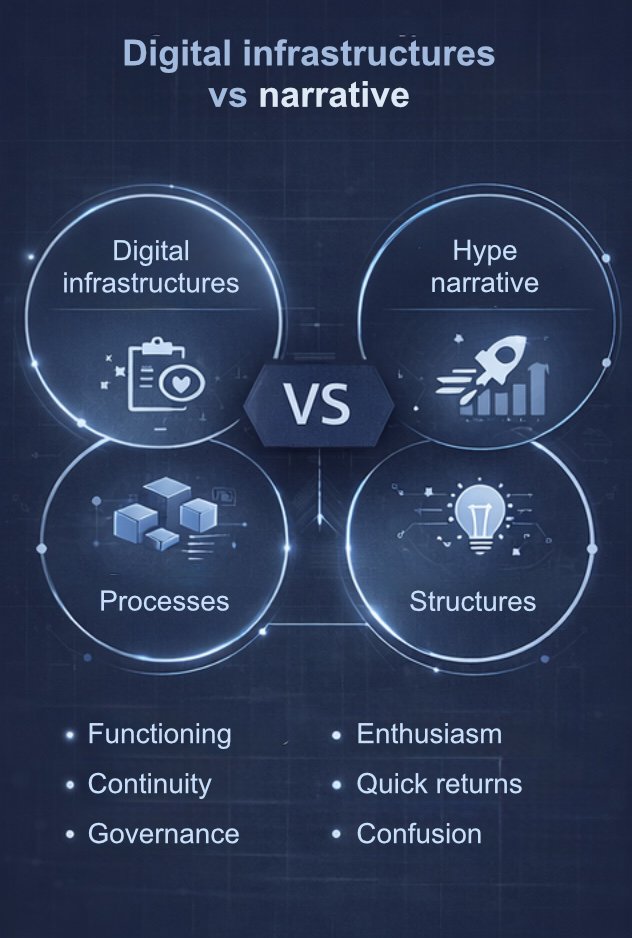
One of the most common side effects of digital innovation is the tendency to oversimplify complex systems.
In the case of blockchain, this simplification has often transformed a sophisticated technology into a vague promise, creating expectations it was never designed to fulfill.
The Hype Effect in Digital Innovation
Every major technological shift goes through a phase of collective enthusiasm.
Problems arise when hype replaces understanding.
In such contexts:
- communication advances faster than technology;
- promises precede operational systems;
- storytelling outweighs analysis.
This gap damages not only end users, but also the credibility of the technologies themselves, which are judged for what they were never intended to deliver.
Risks of Decontextualized Communication
Discussing blockchain without context exposes audiences to:
- decisions based on partial information;
- expectations misaligned with technical reality;
- loss of trust in the medium to long term.
This is why it has become increasingly necessary to bring discussions about innovation back to responsibility: explaining limits, clarifying functions, and distinguishing technology from narrative.
Digital Infrastructures: What It Really Means to Make Technology Work
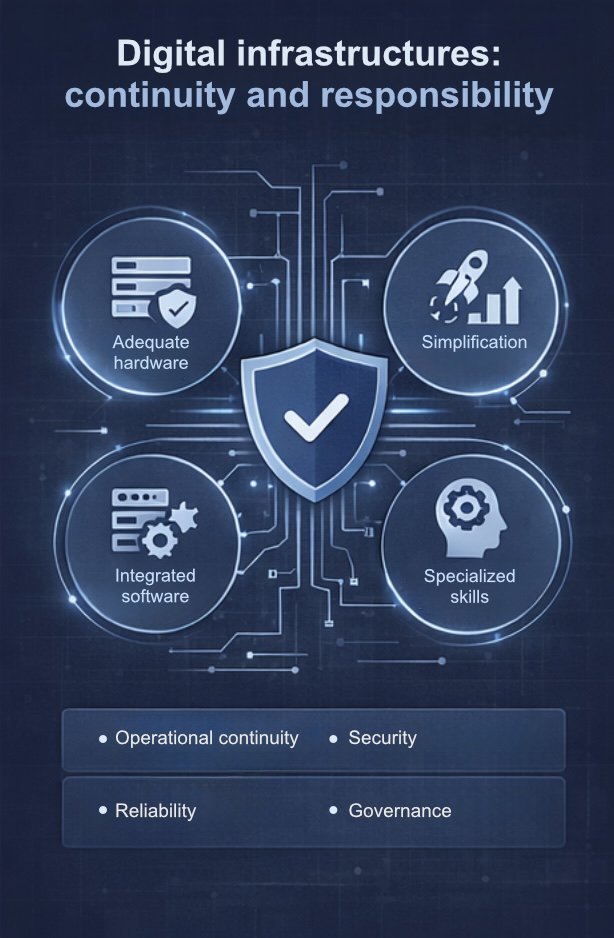
Every digital infrastructure relies on three essential pillars: design, continuity, and accountability.
Without these elements, even the most advanced technology remains incomplete.
Hardware, Software, and Operational Continuity
Behind every functional digital system lie components that are often invisible:
- appropriate hardware
- updated software
- continuous maintenance
- specialized expertise
Blockchain is no exception.
Its effectiveness depends on the ability to operate continuously while managing technical complexity, costs, and security. This is where the difference between theoretical projects and real infrastructures becomes evident.
The Difference Between an Idea and a System
An idea may be compelling, but a system must be reliable over time.
This requires governance, clear processes, and defined responsibilities—elements rarely highlighted in superficial discussions of innovation.
Why Technology Matters More Than Promises
In the long run, what remains are not promises, but systems that function.
The history of digital innovation shows this clearly: technologies with lasting impact are those built on solid infrastructures, not those generating the most attention.
Promises Change, Infrastructures Remain
The internet did not succeed because it promised immediate results, but because it established a global infrastructure.
The same applies to cloud computing, data centers, and digital payment systems.
Blockchain follows the same logic: its value emerges over time, as it is integrated into sustainable and responsible processes.
The Responsibility of Those Who Communicate Technology
Those who communicate about innovation today carry increasing responsibility:
to avoid confusing technical possibilities with guaranteed outcomes.
Communicating technology means:
- providing context;
- clarifying limitations;
- avoiding misleading simplifications.
Only in this way can digital innovation contribute to a more mature and responsible technological culture.
Regulation and Responsibility: A Necessary Step
European regulatory developments should be seen as a natural step toward sector maturity.
Regulation does not hinder innovation; it helps make it more transparent, understandable, and sustainable.
In a regulated environment, technology can be evaluated for what it truly is:
an infrastructure to be understood, not a promise to be pursued.
This approach supports:
- stronger user protection;
- more accurate communication;
- a more resilient ecosystem over time.
Conclusion: Returning to Technology Before Making Decisions
Blockchain represents one of the most significant digital infrastructures of our time—if it is approached for what it truly is: a technology, not a promise.
Re-centering the discussion on functionality, limits, and responsibility is now essential to avoid judging innovation based on unrealistic expectations.
In an increasingly complex digital world, true expertise lies not in predicting the future, but in understanding systems before making decisions.
And this is where any serious reflection on innovation should begin.






 Market and Data
 _old_Become an author
 Wallet


