


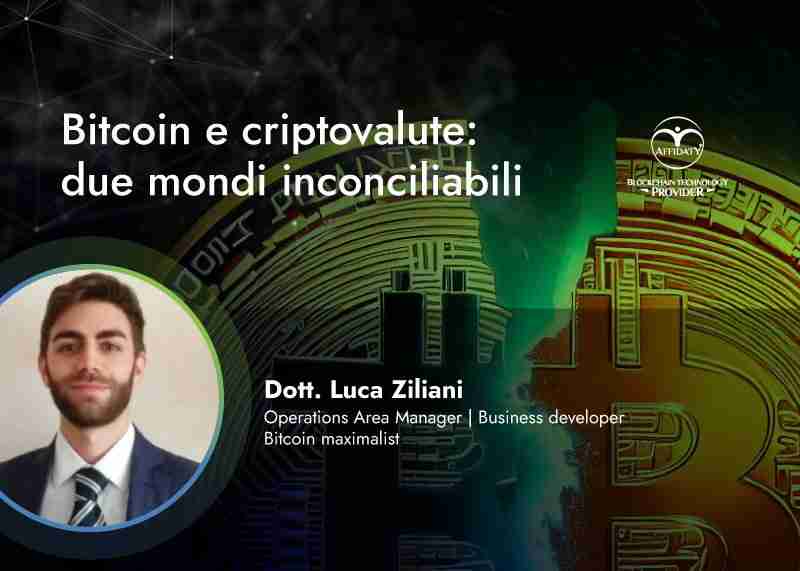
Despite initial skepticism, which is typical of any innovation in its early stages, it is now clear that cryptocurrencies are part of our daily lives and that their mass adoption will bring a revolution that will further integrate the digital world into our lives.
At the heart of any known cryptocurrency is the blockchain: a technology capable of disintermediating and decentralizing the management of information and the economic value associated with it, and which is considered one of the technologies that will be at the base of corporate information systems around the world in the near future.
Since this innovation has now been accepted by the public and, to a large extent, by regulators around the world, and since the environmental issues associated with it have mostly been overcome, there is a question that we have stopped asking ourselves: do we really need a blockchain?
Indeed, when it comes to technological innovation, we expect a certain level of efficiency, but the blockchain is not an efficient system, but rather the opposite. It is based on the redundancy of the information it contains, which is duplicated on all nodes of the network, and on the Proof of Work, which requires high computing power (hashrate) and therefore high electricity consumption by the nodes themselves, in order to verify the accuracy of that information and ensure its immutability.
At least this is true for the first one that was invented, and the only one that can be truly decentralized: Bitcoin‘s blockchain.
Yes, because everything that has come after, all the technology that underlies other cryptocurrencies, is nothing but an attempt to overcome Bitcoin‘s limitations, to overcome the so-called blockchain trilemma, which states that only two of the characteristics of decentralization, scalability, and security can be achieved at the expense of the third.
And while for Bitcoin, Satoshi’s choice was to sacrifice scalability, in terms of the number of transactions per second, for Ethereum (post merge), Cardano, Solana, Avalanche, Polygon, and Tron, which are just some of the most used, the characteristic of decentralization was sacrificed in order to obtain greater scalability.
And what has all this achieved? Only to create dozens of “blockchains” all having, essentially, the same functionality albeit with slightly different characteristics in terms of consensus mechanisms, number of network nodes, and transactions per second processed, and yet all with the same common note: the lack of decentralization.
But why is decentralization so important? Simply because it makes a blockchain truly immutable by making it more difficult to carry out a coordinated attack by the majority of nodes on the network to modify the transactions that have been saved. In fact, a decentralized blockchain like Bitcoin‘s is based on the concept of non-trust: since you cannot trust those who validate transactions, as they would have the ability to modify them for their own benefit, each node is required to store the history of all transactions that have occurred (something that generally happens in any blockchain) and makes every attempt to modify them through Proof of Work extremely costly (this is the difference), discouraging malicious behavior and instead rewarding the work done to validate them with the creation of new cryptocurrencies (mining).
This means that any blockchain that is not completely decentralized tends to be exposed to potential attacks and necessarily requires users to place their trust in those who control it, especially when it is based on Proof of Stake, which requires nodes that stake a larger amount of cryptocurrencies to be more likely to be chosen to validate transactions.
As a result, those who own more coins can agree and launch a targeted attack, which is made much easier by the fact that it is sufficient to agree on at most a few dozen nodes and not tens of thousands, as in the case of a decentralized blockchain where all nodes on the network have the same value.
So, if users have to trust those who have control over the blockchain to ensure that their money, in the form of cryptocurrency, is really their property, what is the difference between the information systems used by a bank or a technology company like Google, for example, since users are forced to trust these entities when using their services? The answer is very simple: there is no difference.
There is no difference between a bank and a cryptocurrency based on a non-decentralized blockchain, as far as those who use their services are concerned, except for the technology, which is also much less efficient by definition, and the fact that banks are much more regulated and therefore more secure. But then why do we need a blockchain if a banking system already exists and is more efficient?
What is certain is that the blockchain, which is rooted in Hayek’s economic theory, is an incredibly effective innovation for one and only one purpose: to disintermediate the concept of money, making it a purely peer-to-peer exchange medium in order to eliminate the monopolistic influence of states on money control, and therefore eliminate the need to rely on banks to use it.
This is why Bitcoin was created, this is why Proof of Work, along with mining difficulty adjustment, is a fundamental mechanism to ensure network security and is precisely because it requires a high energy consumption, as it means making an attack on the network extremely expensive, and it is always for this reason that decentralization is the most important characteristic of all: because if it were not, any court could easily order the servers to be shut down and the entire blockchain to cease to exist.
For this reason, all cryptocurrencies that have been designed to overcome the limits of Bitcoin are ultimately destined to fail: because as soon as they start to represent a threat to the current financial system, they will be declared illegal and discontinued, exactly as has already happened with the e-gold experiment.
Talking about cryptocurrencies means considering everything outside of Bitcoin, and at the moment, any existing solution is not decentralized and, therefore, it is extremely unlikely to be considered a valid alternative to the global financial system.
What represents an unimaginable revolution until a few years ago, instead, is a completely decentralized system, because it takes away the power associated with the creation of money from the institutions that have had it for centuries and returns it to the people; people who, as we are seeing again in recent months, are the ones who ultimately pay the price of artificial monetary inflation policies decided for them by such institutions.
Therefore, the blockchain is exclusively that of Bitcoin and Bitcoin is the underlying currency that makes this technology economically sustainable; the world of cryptocurrencies, on the other hand, is an experiment aimed at trying to replace some secular institutions with new entities, to change the actors involved but not the system itself, and it is unlikely to expect that this can happen because, as already mentioned, this change does not bring any additional advantage for users, so, in fact, the basic characteristic of any technological revolution is lacking.
This means that if the blockchain is successful as a technology, it will depend exclusively on the adoption of Bitcoin: to give birth to a new financial system, it is necessary to use it all over the world, or at least in most of it, but for this to be possible, it must be scalable and, as mentioned earlier, Bitcoin is not.
This is why the real innovation, at this point, lies in not using the blockchain or, better said, using Bitcoin without the blockchain.
transactions that occur between two users by opening a dedicated channel, and which allows them to be transcribed onto the main blockchain in the form of a single transaction once the channel itself is closed (similarly to the settlement mechanism that occurs between banks, but extended to every pair of network users).
This makes it possible to process a greater number of transactions than cryptocurrencies based on Proof of Stake, and with a transaction speed faster than Visa and Mastercard, thus overcoming the blockchain trilemma and making Bitcoin usable on a daily basis, finally achieving Satoshi’s vision of Bitcoin as a decentralized and peer-to-peer means of exchange that is also a store of value.
For an innovation to be such, it must bring a substantial improvement compared to the state of the art and change the habits of those who use it every day, surviving at the expense of all its imitations. The blockchain has the potential to become the most important innovation in modern history, but only if Bitcoin is accepted as the base currency of the new global financial system; and this will only happen if people recognize it as such and use it.
Yet, in order for this to happen in the future, it is necessary for each of us to grasp the essence of blockchain technology, understand the driving force behind such a revolutionary innovation, and fully understand how Bitcoin and cryptocurrencies are two incompatible worlds that cannot coexist and that inevitably, will continue to clash until one survives at the expense of the other.
I bet on Bitcoin, and you?


 Market and Data
 _old_Become an author
 Wallet


