



Mining.
Bitcoin mining is the process of validating transactions and creating new bitcoins on the Bitcoin network. Mining is carried out by specialized computers that solve complex mathematical problems using Bitcoin’s proof-of-work algorithm. Each time a problem is solved, the computer that solved it is rewarded with a small amount of bitcoin. This process of problem-solving and reward is repeated continuously, allowing the Bitcoin network to function safely and add new transactions to its blockchain (the list of all transactions that have occurred on the Bitcoin network).
Proof-of-work is a consensus system used in many distributed systems, such as Bitcoin, to allow network participants to reach an agreement on the state of transactions. In the Bitcoin system, miners must solve a complex hash problem, known as the “proof-of-work problem”, to be able to add a new block of transactions to the blockchain. Solving the hash problem requires time and computational resources, which means that miners must invest some effort to solve it. Once a miner has solved the hash problem, the new block is added to the blockchain and the miner receives a reward in bitcoin for their work. Proof-of-work was designed to prevent network participants from adding false transactions or fraudulently modifying existing ones, as any attempt would be thwarted by the network and the fraudulent miner expelled.
Trading.
Bitcoin trading is the activity of buying and selling bitcoin on a financial market. Bitcoin traders seek to make profits by buying bitcoin at a low price and selling it at a higher price in the future. Bitcoin trading can be carried out on various online platforms, such as cryptocurrency exchanges. To start trading bitcoin, it is necessary to first open an account on a cryptocurrency exchange. Once registered on the platform, funds can be deposited into the account to start trading. At this point, one can choose whether to buy or sell bitcoin, keeping in mind the current market price and predictions on how it may evolve in the future. It is important to note that bitcoin trading carries risks, as the price of cryptocurrencies can vary significantly in a short period of time. Therefore, it is essential to conduct adequate research and planning, as well as undertake an appropriate period of study, before starting to trade. It is important to use good money management and a well-defined trading strategy to protect one’s cryptocurrency portfolio.
Technological support.
The use of algorithms and artificial intelligence (AI) for bitcoin and other cryptocurrency trading is becoming increasingly common. Trading algorithms can be used to analyze data on bitcoin prices and transactions and use this information to make automatic trading decisions. AI, in particular, can be used to develop price prediction models and automate trading.
For example, an AI algorithm could be trained on historical bitcoin price data to predict which direction the price will move in the future and then use these predictions to automatically buy or sell bitcoin. There are many advantages to using algorithms and AI for bitcoin trading: they can perform more complex and faster analysis than a human being, and can also operate 24 hours a day, 7 days a week, which means they never miss trading opportunities.
AI can help reduce human error and emotion in trading decisions. That being said, it is important to note that algorithms and AI are not infallible and do not completely eliminate risk in bitcoin trading. Additionally, algorithms and AI are only tools, and success in trading depends on the quality of input data and the proper configuration of the algorithms themselves. It is important to constantly monitor the algorithms and AI used to avoid any potential issues or unexpected behaviors.
Algorithms and AI can help address the emotional issues that bitcoin traders may face, as they operate based on a set of predefined rules and data analysis, eliminating the effect of emotions on trading decisions. The use of algorithms and AI in bitcoin trading can help remove fear and greed, which are common emotions among traders and can lead to irrational trading decisions.
They can also help remove the effect of negative emotions such as anger or sadness, which can lead to impulsive trading decisions. Additionally, they can help ensure greater objectivity in trading decisions, as they base their decisions on data analysis rather than the trader’s personal emotions.
Wallet and Exchange.
A wallet is software that allows users to manage and store their private keys. Wallets can be online, desktop, or mobile, and there are different types of wallets, such as hardware wallets, physical devices that allow users to securely store their private keys.
An exchange, on the other hand, is an online platform that allows users to buy and sell cryptocurrencies using fiat currencies (such as the euro or the dollar) or other types of cryptocurrencies. Exchanges act as intermediaries between buyers and sellers and allow for fast and secure cryptocurrency exchanges. The main difference between a wallet and an exchange is that a wallet is used to store private keys, while an exchange is used to buy and sell cryptocurrencies.
Many people confuse these two technologies, wallet and exchange. It is essential to understand that they are two distinct and very different things. The main difference is that the wallet is where I keep my private keys, so I have actual possession of my bitcoins without intermediaries. This entails responsibilities, as if I lose access to the application, I have irretrievably lost my savings. It is estimated that about 25% of bitcoins in circulation have been lost for similar reasons.
It is therefore important to choose a wallet that allows for secure access, and especially account recovery. We should only choose applications that, in addition to the normal login procedure, provide me with a passphrase, usually composed of 12 words, better if 24, which will allow me to regain access to the private keys essential to dispose of my beloved bitcoins again.
The 5 golden rules.
Before using and buying bitcoins, it is important to keep in mind that it is a currency different from the traditional one, so it is advisable to inform oneself beforehand about the risks involved. Observing the market before moving is essential:
- Always keep our wallet safe, just as we do with our real wallet in everyday life.
- The value of Bitcoin is not stable, so it can increase or decrease unpredictably. For this reason, it is not advisable to keep all your savings in bitcoin and convert more than you are willing to lose. It is a high-risk investment.
- Once confirmed, the transaction cannot be cancelled, so it is advisable to ensure in advance that the person (or organization) to whom you want to send the money is reliable. Check several times the correct insertion of the recipient’s address. There are malware that change the address by acting on copy and paste commands, inserting one similar to the original but different in a few characters and sending our money to another person.
- Bitcoin is not anonymous, all transactions are collected and are publicly available in a shared ledger. What is not possible to know is the real name of who carried out the operation, unless there is a good reason, such as a police investigation for a crime committed.
- It is a type of currency in full development and with an uncertain future. The maximum limit of bitcoins is set at 21 million and for many, its value is destined to rise, but no one can swear that it will still exist in 20 years.
Earning with Bitcoin.
Bitcoin lending is a financial practice that involves lending your cryptocurrency to another user or company in exchange for interest. It is a way to earn income from your position in Bitcoin without necessarily having to sell it. Loans can be made on online platforms that offer Bitcoin lending services, where users can provide their cryptocurrency to be lent to other parties or companies. In this way, users can earn interest on their Bitcoin, while other parties can access Bitcoin for trading or investment purposes.
Bitcoin lending is a very common practice (DeFi), especially among investors looking to earn a return on their Bitcoin without parting with it. However, one must be careful of the risks associated with this practice, such as the risk of default by the borrower or the risk of losing control of their Bitcoin during the loan period.
There are several ways to get Bitcoin:
- Mining: Bitcoin mining involves solving complex mathematical problems using a computer’s processing power. Once solved, these problems are added to the Bitcoin blockchain, and the miner receives a small amount of Bitcoin as a reward. However, mining requires a significant initial investment in hardware and maintenance costs such as electricity.
- Trading: Bitcoin trading involves buying Bitcoin when the price is low and selling when the price is high. There are several online platforms for Bitcoin trading, such as Coinbase or Binance. However, trading requires specific knowledge and skills to analyze markets and predict price fluctuations.
- Lending: Bitcoin lending involves lending Bitcoin to others in exchange for interest. There are several online platforms for Bitcoin lending, such as Nexo or BlockFi. With lending, investors can earn passive income without having to deal with the initial investment and maintenance costs required for mining or the risks of trading without adequate experience.
- Receive payments in Bitcoin: if you work for a company or have a business that accepts Bitcoin payments, you can get Bitcoin simply by accepting payments in this cryptocurrency.
- Buy Bitcoin: you can buy Bitcoin using fiat money (such as dollars or euros) on an exchange platform such as Coinbase or Binance.
- Receive Bitcoin as a gift: you can receive Bitcoin as a gift from friends or relatives who already own this cryptocurrency.
Paying in Bitcoin.
Credit and debit cards, payment systems like PayPal, and similar methods work well on the Internet, but they have a big limit: they adapt slowly to the growing needs of technology, and not everyone is happy about it… Most digital payment methods have a feature that for many people represents a huge advantage: speed, negligible transaction costs, and it is outside the banking system. Above all, it does not leave information about our lifestyle habits around. While it is true that those who have nothing to hide may not care too much, it is also true that for many, maintaining anonymity about what they buy, sell, or transfer represents a life choice, an indispensable expression of freedom. We know that information is a valuable commodity these days, so why give it away unwittingly to who knows who? The Bitcoin system was created for this.
When you buy something by paying in Bitcoin, the transaction is recorded in the Blockchain, but no one can trace it back to our identity, as to the goods or services received. However, the use of this digital currency as a payment method is still very limited, although several stores (especially online) have started accepting it. Pay attention to the small Bitcoin symbol in the “Payment Methods” section to check whether a site accepts this or another digital currency. There are apps like BitcoinMap that use geolocation to show us nearby businesses that are “open” to Bitcoin. Contrary to what we might think, there are places in Italy where we can pay in Bitcoin: bed and breakfasts, bookshops, shops, and much more. In Rovereto, a pioneer city in the field of cryptocurrency exchanges, digital currency payments are also accepted at the bar as well as at the newsstand. In the capital, there is a luxury watch shop that allows Bitcoin payments. Its motto effectively reads, “if you trust math, you can trust Bitcoin.”
How it works.
To send and receive bitcoin payments, you need to first own a wallet. The procedures for transactions are very similar regardless of the type of digital wallet. For each transaction, whether incoming or outgoing, there is a personal alphanumeric identification code that defines the address, essential for making payments. Instead of the alphanumeric code, you can use the QR code containing the same address. This represents a more convenient and faster method compared to typing in the code, and is currently also safer than copy and paste.
To receive a bitcoin payment, simply provide your address or QR code. This is an example of a bitcoin address: 19BY2XCgbDe6WtTVbTyzM9eR3LYr6VitWK. As you can see, it is difficult and tedious to rewrite this string for making a payment, which is why the QR code displayed on your smartphone is more practical.
The positive side for merchants is that they do not need any dedicated devices such as POS or similar. A simple smartphone or PC within the commercial establishment is sufficient.
The three steps.
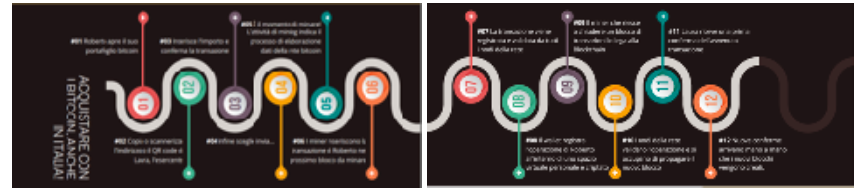
The process of paying with cryptocurrency is more difficult to explain than to do. I summarize it in three steps:
- Register with a wallet/exchange and purchase bitcoin by transferring money from your bank account.
It is possible to do a bank transfer or buy with a credit card, although often this system requires higher fees. - Install the app on your smartphone that allows you to pay and receive money. Now your phone is also your digital wallet.
- Enter a store. To buy a good or service and pay with bitcoin, scan the QR code displayed by the merchant.
Finally, enter the amount and confirm the transaction.
Conclusion.
Bitcoin represents a true revolution in the world of cryptocurrencies, from its mysterious origins to the present day. Its history has been marked by increasing popularity and adoption, not only as a form of investment but also as a means of exchange for goods and services. Bitcoin has significant social and economic implications that go beyond just changing the way we manage our money. It has the potential to help reduce dependence on central banks and promote financial inclusion for those who have been excluded from traditional banking systems.
Bitcoin use cases are constantly evolving, with many companies and organizations beginning to accept it as a form of payment, demonstrating its validity and credibility as a means of exchange. Its use as a form of saving and investment is attracting more and more attention from investors as it offers another option for portfolio diversification. Predictions for the future of Bitcoin are uncertain, with some seeing it as the next big thing and others considering it a speculative bubble.
However, regardless of this, it is important to understand what Bitcoin is, how it works, how to use it and store it. After careful analysis supported by adequate knowledge, if we realize that it can be useful for us, we can convert some euros and become part of a peaceful revolution that is fundamental for a future up to the challenges that await us.
In summary, Bitcoin represents a new frontier in the digital economy, and its growing adoption and use demonstrate its validity and potential as a means of exchange, savings and long-term investment. The topic of Bitcoin is extremely vast and complex, and the aspects we have covered in this article represent only a small part of what there is to know about this technology.
From technical aspects to social and economic impact, there are many facets to consider when talking about Bitcoin. It is important to emphasize that the topics covered in this article are only starting points for reflection, and that deepening one’s knowledge is necessary to begin to understand a paradigm shift such as that represented by Bitcoin. Understanding how Bitcoin’s underlying technology works, as well as its social and economic implications, is essential to making informed decisions about using and investing in this cryptocurrency. Furthermore, it is important to keep in mind that the cryptocurrency landscape is constantly evolving and changing, so staying up to date on the latest news and developments is important.
This means that to fully understand Bitcoin and its implications, it is necessary to dedicate time and energy to studying and learning continuously. In summary, Bitcoin represents a paradigm shift in the economic/financial world of cryptocurrencies, but continuous study and in-depth analysis are necessary to fully understand it. In general, studying Bitcoin can lead to numerous benefits, not only in economic and financial terms, but also in terms of knowledge and understanding of social and technological trends and implications.
First, by delving into the technology behind Bitcoin, its social and economic implications, its opportunities for use and investment, we will be able to have a more complete and informed view of the cryptocurrency and its potential. We will be able to make more informed decisions if we decide to invest in Bitcoin and use it as a means of exchange or savings. Second, Bitcoin represents one of the greatest innovations in the digital economy in recent years, and in-depth analysis will allow us to be protagonists in the development of the future of money and online transactions. We could seize the opportunities that will arise with the growing adoption of this digital currency.
Being able to devote time to studying Bitcoin will give us the opportunity to connect with a global community of people interested in this technology and passionate professionals in this field with whom to exchange ideas and knowledge. This can help develop new professional relationships and stay up to date on the latest trends and developments in the world of cryptocurrencies.
“Bitcoin is more than just an investment, it is a paradigm shift that is revolutionizing the way we think about money and online transactions. Let’s get ready to discover how this technology can change our future.”




 Market and Data
 _old_Become an author
 Wallet


