


Currently, the bitcoin and ethereum blockchains use an energy-intensive process called proof-of-work (PoW) to ensure all transactions on the network are valid and the distributed record of the network is accurate. PoW, the consensus algorithm of btc and eth, has demonstrated over the years to be a secure and reliable protocol, with no successful attacks on the bitcoin chain, and as long as there are enough honest participants, the risk of hash power aggression will be limited to zero.
But despite PoW being secure and reliable, Satoshi Nakamoto’s algorithm seems to have lost appeal due to its energy-intensive aspects and tendency towards centralized mining pools. A common criticism of the PoW mining industry is that it encourages resource centralization and thus security providers.
A more scalable and energy-efficient system is increasingly attracting the interest of major blockchain development teams, such as ethereum, which is transitioning from PoW to proof-of-stake (PoS), a different way of ensuring blockchain security where investors lock their funds in exchange for rewards.
Countless PoS projects are, in fact, heading towards tremendous growth for their promises of energy efficiency and greater decentralization, growing both in terms of interest as new frontiers of algorithmic consensus and as new business opportunities.
Alongside substantial technological differences, it should be emphasized that a PoS network creates economic opportunities by incentivizing Stakers to contribute to its security, rewarding validators with block rewards and transaction fees.
In the PoS network, StakerHolders are rewarded by the sum of transaction fees and the value of network inflation, which can be thought of as the primary incentive that encourages users to leverage their cryptographic resources.
The following chart shows the top 10 Proof of Stake networks ranked by the number of unique staking addresses. The networks with the most exclusive staking addresses are ranked at the top. The ranking provides an overview of the network with the highest retail staking participation in the entire crypto universe.
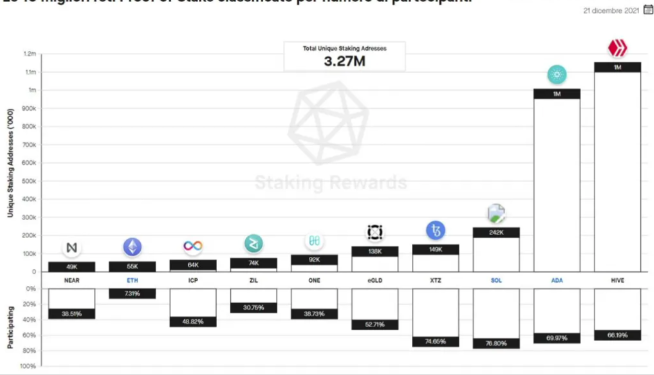
Source: https://www.stakingrewards.com/
In a PoS system, contention is replaced by competition to attract native cryptocurrency, where participants who wish to become network validators lock a portion of this proprietary cryptocurrency as a commitment to contribute in good faith to the consensus process.
This chart shows the top 10 Proof of Stake networks ranked by USD value in relation to the quantity of tokens put in stake, with the highest Stake Value indicating network security, resilience, and greater network security.
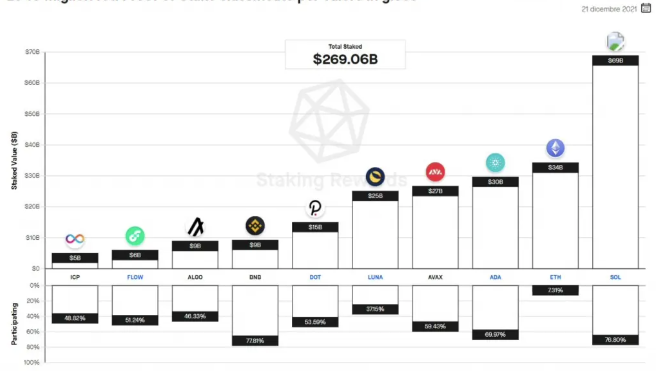
Source: https://www.stakingrewards.com/
Although the total stake value provides security, staking has an opportunity cost: resources are locked up for a period of time and cannot be used for other purposes, such as borrowing, trading, or using tokens for DeFi.
This problem applies to most PoS networks that use a staking mechanism, but it is avoided in networks such as Cardano and Takamaka, which support a native liquid staking.
Beyond the technical aspect, it should be emphasized that these PoS chains open up similar business opportunities for both individuals and companies seeking to capitalize on the rewards they receive.
The yield is currently interesting not only because staking reduces the opportunity cost of holding crypto, but also because these pay a reward significantly more meaningful than other almost zero-interest investment assets.
For example, note the rewards for holding some crypto in a portfolio and note not only how yields vary from just over 2% to a maximum of 19% per year.

Source: https://www.stakingrewards.com/
The opportunity to use cryptographic resources to earn yield through staking could make these resources more attractive and help increase adoption of cryptocurrencies. It is important to remember that we are still early in this technology and it is worth noting that a new, more revolutionary consensus mechanism than PoS could be created in the future, making the current innovation irrelevant.
However, given the years of research dedicated to consensus projects, it is highly unlikely to happen overnight. While all eyes are on Ethereum 2.0, which was supposed to be released in 2020, many recent blockchain technologies have based their consensus on the PoS algorithm, laying the foundation for a nascent industry and a new financial paradigm.
According to estimates by JP Morgan, staking across all PoS blockchains currently generates $9 billion in annual revenue, but is expected to become a $40 billion business by 2025.
Only time will tell.
Mario Carlini CEO of Takamaka.io
Ref.
https://www.goldmansachs.com/what-we-do/consumer-and-wealth-management/p rivate-wealth-management/intellectual-capital-f/beauty-is-not-in-the-eye-of-the-be holder-report.pdf
https://www3.weforum.org/docs/WEF_Getting_Started_Cryptocurrency_2021.pdf https://www.stakingrewards.com/
https://www.stakingrewards.com/






 Market and Data
 _old_Become an author
 Wallet


