



Introduction: AI doesn’t make us more creative – it forces us to clarify the goal
From my experience, A.I. didn’t teach me what creativity is. Instead, it forced me to define more clearly what I’m trying to achieve.
Because A.I. has a brutal trait: it’s incredibly fast at producing possibilities, but it’s also extremely good at producing plausible things that don’t actually match what you had in mind.
If you can’t define the objective, constraints, and quality criteria, it will take you “somewhere” in a few seconds. And that “somewhere” can be mediocre, incoherent, or even completely wrong.
On the other hand, the very incoherence and aberrations of guided generation can open up unforeseen scenarios – and sometimes even more interesting ones. A mistake becomes creative only if you notice it and choose what to keep.
In this article I’ll show you how I apply this in practice, with a focus on image generation. I’ll walk you through a character-design case study I had fun with a few months ago.
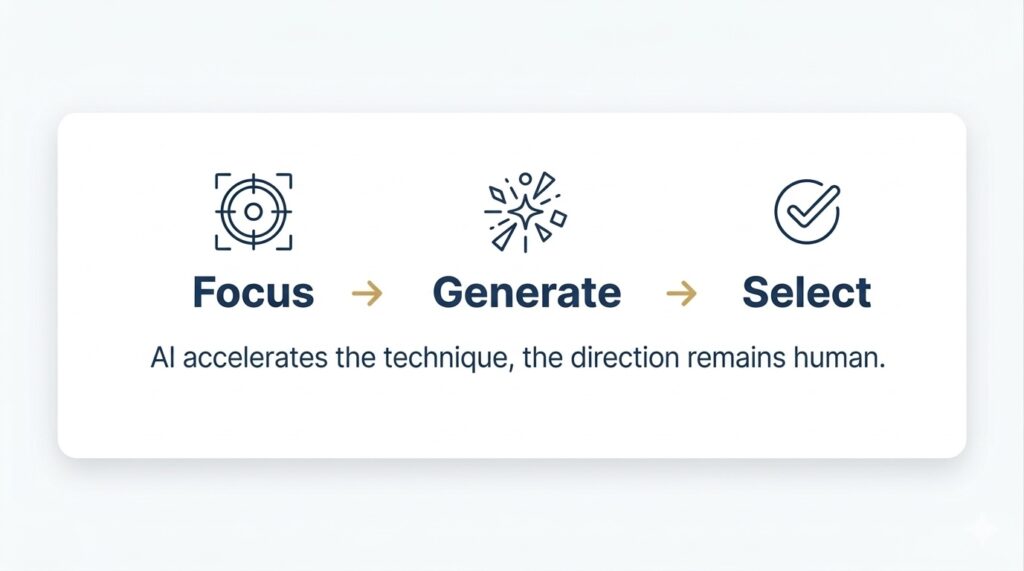 Infographic A.I. generated: “Focus -> Generate -> Select”
Two kinds of creativity: “spark” and process
Before talking about tools, it’s worth clarifying what we mean when we say “creativity.” I see a major dividing line: there are at least two different ways creativity can show up – the spark (intuition) and the process. Often, they alternate and blend. Artificial intelligence can interact with both. How? Let’s see.
1) Spark creativity: intuition and lateral thinking
There is an “explosive” kind of creativity: it arrives as an unexpected connection, a solution that flips the perspective – an idea that doesn’t emerge by linear accumulation, but by a leap. It’s that moment when, facing the same problem, you don’t add a detail: you change the question.
It’s hard not to cite Edward de Bono: to break out of patterns, you need techniques and shifts in perspective that aren’t just sequential logic. In other words: you don’t always reach something “new” by doing more of the same thing; sometimes you must change plane, rule, or viewpoint. As de Bono sums it up in Lateral Thinking: “You cannot dig a hole in a different place by digging the same hole deeper.”
If you want a different outcome, pushing harder isn’t enough – you need to change direction.
A.I. can become a powerful engine for this kind of stimulus: it generates associations, variations, and “controlled breaks” very quickly. But the real spark isn’t in the output – it’s in the moment you recognize something worthwhile and decide to pursue it. A.I. shortens the distance between intuition and first draft.
2) Process creativity: method, constraints, structure
Then there’s the creativity that doesn’t wait for inspiration: the one that works with constraints, checks, and steps. It’s the creativity that makes results replicable – and that lets you arrive at a good project even when the spark doesn’t come immediately, or when you have many constraints to respect.
If I’m developing a concept and I already know constraints, stylistic cues, and the expected output level, generative AI helps me treat those elements like ingredients: it combines them, weighs them differently, and returns variations I can reason about.
In “Da cosa nasce cosa”, Bruno Munari describes a way of designing where invention isn’t lightning in a vacuum, but the outcome of an ordered sequence of choices, controls, and transformations.
It’s an accessible, transferable design method: the same rigor can apply to a daily gesture or a complex project. And within that path there can still be space for the spark, but channeled inside a structure.
A circular process like Design Thinking, instead, works more like a loop: observe, define, ideate, prototype, test, and repeat.
The practical difference today is that A.I. makes it “cheap” (in time terms) to run more cycles of that loop: evaluate more options, calibrate the prompt at each iteration, and progressively move closer to the desired result.
A generic example: instead of stopping at the first “almost right” image, I run micro-cycles – generate -> compare -> correct – changing only one parameter at a time. Sometimes A.I. drifts and forces me to decide: follow the new path or return to the more coherent one. In short: A.I. accelerates the process, but increases the value of evaluation criteria. Creative work is still choosing well.
And that’s where the next theme opens up: when technique becomes more accessible, the real competitive advantage is the taste behind your decisions.
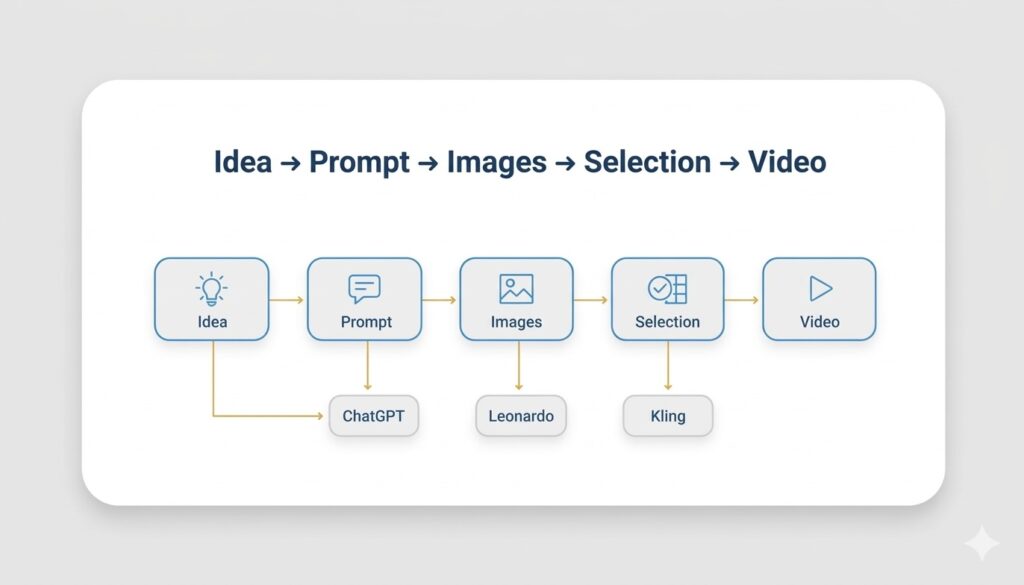 Infographic “Design Method (linear) <-> Design Thinking (circular)”: AI = faster iteration.
AI democratizes technique (but it doesn’t automatically democratize taste)
We’ve seen how this technology reduces the distance between an idea and its communication.
Before, turning a concept into something shareable required specific technical skills, time, and often handoffs across different roles. Today many barriers are lower: you can generate visual drafts in minutes, explore variations at near-zero cost, and communicate an idea even if you don’t yet have the “hand” or technique to render it exactly as you imagine.
That’s a democratic aspect: many ideas die not because they’re weak, but because they can’t make themselves understood. AI can act as a translator between your head and the world.
But here’s the point that, for me, is crucial: A.I. democratizes technique; it does not automatically democratize taste.
Taste can be an innate talent, sure – but far more often it’s a built skill: years of study, practice, errors, visual culture, and awareness of what works (and why). If technique becomes increasingly democratic, value shifts even more toward thinking: defining criteria, taking a stance, deciding what to keep and what to discard.
In other words, with A.I. the creative becomes more and more a decision-maker: less a technical executor, more an author of direction.
Errors and aberrations: when they become sparks
There’s an element often seen mostly as a problem: A.I. makes mistakes.
Sometimes obviously; other times in a plausible way – and that’s more insidious. In the debate, people talk about “hallucinations”: invented or inaccurate outputs that still look credible.
In creative work, though, some errors can become useful deviations. My filter is simple: notice -> select. First I notice something isn’t “correct” compared to the brief; then I decide whether there’s a detail or atmosphere worth saving.
With the Metaphysical Yeti, that’s exactly what happened: A.I. misunderstood the creature – but inside that mistake there was a stronger direction than my initial idea, and I had to choose whether to follow it or step back.
Two practical examples: the same project, two paths (spark vs process)
Here I’ll make this more concrete with a personal character-design project: “The Metaphysical Yeti.” Ideally, there are two ways to approach it: one born from a spark, the other built as a process. In this case it was born from a spark – from a question I asked myself: “How would De Chirico have depicted the Yeti?” But we can also imagine what a structured brief could look like to reach a similar result more methodically.
In both cases I used (or could have used) a combination of tools: ChatGPT to build and refine prompts, Leonardo.ai to generate images, Kling to create a final video.
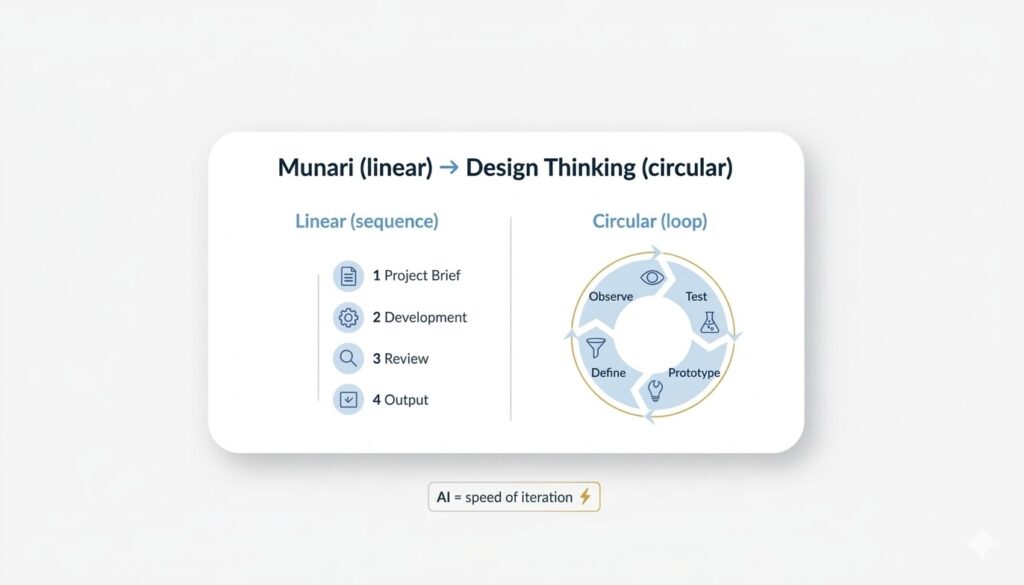 [Image 3 – Sequence] “Idea -> Prompt -> Images -> Selection -> Video”
Example 1 – When everything starts from a spark (and AI shortens the distance)
Starting point (spark): a visual idea arrives in my head like a single frame: “De Chirico’s Yeti.” In that moment I don’t have a brief yet – I have an intuition.
First attempt: I start generating by simply telling ChatGPT what I want: a Yeti in De Chirico’s metaphysical style. It gives me a first prompt and decides 90% of the parameters on its own. I paste the prompt into Leonardo.ai using one of the available models. The result is “something” coherent with the request, but not to my taste – not interesting.
I try again by providing visual references: I look for 3 images of a Yeti (mostly illustrations) and 3 images of De Chirico paintings. I slightly refine the request: “for the prompt, use the Yeti illustrations as the base reference and De Chirico’s images as the style reference.”
The surprise (useful mistake): one generation outputs something unexpected: what was supposed to look like a mythological creature looks like a person dressed as a Yeti. A sort of helmet, a wooden mask, empty eyes like sunglasses; the fur becomes a coat. Gloves and boots. A disturbing, enigmatic figure. A solution I wouldn’t have chosen rationally – and yet it expresses the idea better. That’s where I recognized the metaphysical key: enigma and unease, beyond the surface. What if the Yeti were just a man in disguise? Here AI doesn’t create instead of me: it puts me in front of a deviation worth following.
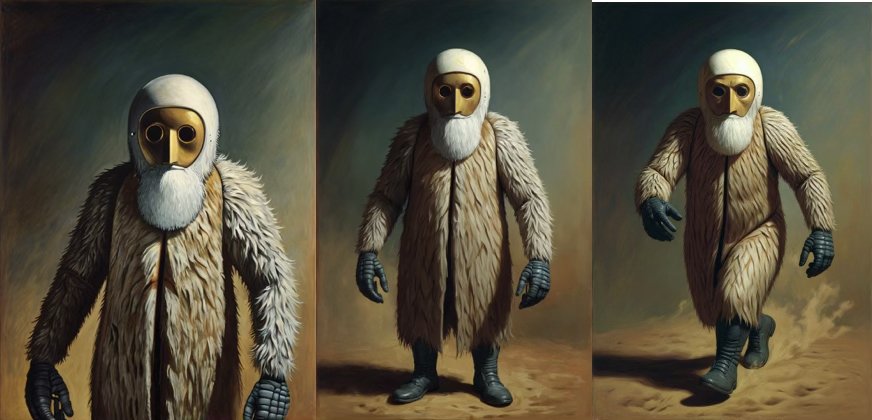
Selection and consolidation (the real human work): I select 2-3 images that contain the right DNA and develop them into poses and scenarios.

From frame to movement (Leonardo.ai -> Kling): I go back to ChatGPT and ask it to craft the prompt for Kling, to make my character walk through a forest during a snowstorm. In seconds I have a 5-second clip.
VIDEO
What this taught me: the spark is still mine, but AI makes the “head -> first draft” step cheap, and errors can become sparks only if I recognize and steer them.
Example 2 – If I had approached it as a process (Method/Design Thinking + fast iteration)
Same starting idea, but here I change mindset: I don’t start from the frame; I start from a brief.
A realistic design brief: the goal is to develop the concept of a mythological creature for short content (images + video), keeping a recognizable visual language consistent with early 1900s aesthetics (traditional textures, clean geometry, symbolic atmosphere; no overly digital look). The project requires 2-3 key images of the character (full body and a variant) and a 5-8 second clip with minimal movement. The creature must feel enigmatic rather than monstrous, with a clear silhouette and controlled details; backgrounds should be essential or stylized sets to ensure coherence in the video.
Here constraints are clear, but a creative choice remains: which creature and which style. Instead of going by feel, I could set up a mini procedural scheme:
- 3 creatures x 3 styles = 9 prompts
- Creatures (example): Yeti / Faun / Chimera
- Styles (example): Metaphysical / Futurism / Vintage illustration (poster)
- Score 1-5 on 3 criteria (brief coherence / silhouette recognizability / detail quality)
- Iterate on 1 direction: I pick the best combination and run 2-3 rounds of controlled micro-variations (light, framing, materials), stabilizing a “master” prompt and its constraints.
At that point the result wouldn’t depend on the initial intuition, but on a verifiable path: maybe I would still choose the metaphysical Yeti, maybe something else. Either way, the process would lead me to evaluate and validate images through my taste and the brief’s coherence.
The common point (and the lesson): focus -> generate -> select
Whether I start from a spark or from a process, the pattern that matters today is always the same:
- Focus (objective, constraints, quality criteria)
- Generate (many options, but with controlled variations)
- Select (motivated choices: what I keep and why)
In the first case, I do most of the focus upstream: I’m clear enough about the outcome and use generations (and aberrations) to refine it. In the second, constraints are clear but I don’t yet have a result in my head: creativity comes later, in choosing among combinations and iterations. This is where AI changes the rules: not because it gives you creativity, but because it makes creativity more dependent on your capacity for direction.
Can AI be creative on its own?
At this point the question arises naturally: is AI creative?
Here we enter a deeper theme that, in my view, touches consciousness.
Federico Faggin (in Irreducible: Consciousness, Life, Computers, and Human Nature) insists on one point: in human beings there is something that cannot be reduced to computation. He states it sharply when discussing what remains “irreducible” to machine knowledge: “…something […] irreducible to machine knowledge: self-awareness, free-will, creativity, feelings.” In this view, AI can simulate intelligent behavior, but it does not have subjective experience: the output is not felt; it is computed.
On the opposite end, a thinker like Daniel Dennett (materialist and functionalist) challenges the idea of a center or inner theater where experience presents itself to an observer. His line is famous: “There is no … Cartesian Theatre where ‘it all comes together’.” If consciousness is the result of distributed physical and computational processes, then – at least in principle – it’s not forbidden to imagine that artificial systems might reach forms of consciousness.
Who has the kind of consciousness needed to make a deliberate choice that goes beyond data? If AI generates possibilities, the act of assigning value – saying this yes, this no, and I know why – remains (for now) a human responsibility.
A practical takeaway: a Nature article notes that AI can become a creative partner (to bounce ideas and visualize concepts), but it can also flatten creativity.
For me the point is this: we don’t need A.I. to “go beyond” or prove consciousness; we need it to be a well-guided accelerator.
A.I. generates possibilities. Human creativity gives meaning and direction.
The work is still choosing: selecting, taking a stance, and staying coherent with objectives and constraints. And that brings me back to the beginning: with A.I., the real challenge is not generating more, but focusing better.
Conclusions and takeaways: new models, frustrations, and skills
New generation models are becoming – and will keep becoming – faster, multimodal, and more accessible. They produce images, text, and video with an ease that can create the illusion of control, only to remind you that the result still depends on how clear you are about the goal and what you consider “good.”
Anyone working with A.I. generation tools knows this: with speed comes a new form of frustration. Outputs that almost work but don’t reach where you want; incoherent results even with correct prompts. It’s worth remembering: many things are still done “the old way,” often faster.
Managing this frustration, for me, means returning to the same scheme: focus -> generate -> select. Accept that not everything that comes out should be used. Treat error as raw material, not as failure. And remember that discarding, destroying, and redoing are integral parts of creative work.
Ultimately, A.I. doesn’t remove project uncertainty: it makes it faster and more visible. It’s up to us to turn it into a space for conscious choice rather than noise. This is where true creative competence is being played today.
If I had to pick skills worth investing in now, they’d be: developing a personal aesthetic taste, training lateral thinking, building a process from a brief, strengthening analytical decision-making, staying focused on the outcome, and remaining flexible in front of surprises.
And in the end it all comes back to this: AI can accelerate technique. Choosing well remains central.
Sources
- Edward de Bono, Lateral thinking (lateral thinking)
- Daniel C. Dennett, Consciousness Explained (materialism, “no Cartesian Theatre”)
- Federico Faggin, Irreducible: Consciousness, Life, Computers, and Human Nature (consciousness and irreducibility)
- Bruno Munari, Da cosa nasce cosa (design process)
- Tim Brown, Change by Design (Design Thinking and innovation)
- Wikipedia, Hallucination (artificial intelligence)
- Nature, AI can spark creativity — if we ask it how, not what, to think (13 Jan 2026)
- Oxford AI Ethics, Is AI a Threat to Human Creativity?



 Market and Data
 _old_Become an author
 Wallet


