



Introduction
Blockchain technology, originally designed to create tamper-proof financial systems, now faces its greatest challenge: the advent of quantum computers. As tech giants like Google and IBM invest billions in developing increasingly powerful machines, the blockchain community is racing against time to safeguard its systems from this potential threat. But how real is this risk? And what measures are being taken to mitigate it?
The Quantum Computing Race
Quantum computers represent a revolutionary technology that, unlike traditional computers based on bits (0 or 1), leverage quantum mechanics principles through qubits, which can exist in a superposition of states.
In 2019, Google achieved “quantum supremacy,” demonstrating that a quantum processor could perform calculations in 200 seconds that would take a traditional supercomputer 10,000 years. The recent announcement of Google’s Willow chip marks another significant advancement, not for its number of qubits (only 105), but for its ability to drastically reduce quantum errors—a problem that has so far limited the practical applicability of this technology.
Willow can perform a calculation in under five minutes that would take one of today’s fastest supercomputers 10 septillion years (10,000,000,000,000,000,000,000,000 years) to solve. As Tim Hollebeek, a technology strategist at security company DigiCert, explains: “A quantum computer could try every path in a maze simultaneously, arriving at the solution much more quickly.”
Despite these impressive advances, it’s important to note that the current generation of quantum computers is still far from posing an immediate threat to blockchain security. Google’s Willow chip, while a significant step forward in reducing quantum errors, has only 105 qubits, whereas, according to a 2022 study by Universal Quantum, about 13 million qubits would be needed to crack a Bitcoin private key in a day.

Google itself confirmed to CNBC that the Willow chip cannot break modern cryptography, and Nvidia CEO Jensen Huang stated that truly useful quantum computers are probably still twenty years away. In a recent episode of ARK Invest’s Bitcoin Brainstorm podcast, Blockstream co-founder and CEO Adam Back expressed skepticism toward those who claim we should be concerned by 2028, suggesting he would even bet against this possibility.
The Bitcoin Security Paradox
Bitcoin, the first and most important cryptocurrency, relies on two cryptographic security pillars that could be vulnerable to quantum attacks:
- The ECDSA (Elliptic Curve Digital Signature Algorithm), used to verify Bitcoin ownership through private and public key pairs.
- The SHA-256 hashing algorithm, used in the mining process and in creating address identities.
Shor’s algorithm, developed in 1994 by mathematician Peter Shor, could theoretically allow a quantum computer to derive a private key from its corresponding public key, thereby compromising transaction security. Grover’s algorithm, on the other hand, could offer a significant advantage in the mining process, potentially threatening the network’s decentralization.

Paradoxically, Bitcoin’s protocol immutability, considered one of its most valuable features, could become its greatest weakness. The community is divided between purists, who want to keep the original protocol intact, and innovators, who push for the implementation of quantum-resistant solutions.
Asymmetric cryptography security is based on a mathematical principle called a ‘one-way function.’ This principle states that the public key can be easily derived from the private key but not the other way around. However, a sufficiently large quantum computer could use Shor’s algorithm to derive a private key from its corresponding public key and thus forge any digital signature.
If this cryptography becomes decipherable, it would grant access to private keys and allow those with a quantum computer to access and steal from crypto wallets. Essentially, it would render the entire industry worthless.
How Many Bitcoins Are at Risk?
Approximately 25% of all Bitcoins in circulation (about 4 million BTC) are potentially vulnerable to a quantum attack. These include:
- Bitcoins in P2PK (pay-to-public-key) addresses, primarily used in Bitcoin’s early days (about 2 million BTC).
- Bitcoins in reused P2PKH (pay-to-public-key-hash) addresses (about 2.5 million BTC).

P2PKH addresses that have never been used to spend Bitcoin are considered secure, as their public keys have not yet been revealed. However, once a transaction is made from such an address, the public key is exposed, rendering the address vulnerable until the transaction is confirmed on the blockchain.
At the current price, the 4 million vulnerable BTC represent over $40 billion. A particularly concerning aspect involves “dormant” wallets, including those attributed to Satoshi Nakamoto, estimated to contain over a million Bitcoins. If these wallets become vulnerable to quantum attacks, sudden access to these vast reserves could completely destabilize the market.
Recently, Tether CEO Paolo Ardoino offered an interesting perspective, suggesting that quantum computing could eventually unlock billions of Bitcoins trapped in dormant wallets. This has sparked mixed reactions in the crypto community, with some traders and experts expressing concerns that reintroducing Satoshi’s estimated million Bitcoins could drastically disrupt Bitcoin’s value and market stability.
The Cryptographic Standards War
In the field of quantum-resistant cryptography, various solutions are emerging. Some projects have already begun implementing post-quantum cryptographic algorithms:
- Quantum Resistant Ledger (QRL): The first fully quantum-resistant blockchain.
- Ethereum 2.0: Plans to integrate post-quantum cryptography.
- IOTA: Already uses Winternitz one-time quantum-resistant signatures.
- Cardano: Developing post-quantum cryptographic solutions.
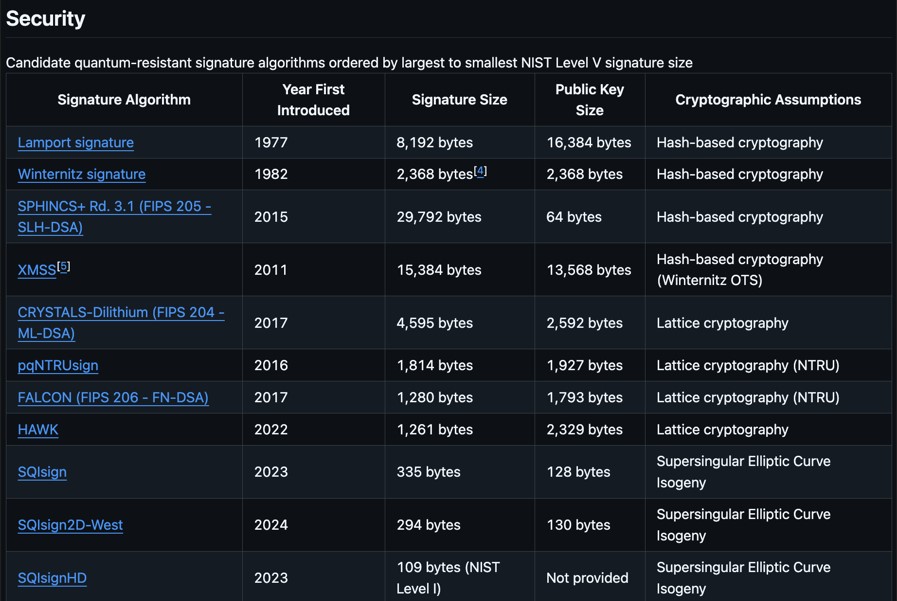
Regarding Bitcoin, a proposal called QuBit is under discussion, introducing a new address type, Pay to Quantum Resistant Hash (P2QRH), which uses various quantum-resistant signature schemes. The QuBit plan includes four phases: a quantum-resistant address standard, a Taproot-compatible standard, a soft fork, and a fully
Sources
[1] Deer, M. “Cryptocurrency vs. quantum computing”. CoinTelegraph. https://cointelegraph.com/learn/articles/cryptocurrency-vs-quantum-computing-a-deep-dive-into-the-future-of-cryptocurrencies
[2] Birnbaum, D. “Bitcoin’s Endgame: Quantum Computing Comes For BTC”. Forbes. https://www.forbes.com/sites/davidbirnbaum/2024/12/28/bitcoins-endgame-quantum-computing-comes-for-btc/
[3] Coinbase. “L’informatica quantistica è una minaccia per le criptovalute?”. Coinbase Learn. https://www.coinbase.com/it/learn/crypto-basics/is-quantum-computing-a-threat-for-crypto#The-Future-of-Quantum-Computing-and-Cryptocurrency
[4] Williams, K. “What Google’s quantum computing breakthrough Willow means for the future of bitcoin”. CNBC. https://www.cnbc.com/2024/12/22/what-google-quantum-chip-breakthrough-means-for-bitcoins-future.html
[5] Barmes, I., Bosch, B., & Haalstra, O. “Quantum computers and the Bitcoin blockchain”. Deloitte Risk Advisory. https://www.deloitte.com/nl/en/services/risk-advisory/perspectives/quantum-computers-and-the-bitcoin-blockchain.html
[6] Torpey, K. “Bitcoin vs. the quantum computer threat: Timeline and solutions (2025–2035)”. CoinTelegraph. https://cointelegraph.com/magazine/bitcoin-quantum-computer-threat-timeline-solutions-2024-2035/
[7] Singh, A. “Quantum Computing: The Future of Unlocking Dormant Bitcoin”. Pune News. https://pune.news/technology/quantum-computing-the-future-of-unlocking-dormant-bitcoin-304246/
[8] Adejumo, O. “Tether CEO willing to explore quantum computing initiative to recover lost Bitcoin”. CryptoSlate. Disponibile su: https://cryptoslate.com/tether-ceo-willing-to-explore-quantum-computing-initiative-to-recover-lost-bitcoin/






 Market and Data
 _old_Become an author
 Wallet


