


What is Bitcoin Halving?
Bitcoin Halving is a programmed event in the protocol that halves the miners’ reward for validating blocks on the blockchain. In simple terms, it is a halving of the issuance of Bitcoin for every new block created.
The main objective is to control Bitcoin’s inflation and ensure its limited supply.
The process is based on a predefined and automatic algorithm, with the reward halving every 210,000 blocks, approximately every four years.
At the time of Bitcoin’s inception in 2009, the reward was 50 BTC per block.
The first Halving in 2012 reduced it to 25 BTC, the second in 2016 to 12.5 BTC, and with the third Halving in 2020, it dropped to 6.25 BTC.
The next one, expected by late April 2024, will bring the reward to 3.125 BTC. This cycle will continue until the completion of the last cycle in 2144, following the network’s economic plan to issue a maximum of 21 million circulating coins.
How does Halving affect Bitcoin’s price?
From the previous analysis, we understand that Bitcoin’s Halving cyclically halves the circulating supply of the currency.
Two crucial economic forces come into play: demand and supply.
In summary, an increase in demand raises the price, while an increase in supply lowers it.
In the traditional world, the scarcity of a highly demanded good prompts consumers to pay more for it.
For Bitcoin, the supply is predetermined, with halving occurring every 210,000 blocks, bringing the maximum supply to 21 million.
But there’s a catch.
While the supply is predetermined, we cannot say the same for demand. This is practically impossible to predict as it depends on many factors of various natures.
Price history post- Bitcoin’s Halving
Let’s graphically analyze Bitcoin’s price behavior after each executed Halving.
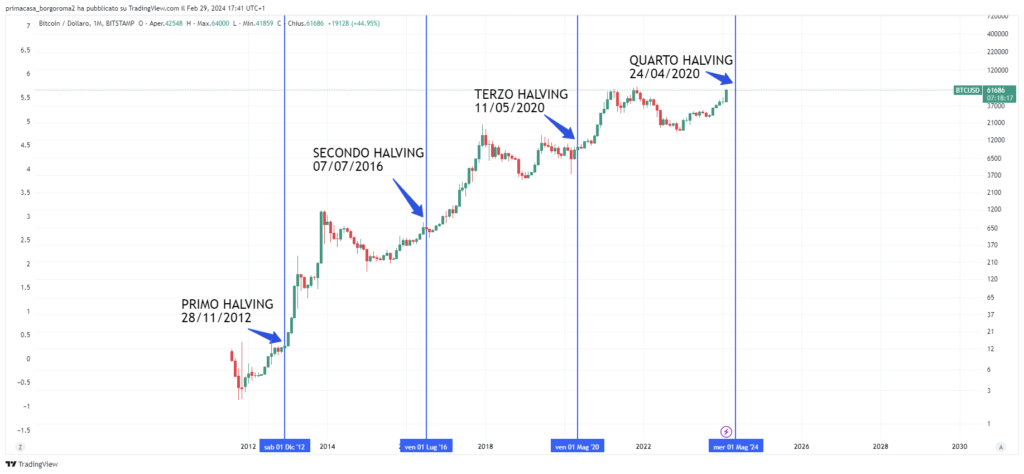
We notice a substantial price increase coinciding with Halving three times in history, although with decreasing percentages.
With the fourth Halving imminent (by late April 2024), we can hypothesize further price increases, considering the past because there will be further halving of supply with each extracted block.
Considering the past price trends, it would be easy to presume further price increases for Bitcoin post-halving.
Although supply is predetermined and limited, we’re not taking into account a very important factor: Demand.
What is demand in practical terms? Well, it’s liquidity, money, purchase orders placed.
It’s obvious, therefore, that supply definitely has an impact, but not without demand; they are two necessary forces destined to coexist.
Bitcoin ETFs
Bitcoin Exchange-Traded Funds (ETFs) are emerging as an innovative and accessible way for global investors to gain exposure to cryptocurrencies, especially Bitcoin. These financial instruments offer a simplified and regulated solution to participate in the cryptocurrency market, allowing investors to leverage potential gains from Bitcoin’s growing adoption.
A Bitcoin ETF replicates the price movement of Bitcoin, allowing investors to purchase shares of the fund and gain direct exposure to the cryptocurrency’s price movement, eliminating some of the difficulties related to cryptocurrency custody and security. Institutional interest is evident, with nine spot Bitcoin ETFs launched on January 11, accumulating a total of 300,000 Bitcoins, with a value of $17 billion.
Net inflows into ETFs have exceeded $6 billion.
With Bitcoin’s Halving approaching, the supply will further decrease, but increasing demand can fuel further price growth.
Between increasing demand and limited supply, the underlying asset price has reached a new annual high of over $63,000, making this cycle quite different; in fact, in a pre-halving period, we have never been so close to historical highs.
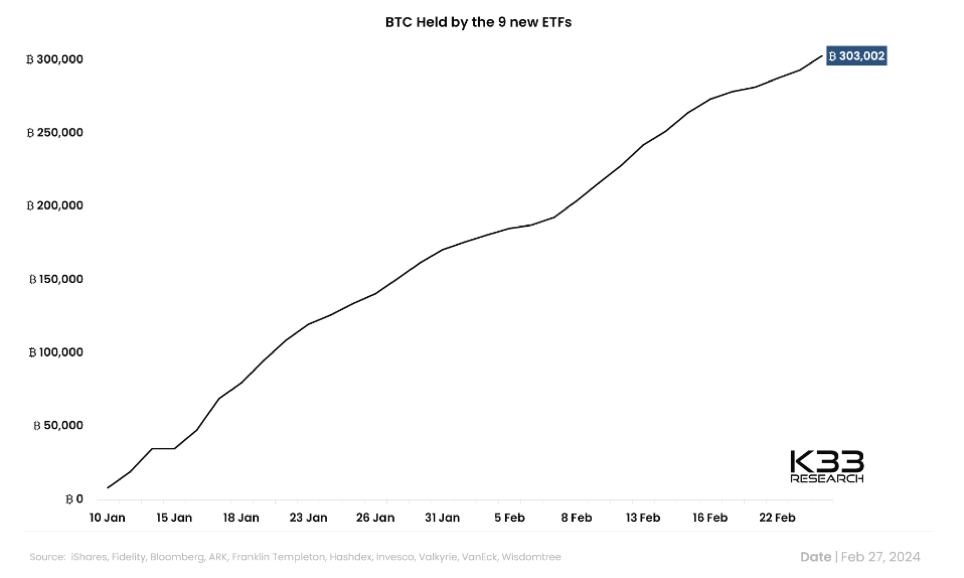
Source: K33 Research
Spot ETFs record net inflows of almost 8,000-9,000 BTC on each trading day.
This is an extremely bullish scenario for BTC price, as just yesterday, the monthly candle closed with a price increase of 43.75%, or $18,613.
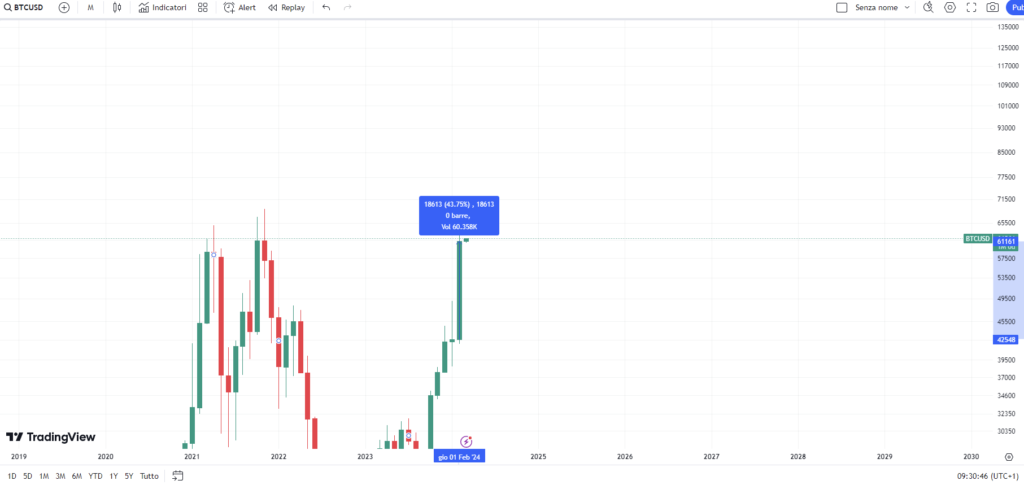
In the graph below, it is evident the clear increase in institutional participation in Bitcoin.
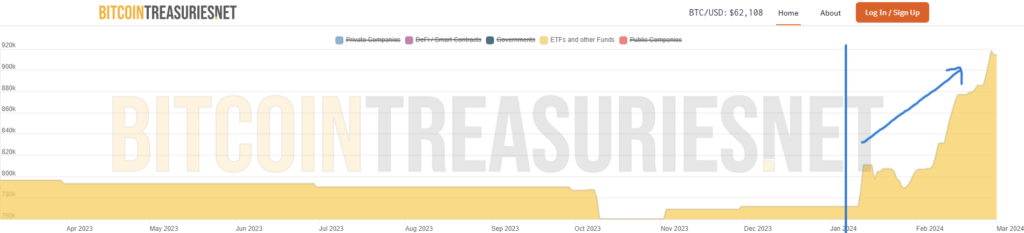
If the buying trend were to continue at this pace, it is likely that the price of Bitcoin will reach much higher levels than the current ones.
Altcoins and Altcoin Season
The term “altcoin” is an abbreviation of “alternative coin” and refers to any cryptocurrency other than Bitcoin.
While Bitcoin remains the first and most well-known cryptocurrency, there are thousands of others, each with unique features and purposes.
Altcoins can offer different functionalities from Bitcoin, such as smart contracts, faster transaction times, or greater privacy. Some of the most well-known altcoins include Ethereum, Ripple, Solana, and many others. Investors often consider altcoins as investment alternatives to Bitcoin, seeking growth opportunities and unique features. However, it’s important to note that altcoins can be more volatile and risky than Bitcoin, given their lower market capitalization and adoption.
Analyzing their behavior during Bitcoin cycles, we can notice certain things that, at least in the past, have repeated.
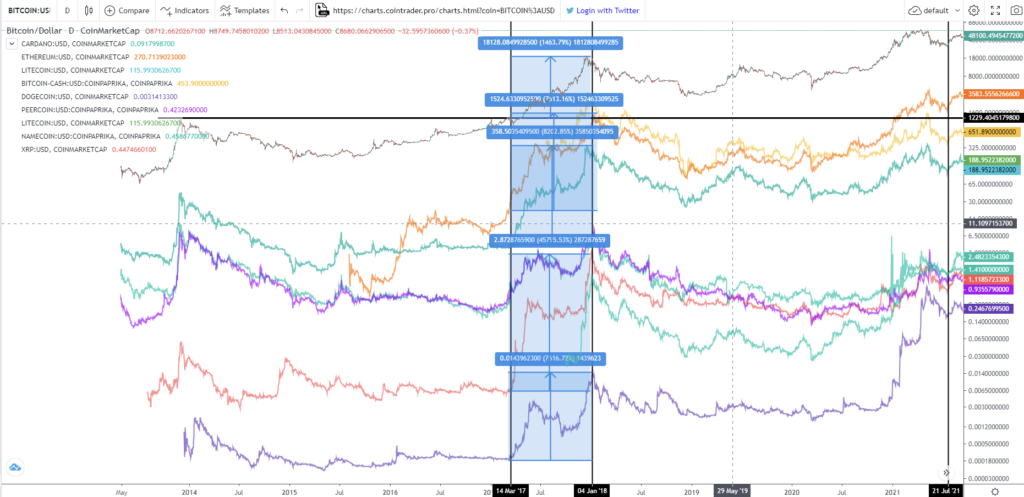
During the 2017 bull run, we observe a very similar behavior for all alternative coins, which begin to rise as soon as Bitcoin surpasses its all-time high. From that moment on, even Bitcoin increases its price, but altcoins outperform it in percentage terms due to their lower capitalization.
In the 2021 bull run, we see a similar behavior.
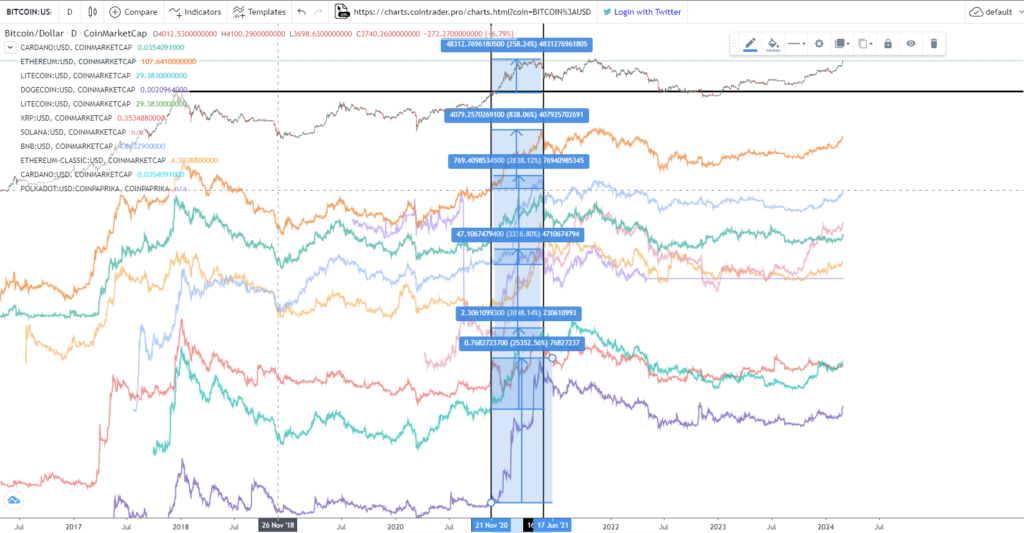
Bitcoin surpasses its all-time high, and from that moment on, altcoins start registering significant upward variations, with remarkable percentage increases.
Currently, we are close to Bitcoin’s all-time highs, and the bet is to understand whether altcoins will follow the same pattern as past cycles or, with the introduction of Spot ETFs, we will see different dynamics. The only certainty is that in financial markets, nothing is guaranteed or predictable. Therefore, before committing any amount, it is advisable (if not mandatory) to conduct a careful analysis of one’s risk profile and seek professional assistance.






 Market and Data
 _old_Become an author
 Wallet


