


Abstract
In the world of digital innovation, blockchain and cryptocurrencies have opened up new horizons for global investors. With the recent development and approval of Bitcoin Spot ETFs in the United States, we are witnessing a radical transformation in the investment sector. This move not only further legitimizes investments in “digital assets” but also paves the way for an increasingly dynamic finance.
This article will analyze how Bitcoin Spot ETFs are influencing the financial landscape, with a particular focus on implications for investors and the role of digital innovation in this paradigm shift.
ETF & Finance
In a rapidly evolving financial world, digital innovation is playing a crucial role in shaping the future of investments. Blockchain and cryptocurrencies, once considered speculative niches, are now assuming an increasingly central role, thanks in part to the introduction of Bitcoin Spot ETFs in the United States. This move marks a significant turning point, not only for crypto investors but for the entire global financial landscape.
Exchange-Traded Funds (ETFs) Spot on Bitcoin formalize investment in a new asset class. Unlike derivatives or funds based on futures, ETFs allow investors to gain direct exposure to the current price of Bitcoin, making investment in the cryptocurrency par excellence more accessible, liquid, and, above all, regulated.
This not only opens the doors to a wide range of traditional investors but also implies a growing recognition and acceptance of cryptocurrencies as legitimate assets in the financial world.
For investors coming from the traditional finance sector, Bitcoin ETFs represent a game changer as they offer a safer and regulated investment vehicle to enter the world of cryptocurrencies without having to navigate the complexities of direct token custody. Furthermore, the regulated nature of ETFs reassures investors about reliability, despite the high-risk profile of the investment.
While for “traditional” investors the approval of the Bitcoin ETF represented a game changer, for institutions, it marked the beginning of a radical change in the offering, development, and management of investment products. In fact, Asset Managers that have begun to offer this product have had to acquire new skills, infrastructure, and technological tools, particularly to ensure institutional-level custody solutions, resorting to specialized custody entities in digital assets.
The most popular has been Coinbase, a well-known American exchange listed on Nasdaq.
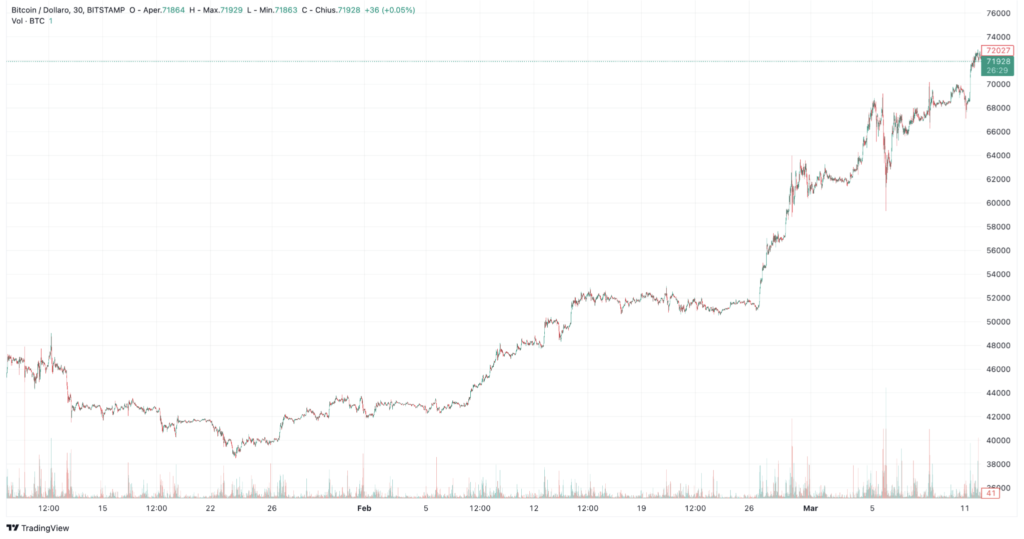
Observing the chart, one can see how this new product has had an immediate impact on bitcoin market, demonstrating both high volatility and the opportunity for potential high returns with investment in digital assets.
After the approval by the SEC (Securities and Exchange Commission) on January 10, 2024, the dollar value of Bitcoin decreased by about 20%, but quickly recovered over 35%, surpassing again the $50k level, a milestone not observed since 2021. Even more interestingly, just two months after the approval of the ETFs, Bitcoin broke a new All-Time High surpassing the $70k mark, presumably also due to strong inflows into the ETFs.
These numbers clearly reflect the speculative nature of the market but also underline the enthusiasm and growing interest in investments in this new asset class.
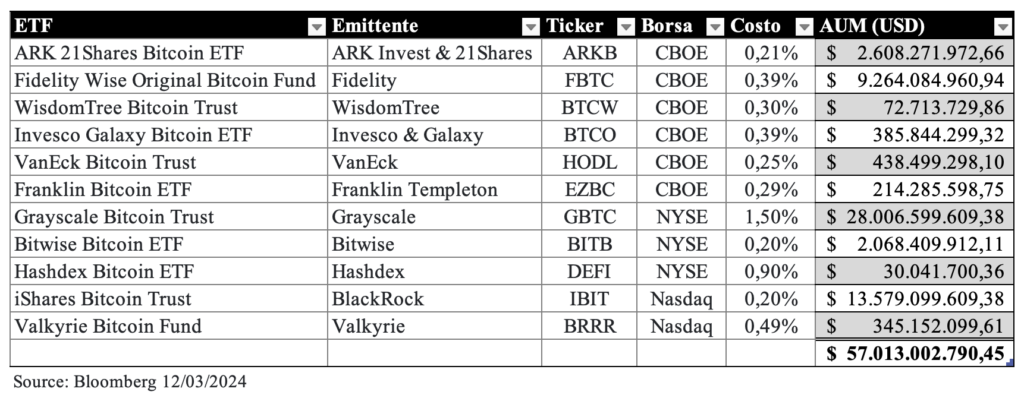
As of March 12, 2024, a total of $57 billion has been raised, and as shown in the table below, the leading actors are: Grayscale followed by Blackrock and Fidelity.
One-week analysis
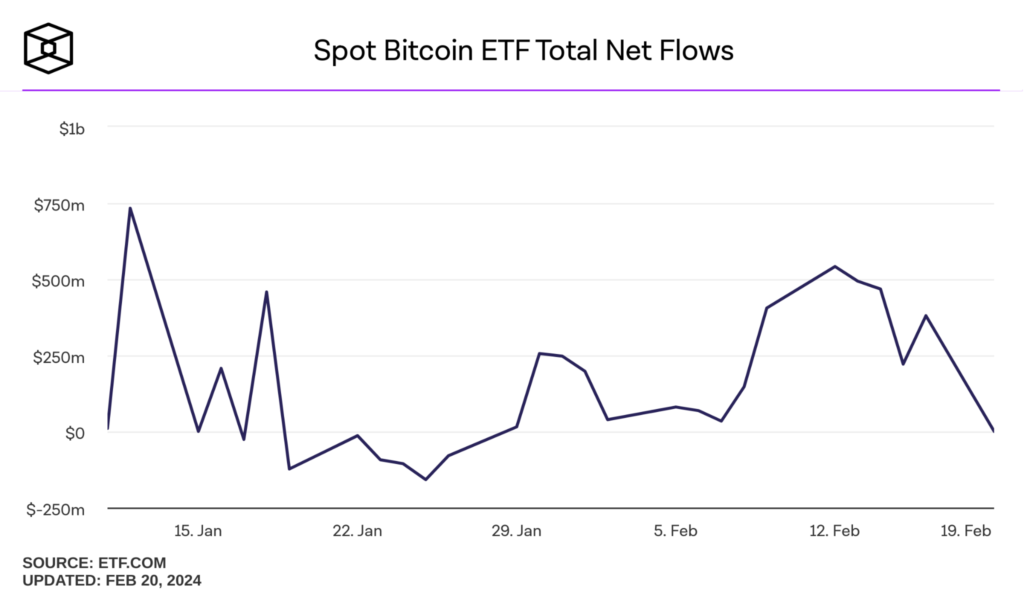
Based on data collected as of February 15, 2024, Bitcoin ETFs have recorded a total net inflow of $477 million, continuing to register positive net inflows for the 15th consecutive trading day. In particular, BlackRock’s Bitcoin spot ETF, IBIT, led the market with a daily net collection of $330 million on February 15, bringing its total historical net collection to $5.17 billion.
One-month analysis
In the first month since launch, Bitcoin Spot ETFs have recorded average daily net inflows of around $125 million per day, despite strong outflows from the Grayscale Bitcoin Trust (GBTC). The total net collection for the month was approximately $2.8 billion, according to Bloomberg Intelligence data. This performance is considered a success by major indicators, with BlackRock and Fidelity funds recording the highest investor inflows [Bloomberg ].
Two-month analysis
Just two months later, the trend remains very positive. The ETFs of Blackrock and Fidelity assert themselves as the most successful, recording the highest inflows of $244 million and $473 million respectively on March 8, 2024.
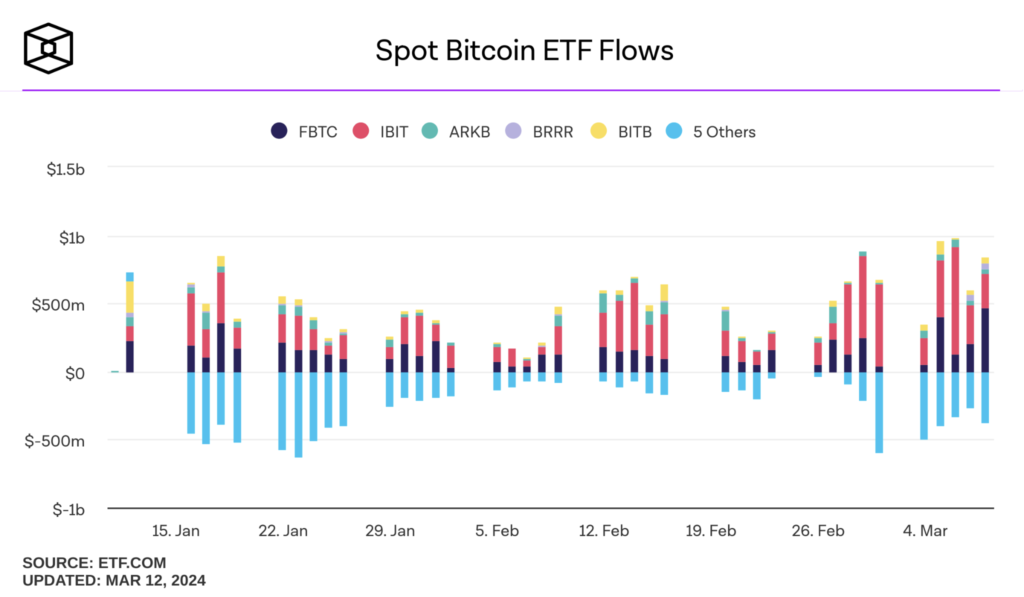
The total daily net flow (in USD) for Bitcoin spot ETFs on March 8, 2024, amounted to $472.56 million.
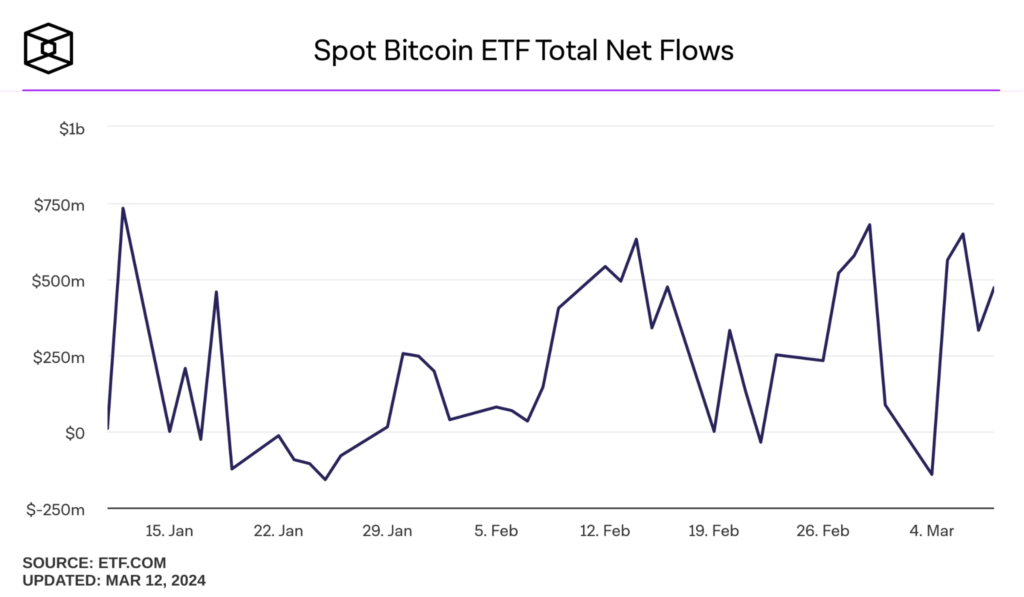
Overall, total net inflows since January 10, 2024, amount to approximately $9 billion for a total of approximately 125,000 Bitcoin, despite strong outflows from Grayscale, which cumulatively liquidated about $9.6 billion (Data as of March 6, 2024).
Future Perspectives: Ethereum Spot ETFs
Following the trail of Bitcoin Spot ETFs, according to CNBC, the SEC is expected to approve Ethereum Spot ETFs as early as May 2024. [CNBC]
The potential approval of an Ethereum Spot ETF would represent another major step towards the integration of cryptocurrencies into the traditional financial system. Furthermore, considering the wide ecosystem of decentralized applications (dApps) based on Ethereum, an Ethereum Spot ETF could implicitly increase investors‘ exposure to another type of asset.
Conclusions
The introduction of Bitcoin Spot ETFs marks a transitional era for cryptocurrency investments, with significant impacts both technologically and operationally. The potential future approval of an Ethereum Spot ETF would pave the way for new possibilities, highlighting the maturity and resilience of cryptocurrencies as an asset class. In this dynamic context, investors should remain informed and agile, ready to adapt to market developments and technological innovations that help define the future of finance.
As we navigate this era of digital innovation, a deep understanding of these technologies and adaptability will be essential to capitalize on emerging opportunities and address challenges in an ever-evolving financial landscape.
However, the sustainable growth of this sector will depend on its ability to address regulatory challenges, effectively manage risks associated with market volatility, and further develop technological infrastructures to ensure secure and efficient transactions.
Dr. Eng. Silvio Ventre
Innovation Manager – Euromobiliare Asset Management SGR






 Market and Data
 _old_Become an author
 Wallet


